No Starch Press ships The Art of 64-Bit Assembly, volume 2
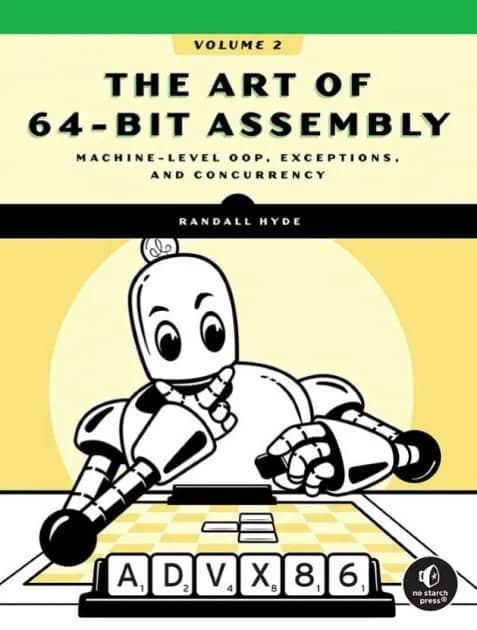
No Starch Press has published a new volume of The Art of 64-Bit Assembly, a book that teaches low-level Windows programming in MASM (Microsoft Macro Assembler). The publisher is offering a free download of Chapter 1, titled "Advanced Macros."
The book's premise is that asking an AI to explain a construct like x86 vtables produces an answer that sounds plausible but skips what actually matters: what Windows expects the vtable layout to look like, why method dispatch behaves the way it does at the instruction level, and what breaks when a programmer deviates from convention. The publisher frames this volume as closing that gap between a plausible explanation and genuine understanding.
Each chapter takes a construct familiar from C++, Python, or Rust, strips away the language runtime, and rebuilds it from scratch in MASM running under Windows. The topics covered include object-oriented programming (vtables, method dispatch, and inheritance built by hand), Windows structured exception handling (SEH) installed and managed at the instruction level, thunks and closures that behave like higher-order functions, coroutines and generators and fibers built without any high-level-language code, concurrent programs using real synchronization primitives written directly in assembly, Unicode string handling done correctly at the level where most code gets it wrong, and building domain-specific macro languages inside MASM from first principles.
The promotional page does not name an author, give a price, or state a page or chapter count. It also does not say whether the free Chapter 1 download is a standalone preview or the first chapter of the purchased book.
Key facts
- No Starch Press published volume 2 of The Art of 64-Bit Assembly, teaching low-level Windows programming in MASM.
- The book rebuilds constructs from C++, Python, and Rust, such as objects, exceptions, closures, and coroutines, from scratch in assembly.
- It covers Windows structured exception handling (SEH), synchronization primitives, Unicode string handling, and building domain-specific macro languages inside MASM.
- Chapter 1, "Advanced Macros," is offered as a free download.
- No author name, price, page count, or release date is given on the source page.
Why it matters
The book's pitch is aimed squarely at a gap AI assistants have opened: an AI can describe how a vtable works in general terms, but it will not tell a programmer what Windows specifically expects the vtable layout to look like, why dispatch behaves the way it does at the instruction level, or what breaks when convention is violated. The book positions itself as filling that gap through hands-on construction rather than explanation.
Who it affects
Systems programmers and anyone who already knows assembly and wants to move past taking the hard parts of low-level Windows programming on faith. It is not an introductory text; the promotional copy assumes existing assembly knowledge.
How to use it
Chapter 1, "Advanced Macros," is available as a free download from the publisher's page. The source does not state a price for the full book, nor a page count, chapter count, or release date.
How solid is it
The source is a publisher's promotional book page rather than an independent review, so the claims about content and approach come from No Starch Press marketing copy, not third-party verification. The topic list itself (SEH, coroutines, synchronization primitives, Unicode handling, macro languages) is specific enough to describe genuine technical scope rather than vague marketing language.
Risks and caveats
No author is credited, no price is listed, and no page or chapter count is given, so readers cannot judge the book's length or cost from the source alone. It is also unclear whether Chapter 1 is a free-standing preview or simply the first chapter counted toward a paid purchase.
“You can ask an AI to explain how vtables work in x86. It will give you something that sounds right. What it won't give you is what Windows actually expects the vtable to look like, why method dispatch behaves the way it does at the instruction level, or what breaks when you deviate from convention.”
— The Art of 64-Bit Assembly, publisher's book description