NoRA normalizes LoRA's down-projection matrices to stabilize training
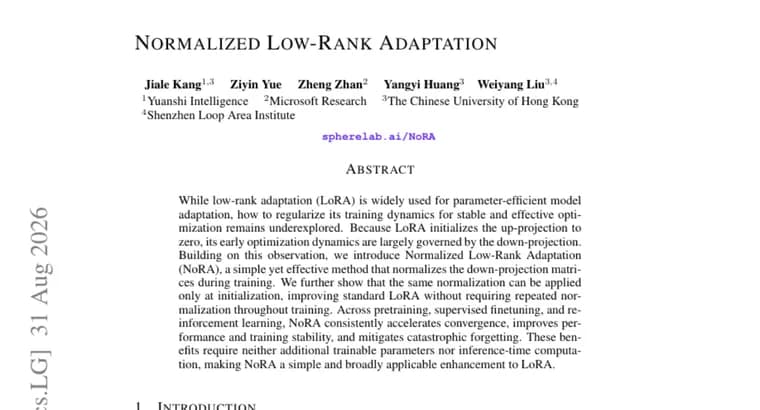
Jiale Kang and co-authors present Normalized Low-Rank Adaptation (NoRA), a modification to LoRA, the widely used technique for parameter-efficient fine-tuning of large models. The authors note that how to regularize LoRA's training dynamics for stable, effective optimization has been underexplored. Their starting observation is that LoRA initializes its up-projection matrix to zero, which means the method's early optimization behavior is governed almost entirely by the down-projection matrix. NoRA responds to this by normalizing the down-projection matrices during training. The authors also show a cheaper variant: applying the same normalization just once, at initialization, rather than repeatedly throughout training, still improves on standard LoRA. They report testing NoRA across three settings, pretraining, supervised finetuning, and reinforcement learning, and say it consistently speeds convergence, improves performance and training stability, and reduces catastrophic forgetting in each. Because the change touches only how the down-projection matrix is normalized, the authors say it needs no additional trainable parameters and adds no extra computation at inference time, making it a drop-in enhancement to existing LoRA setups.
Key facts
- NoRA (Normalized Low-Rank Adaptation) normalizes LoRA's down-projection matrices during training to stabilize optimization.
- The method targets a specific mechanism: because LoRA's up-projection starts at zero, early training is driven mainly by the down-projection.
- A lighter variant applies the normalization only once, at initialization, and still improves on standard LoRA.
- The authors report gains in convergence speed, performance, training stability, and resistance to catastrophic forgetting across pretraining, supervised finetuning, and reinforcement learning.
- NoRA adds no extra trainable parameters and no extra inference-time computation.
Why it matters
LoRA is the default way to fine-tune large models cheaply, but the authors point out that its training dynamics have not been well regularized. They trace a concrete cause: LoRA zeroes out the up-projection matrix at the start, so the down-projection matrix effectively controls early optimization on its own. NoRA is a direct fix aimed at that specific weak point rather than a general-purpose replacement for LoRA.
Who it affects
Anyone fine-tuning large models with LoRA, whether for pretraining, supervised finetuning, or reinforcement learning, since the authors tested NoRA across all three settings.
How to use it
NoRA normalizes the down-projection matrices during training. The authors also describe a cheaper version that normalizes only at initialization rather than continuously, and say it still improves on plain LoRA. Either way, the change adds no new trainable parameters and no extra computation at inference time, so it can be dropped into an existing LoRA pipeline without extra cost.
How solid is it
The claims come from the paper's own abstract, which reports consistent gains in convergence, performance, stability, and resistance to forgetting across three training regimes, but states no benchmark scores, no magnitude of improvement, and names no specific models, datasets, or rank settings used in the experiments. It also does not compare NoRA against other LoRA variants beyond standard LoRA.
Risks and caveats
Without published numbers, it is not possible to judge how large the improvement is or whether it holds outside the settings the authors tested. The abstract names no code or model release, so independent verification is not yet possible from the information given.