NUS researchers weave a touchscreen into a sleeve that survived 50 washes
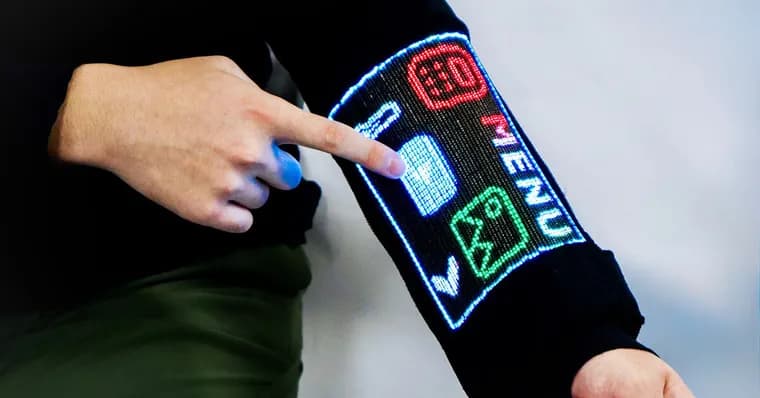
Researchers at the National University of Singapore (NUS), led by Assistant Professor Tural Khudiyev, have built a touchscreen directly into a garment using electronic fibers that combine light-emitting diodes (LEDs) and touch sensors. In the prototype, 54 such fibers are threaded into the forearm of a sleeve. The result is a flexible display that shows images and video, responds to finger presses and connects wirelessly to digital devices, while keeping the breathability and flexibility of ordinary fabric.
The approach differs from typical wearables, which attach a screen or device to the body. Here the display and touch functions sit inside the fibers themselves, each about one millimeter thick, so there is no rigid display panel. The core difficulty is that electronic circuits are normally laid out on flat surfaces, while a thread is narrow and cylindrical, with little room for the wiring a display needs. The team developed an interconnection architecture that lets thousands of microelectronic devices be connected along a single fiber. It starts with tiny insulated wires. A laser exposes specific points on their surfaces, and controlled wetting directs molten solder to those points, making electrical connections without joining unintended areas. With this method the team integrated more than 5,000 chips through over 20,000 electrical connections.
The interconnected digital LEDs are then built into a multilayer fiber by thermal drawing. The resulting thread is approximately one millimeter in diameter and 10 meters long, with separate layers for showing images and detecting touch. A touch-sensitive layer sits beneath the LEDs. When someone presses the fiber, the contact completes an electrical circuit, so the system can identify where the touch happened and light the nearest pixel. Display and interaction happen in the same thread.
In the prototype, each of the 54 pixel-bearing fibers carries 96 LEDs, together forming a 96-by-54-pixel display measuring 168 by 105 millimeters. It refreshes at 30 frames per second and supports 8-bit color depth. The source calls the resolution modest compared with a smartphone. Still, the sleeve can play video, show photographs, run a calculator and work as a compass. It can receive images over Bluetooth, respond to voice commands, and rotate the display or adjust brightness automatically. It registers multiple touches at once. Each pixel fiber has its own control channel, so a fault in one line does not necessarily interrupt the others.
Other fibers in the sleeve carry a microphone, a speaker, and sensors for movement, temperature, magnetic orientation and ambient light. A temperature-sensing fiber under the arm, for example, can measure body temperature and show the reading on the sleeve.
According to the researchers, the prototype kept nearly unchanged light output and touch response after 50 machine-washing cycles with detergent and 1,000 bends around a radius of five millimeters. The display is also reported to be as breathable as cotton, polyester and denim, and to stay within established skin-contact safety limits.
The team names healthcare as one potential application: fibers with physiological sensors could collect data continuously and show it on the garment, so wearers need not consult a separate device. Combined with artificial intelligence, the researchers suggest, such systems could eventually support personalized monitoring and feedback. That remains a future direction, not something the current prototype demonstrates. Next steps are better resolution, more sensing functions and exploring on-device AI. The research team is Tural Khudiyev, Heng Fu, Ziang Li and Swetika Chaturvedi, at the College of Design and Engineering, NUS; Khudiyev is in the Department of Materials Science and Engineering.
Key facts
- A sleeve with 54 pixel fibers, each carrying 96 LEDs, forms a 96-by-54-pixel touchscreen measuring 168 by 105 millimeters, refreshing at 30 frames per second with 8-bit color.
- According to the researchers, light output and touch response stayed nearly unchanged after 50 machine-washing cycles with detergent and 1,000 bends around a five-millimeter radius.
- A laser-and-solder method joined more than 5,000 chips through over 20,000 electrical connections; the thermally drawn thread is about one millimeter thick and 10 meters long.
- Beyond display and touch, the sleeve has fibers for a microphone, a speaker and movement, temperature, magnetic orientation and ambient light sensors, plus Bluetooth and voice commands.
- AI-assisted health monitoring is only a suggested future direction; next steps are higher resolution, more sensing and on-device AI.
Why it matters
Most wearables put a screen or a gadget on the body. This work builds display and touch into the thread itself, so the garment becomes the interface while keeping the breathability and flexibility of everyday fabric. The technical hurdle was wiring: a thin cylindrical thread leaves little room for the connections a display needs. The NUS laser-and-solder interconnection method, which put more than 5,000 chips and over 20,000 connections into the fibers, is how the team got past it.
Who it affects
For now it is a research result, so the nearest audience is wearable-electronics and textile researchers. The team names healthcare as one potential application, where physiological sensors could show measurements on the garment without a separate device. The source says the technology could eventually let clothing act as an interface for digital information, environmental sensing and health monitoring.
How to use it
There is nothing to buy or deploy. The source gives no price, release plan or timescale, only that the technology could 'eventually' change what clothing does. What exists is a sleeve prototype that plays video, shows photos, runs a calculator, works as a compass, takes images over Bluetooth and responds to voice commands. The team's next steps are better resolution, more sensing functions and on-device AI.
How solid is it
The performance claims come from the researchers as relayed by designboom, with no outside experts or independent reactions quoted. The wash result is stated only as 'nearly unchanged' after 50 cycles; no percentage of performance retained is given. The source gives no journal, paper title or publication date. The breathability and skin-contact safety claims are described as reported. The hardware numbers (54 fibers, 96 LEDs each, 96-by-54 pixels, 30 frames per second, 8-bit color) are specific and consistent across the account.
Risks and caveats
This is a single university prototype. The display is modest in resolution compared with a smartphone. The source does not mention a power source, battery life, cost or manufacturing scale. It also does not say how the 10-meter thread relates to the fibers used in the sleeve panel. Personalized AI monitoring is a suggestion by the researchers and is not demonstrated in the current prototype. No wash count beyond 50 and no failure point are reported.