Nvidia extends its AI edge beyond GPUs into data orchestration
For the first few years of the AI boom, Nvidia was the only source for state-of-the-art GPUs, and that scarcity made the chips immensely profitable as the industry scaled out. Nvidia's market capitalization grew 10x between the start of 2023 and mid-2025 on the strength of that story. Then hyperscalers, including Amazon and Google, began building their own chips, eroding Nvidia's exclusivity, and Nvidia's shares settled into a more modest trajectory over the past year as investors weighed how durable its advantage really was.
That story changed after Nvidia's earnings report on Wednesday. Investors are now recognizing that the company's advantage extends far beyond the GPU chip itself. As AI compute scales into the gigawatt range, simply operating a data center at peak efficiency has become a serious engineering problem, and Nvidia has built much of the state-of-the-art hardware for solving it, giving the company an edge in the systems around the GPU even as GPU competition intensifies.
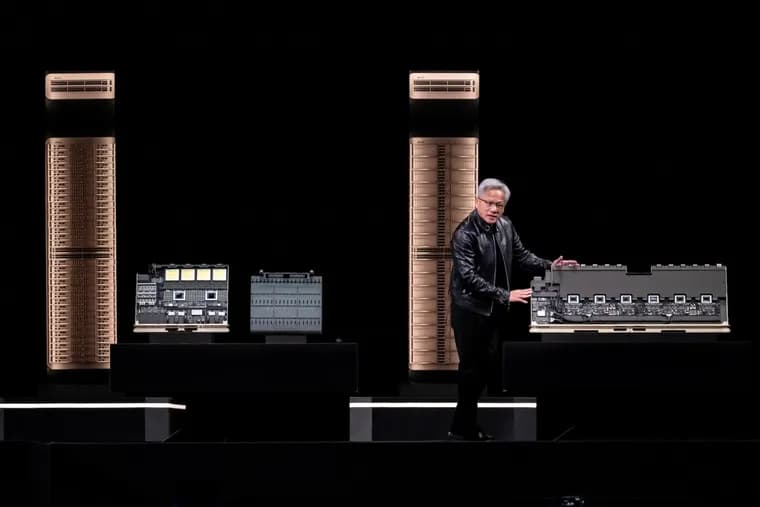
That edge shows up in what Nvidia actually sells. The company is currently rolling out its Vera Rubin architecture, which pairs the Rubin GPU with a set of companion units: the Vera CPU, the Groq 3 LPX inference accelerator, and dedicated storage and networking racks. Rather than processing tokens themselves, these companion systems exist to keep everything around the GPU running efficiently. Jason Hardy, Nvidia's VP of storage technology, described the Vera CPU's job as orchestrating data: 'Vera is important because there's only so much memory that you can put in a single server or any sort of compute platform.' As memory capacity has scaled up alongside computing power, benefiting memory makers like Micron, getting the right data to the GPU at the right moment has become the harder problem, especially as companies try to push tokens-per-watt lower. Hardy said the Vera CPU delivers 'upwards of 3x improvement in these operations,' letting Nvidia's flash storage 'get all that performance out of it without bottlenecking.'
The same underlying problem shows up outside Nvidia's product line. OpenAI took a different approach with its own Jalapeño chip, designed to sidestep the data-movement problem rather than accelerate around it. In a blog post earlier this month, OpenAI said it designed Jalapeño 'to minimize data movement and communication delays,' adding that its large domain 'allows the entire workload to remain within one connected system, minimizing data movement and helping the complete request stay fast and efficient from beginning to end.' Nvidia spreads the work across specialized companion chips, while OpenAI keeps an entire workload inside one integrated chip, but both are chasing the same goal: efficiency through smarter data traffic rather than raw processing power.
That shared goal defines a new layer of infrastructure for companies to compete over, one where building a rival GPU matters less than making the entire system work efficiently. The shift is not an automatic win for Nvidia: the company will still have to compete with rival chipmakers and hyperscalers at this layer just as it has on GPUs. But at least in these early stages, Nvidia looks to have a commanding lead.
Key facts
- Nvidia's market cap grew 10x from the start of 2023 to mid-2025, then settled into a more modest trajectory over the past year as hyperscalers like Amazon and Google began building their own chips.
- Since Nvidia's earnings report on Wednesday, investors have started recognizing that its advantage extends beyond the GPU into the systems that orchestrate data across a data center.
- Nvidia's Vera Rubin architecture pairs the Rubin GPU with the Vera CPU, the Groq 3 LPX inference accelerator, and dedicated storage and networking racks.
- Jason Hardy, Nvidia's VP of storage technology, says the Vera CPU delivers 'upwards of 3x improvement' in the data-traffic operations that feed the GPU.
- OpenAI takes a different approach with its Jalapeño chip, designed to minimize data movement by keeping an entire workload inside one integrated chip.
Why it matters
For years the Nvidia story was about GPU scarcity: only Nvidia had state-of-the-art chips, and that made them immensely profitable as the AI industry scaled out, helping drive a 10x rise in Nvidia's market cap from early 2023 to mid-2025. That story got shakier over the past year as hyperscalers like Amazon and Google began building their own chips, leaving investors to wonder how durable Nvidia's advantage really was. Nvidia's earnings report on Wednesday reset the narrative: the article argues Nvidia's real advantage now extends into the hardware and systems that orchestrate data across a data center as AI compute scales into the gigawatt range, a layer that is becoming a competitive battleground in its own right.
Who it affects
Nvidia itself, whose product line now centers on the Vera Rubin architecture: the Rubin GPU paired with the Vera CPU, the Groq 3 LPX inference accelerator, and dedicated storage and networking racks. Rival chipmakers and hyperscalers, including Amazon and Google, who built their own chips to compete with Nvidia's GPUs but now face a second competitive layer at the systems level. OpenAI, which is solving the same data-movement problem differently with its own Jalapeño chip. And investors and data center operators trying to judge how durable Nvidia's position is as AI compute scales toward the gigawatt range.
How to use it
There is no product to buy here so much as a way to judge one: when evaluating an AI infrastructure vendor, a GPU's raw throughput is no longer the whole picture. Nvidia's Vera Rubin architecture, currently rolling out, bundles the Rubin GPU with the Vera CPU and the Groq 3 LPX inference accelerator as one rack-level system, so buyers should weigh the data-orchestration piece alongside the GPU rather than comparing chip specifications alone. The same lens applies to OpenAI's Jalapeño chip: its value lies in the integrated design that minimizes data movement, not in a standalone spec sheet.
How solid is it
The account rests on direct reporting: the TechCrunch writer says they spent the past week talking with Nvidia staff, including an on-the-record quote from Jason Hardy, Nvidia's VP of storage technology, who supplied the 3x figure. That figure describes unspecified 'these operations' and comes from an Nvidia executive discussing Nvidia's own product, so it reads as a vendor's claim about itself rather than an independently measured benchmark. The OpenAI material is sourced to OpenAI's own blog post, not to an interview. The 10x market-cap growth figure is a checkable public data point, not attributed to a person. No author name appears on the article, no exact date is given for Nvidia's earnings call beyond 'Wednesday' or for OpenAI's blog post beyond 'earlier this month,' and no completion timeline is given for the Vera Rubin rollout.
Risks and caveats
The central 3x figure comes from an Nvidia executive promoting Nvidia's own hardware, and he names only 'these operations' without specifying which ones, so it cannot be checked against an outside benchmark. The article does not name any specific rival chipmaker or hyperscaler competing at this new orchestration layer, citing Amazon and Google only as GPU competitors, so how quickly Nvidia's lead there might narrow is untested. It also does not explain what the Groq 3 LPX inference accelerator is or whether it has any relation to the separate AI chip company Groq, leaving that name unexplained. And the framing that Nvidia now holds a commanding lead is the reporter's own conclusion from a week of interviews with Nvidia staff, not a finding confirmed by an outside party.
“We saw upwards of 3x improvement in these operations, where the Vera CPU is allowing for acceleration.”
— Jason Hardy, Nvidia's VP of storage technology