NVIDIA's Nemotron retrieval stack adapted for Modern Greek, answer accuracy more than doubles
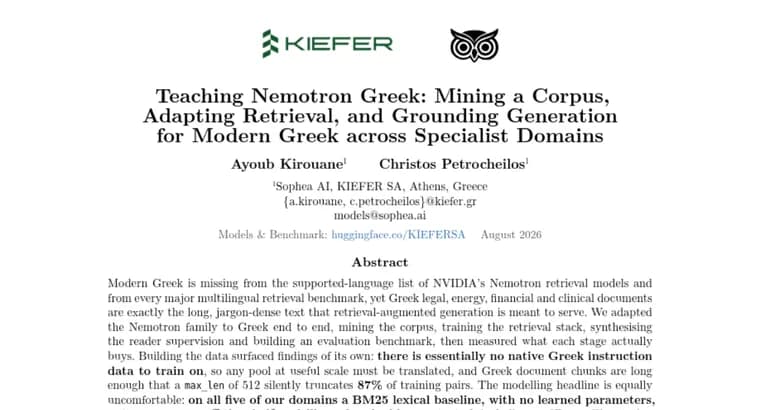
Modern Greek is absent from NVIDIA's Nemotron retrieval models and from the major multilingual retrieval benchmarks, despite retrieval-augmented generation (RAG) mattering for legal, energy, financial and medical applications in the language. A team of researchers built an end-to-end adaptation of the Nemotron retrieval stack for Modern Greek: mining a Greek corpus, generating synthetic supervision data, training a retrieval model, adapting a reranker, fine-tuning a reader model, and creating a new benchmark called HERA.
The study first found that a parameter-free BM25 baseline, a keyword-matching ranking method with no learned parameters, outperforms several off-the-shelf multilingual dense retrieval models on specialist Greek corpora. After fine-tuning a Nemotron 1B embedder on 65,773 Greek retrieval pairs, its nDCG@10 score, a standard measure of ranking quality, rose from 0.362 to 0.835, well ahead of the unadapted model. The Greek-language competence the model picked up transferred to general-domain Greek text too, though the size of the advantage over BM25 still depends on the domain.
The team also adapted a cross-encoder reranker, a second-stage model that reorders retrieved passages by relevance, and reported consistent improvements across the specialist domains tested. For generation, they applied LoRA fine-tuning, a lightweight technique that trains a small set of added parameters rather than the whole model, to a Nemotron 30B-A3B mixture-of-experts reader. Judged answer correctness rose from 29.4% to 66.9%, alongside significant gains in faithfulness and citation quality.
The authors present HERA as the first large-scale benchmark built specifically for Greek retrieval-augmented generation, and say they are releasing the adapted models and the benchmark to support further research on Greek-language RAG systems.
Key facts
- A parameter-free BM25 baseline outperforms several off-the-shelf multilingual dense retrieval models on specialist Greek corpora.
- Fine-tuning a Nemotron 1B embedder on 65,773 Greek retrieval pairs raised its nDCG@10 score from 0.362 to 0.835.
- LoRA fine-tuning a Nemotron 30B-A3B mixture-of-experts reader raised judged answer correctness from 29.4% to 66.9%, with better faithfulness and citation quality.
- A cross-encoder reranker was also adapted, with consistent gains reported across specialist domains.
- HERA is introduced as the first large-scale Greek benchmark for retrieval-augmented generation, with the adapted models and benchmark to be released.
Why it matters
Modern Greek had no support in NVIDIA's Nemotron retrieval models or in the major multilingual retrieval benchmarks, despite RAG mattering for Greek legal, energy, financial and medical work. This is a full adaptation pipeline rather than a single fine-tuned model: corpus mining, retrieval training, reranking and grounded generation together with a new benchmark, producing a Greek-language RAG stack that did not previously exist.
Who it affects
Teams building retrieval-augmented systems in Modern Greek, particularly in specialist domains like legal, energy, finance and medicine, gain an adapted embedder, reranker and reader, plus HERA to evaluate against. The approach also serves as a template for other languages missing from Nemotron and the major multilingual retrieval benchmarks.
How to use it
The authors say they are releasing the adapted Nemotron 1B embedder, the reranker, the LoRA-tuned Nemotron 30B-A3B reader, and the HERA benchmark to support further research on Greek RAG. The source gives no pricing, licence terms or release timeline.
How solid is it
The gains are reported with standard retrieval and RAG metrics: nDCG@10 for the embedder and judged answer correctness for the reader. Both more than double, nDCG@10 from 0.362 to 0.835 and correctness from 29.4% to 66.9%, and the fine-tuning set (65,773 pairs) is disclosed. The source does not detail who judged answer correctness or the full evaluation protocol beyond the figures given.
Risks and caveats
The adapted retriever's advantage over the plain BM25 baseline is domain-dependent, so gains may not hold uniformly across every specialist area. The source text does not name the individual authors or their institutional affiliations, the specific off-the-shelf multilingual models BM25 was compared against, the size or composition of the HERA benchmark, or a release timeline for the models and benchmark.