OctLLM feeds 3D shapes to an LLM as octree tokens
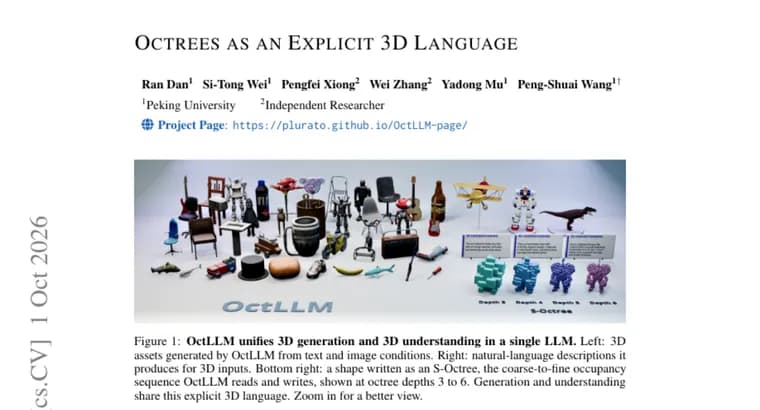
A paper on Hugging Face Papers introduces OctLLM, a unified multimodal large language model that handles 3D shapes alongside text and images. It starts from a criticism of existing 3D LLMs, which the paper says compromise on two fronts. First, they compress shapes into latent codebook indices or coordinate text, which removes spatial structure from what the model observes. Second, they acquire the 3D modality by fine-tuning the backbone, which overwrites its general language ability.\n\nOctLLM's answer to the first problem is to give the model geometry as an explicit 3D sequence of octree occupancy tokens. The catch is that full octree sequences grow rapidly with depth. To keep them short, OctLLM randomly empties penultimate-level nodes and omits their descendants while preserving the shape. The result is a shorter, coordinate- and depth-anchored Sparse Octree, called S-Octree, which is used for position-aware mask-modeling generation and for 3D understanding.\n\nThe second problem is training. The authors say full fine-tuning is costly, LoRA limits 3D capacity, and both modify the language pathway. OctLLM instead adds 3D capacity in parameters separate from the pretrained ones. Mesh tokens are routed through independent trainable branches in a subset of blocks, while text and image tokens keep the frozen vision-language pathway. The two streams interact through shared self-attention.\n\nThe paper reports that OctLLM trains far fewer parameters than full fine-tuning and still sets a new state of the art among unified multimodal LLMs. Against ShapeLLM-Omni, it lowers image-to-3D FID by 17.4% (lower is better) and raises render-grounded captioning by 28.7 points. It also matches the backbone on general language benchmarks, which is the paper's evidence that the language ability was not overwritten.
Key facts
- OctLLM passes 3D geometry to the model as an explicit sequence of octree occupancy tokens, rather than latent codebook indices or coordinate text.
- To keep sequences short, it randomly empties penultimate-level nodes and omits descendants, producing a Sparse Octree (S-Octree) anchored by coordinates and depth.
- 3D capacity sits in separate trainable branches in a subset of blocks; text and image tokens keep the frozen vision-language pathway, and the streams meet through shared self-attention.
- Versus ShapeLLM-Omni, the abstract reports image-to-3D FID lowered by 17.4% and render-grounded captioning raised by 28.7 points.
- The model trains far fewer parameters than full fine-tuning and matches the backbone on general language benchmarks.
Why it matters
Adding a new modality to a language model usually costs something the model already did well. The paper's argument is that existing 3D LLMs pay twice: they flatten shapes into codes or coordinate text, losing spatial structure, and they fine-tune the backbone, overwriting general language ability. OctLLM tries to avoid both. It keeps the geometry in a structured octree form and keeps the pretrained vision-language pathway untouched, adding 3D through separate parameters. If the reported results hold up, that is a template for bolting 3D onto an existing multimodal model without degrading it.
Who it affects
Researchers building unified multimodal models that must generate and understand 3D shapes are the direct audience, especially those comparing against ShapeLLM-Omni. Teams that want to extend an existing vision-language model with a new modality, and worry about damaging its language skills or paying for full fine-tuning, may also find the branch-based design relevant.
How to use it
This is a research paper, not a product. The abstract describes the method but not a ready-to-use tool. Code or model release is not mentioned. Practitioners can take the ideas as design patterns: represent shapes as sparse octree tokens with coordinate and depth anchoring, and route the new modality through independent trainable branches in some blocks while freezing the pretrained pathway.
How solid is it
The claims come from the authors' own abstract, and they are specific: a 17.4% lower image-to-3D FID and a 28.7-point higher render-grounded captioning score than ShapeLLM-Omni. The abstract does not give absolute FID values for OctLLM and ShapeLLM-Omni, nor the scale or metric of the captioning score, and it does not spell out whether the 17.4% is a relative or absolute reduction. The benchmarks used for the general language comparison are not named, and the backbone model is not named. Treat the headline numbers as authors' reports until the full paper and independent results are checked.
Risks and caveats
Several details that decide how far the result generalises are not given in the abstract: octree depth, parameter counts, training cost and dataset sizes. The claim of training far fewer parameters than full fine-tuning is stated without figures. The comparison is against one named baseline, ShapeLLM-Omni, and the state-of-the-art claim is limited to unified multimodal LLMs. The sparsification step randomly empties nodes while preserving shape, so how well it holds up on complex geometry is not covered here.
“Geometry enters as an explicit 3D sequence of octree occupancy tokens.”
— OctLLM paper abstract