OmniEdu fine-tunes foundation models for K-12 teaching
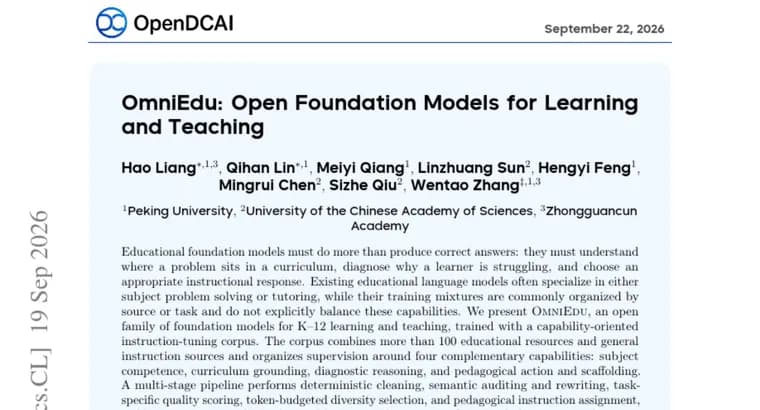
Researchers present OmniEdu, an open family of foundation models built specifically for K-12 learning and teaching. The starting point is a critique of existing educational language models: they tend to focus on either problem solving or tutoring, and their training mixtures are organized by source or task rather than by the capability the model actually needs. OmniEdu instead organizes its instruction-tuning corpus around four capabilities: subject competence, curriculum grounding, diagnostic reasoning, and pedagogical action and scaffolding.
That corpus combines over 100 educational and general instruction sources through a pipeline of deterministic cleaning, semantic auditing and rewriting, task-specific quality scoring, token-budgeted diversity selection, and pedagogical instruction assignment. The pipeline yields 69,999 training examples and 15.96 million supervised response tokens in total, of which 60,951 examples are education-specific.
The team fine-tuned models at three sizes, 4B, 9B and 27B parameters, and evaluated them on curriculum grounding, K-12 problem solving and pedagogical tutoring, alongside general capability. The largest model, OmniEdu-27B, scores 63.12% exact match and 76.69% F1 on K12-Bench, 85.89% on MathFish, 86.95% on EDUMATH, and 78.74% on MathTutorBench's Scaffold setting; it also posts the highest Teaching average among the evaluated models on LongTutor, at 3.02. The authors report that education-oriented tuning consistently improves results across all three educational benchmark groups and across all three model scales, and take this as evidence for the value of curated, capability-balanced supervision when adapting general language models to educational tasks.
Key facts
- OmniEdu organizes its training data around four capabilities (subject competence, curriculum grounding, diagnostic reasoning, pedagogical scaffolding) instead of by source or task.
- The instruction-tuning corpus draws on over 100 educational and general sources and yields 69,999 examples (60,951 education-specific) and 15.96M supervised response tokens.
- Models were fine-tuned at 4B, 9B and 27B parameters.
- OmniEdu-27B reaches 63.12% EM / 76.69% F1 on K12-Bench, 85.89% on MathFish, 86.95% on EDUMATH and 78.74% on MathTutorBench's Scaffold setting, plus the top Teaching average (3.02) on LongTutor among the models compared.
- The authors report gains across all three educational benchmark groups and all three model scales, not just at the largest size.
Why it matters
The paper's stated problem is specific: existing educational language models are usually built for either solving problems or tutoring students, and their training data is organized by where it came from or what task it covers rather than by the capability a teaching model actually needs. OmniEdu's contribution is a corpus and pipeline organized around four named capabilities at once, aimed at models that can do subject-matter problem solving, follow curriculum structure, diagnose why a learner is stuck, and scaffold instruction accordingly, in one system rather than four separate ones.
Who it affects
The direct audience is researchers and edtech builders working on tutoring systems and curriculum-aware assistants for K-12 education, since the paper's benchmarks (K12-Bench, MathFish, EDUMATH, MathTutorBench, LongTutor) are all built around that age range and its subject matter. Students and teachers are the eventual beneficiaries if such models reach classroom tools, but the paper itself reports model and benchmark results, not a deployed product.
How to use it
The source text does not state a release date, a license, or whether the model weights or the training data are being made public, so none of that can be reported here. What is described is the training recipe: fine-tuning at three parameter scales (4B, 9B, 27B) on a 69,999-example, 15.96M-token instruction corpus built through a five-stage pipeline of cleaning, semantic auditing and rewriting, quality scoring, diversity selection, and pedagogical instruction assignment.
How solid is it
The claims rest on five separate benchmark axes spanning curriculum grounding, K-12 problem solving and tutoring, plus general capability, rather than a single headline number. The authors report that education-oriented tuning improves results consistently across all three benchmark groups and across all three model sizes, which is a stronger claim than a single strong score at one scale would be. The source does not name any specific competing model or baseline that OmniEdu is compared against, so how it stacks up against other systems in the field is not established by what is reported here.
Risks and caveats
The abstract text gives no author names or institutional affiliations, no release date, license or availability information, and no named baseline for comparison, so this retelling cannot supply any of that. The reported gains are measured on the paper's own chosen benchmark suite; how the models perform on curricula, languages or student populations outside those benchmarks is not addressed. As a domain-specific fine-tuning effort on existing foundation models, the contribution is methodological and incremental rather than a new base model or a novel capability.