OmniScientist perceives raw data instead of summaries
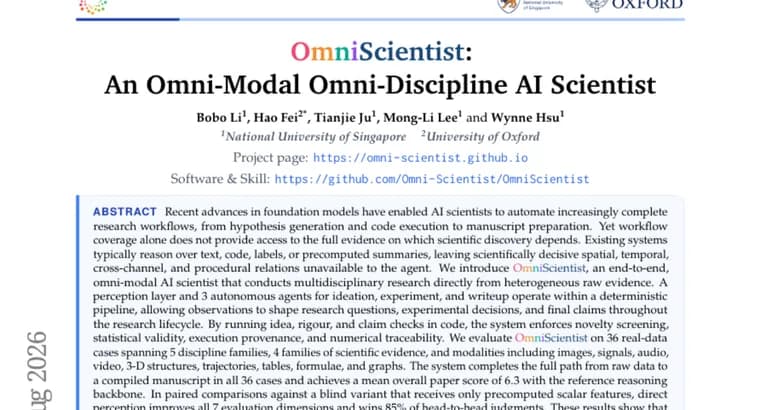
A paper titled 'OmniScientist: An Omni-Modal Omni-Discipline AI Scientist' proposes an AI system built to conduct scientific research directly from raw evidence rather than from processed summaries. The authors note that recent AI-scientist systems already automate much of the research workflow, from generating hypotheses and running code to preparing a manuscript, but that this workflow coverage does not by itself give a system access to the full evidence a discovery depends on. Existing systems typically reason over text, code, labels, or precomputed summaries, which the authors say leaves out spatial, temporal, cross-channel, and procedural relations that can be scientifically decisive but are simply unavailable to an agent working from a summary.
OmniScientist is described as end-to-end and omni-modal: a perception layer feeds three autonomous agents, one each for ideation, experiment, and writeup, that operate inside a deterministic pipeline. Raw observations shape the research questions, the experimental decisions, and the final claims at every stage of that pipeline, not only at the start. The system also runs idea, rigour, and claim checks in code, which the authors say enforces novelty screening, statistical validity, execution provenance, and numerical traceability.
The authors evaluated OmniScientist on 36 real-data cases spanning 5 discipline families and 4 families of scientific evidence, with input modalities including images, signals, audio, video, 3-D structures, trajectories, tables, formulae, and graphs. The system completed the full path from raw data to a compiled manuscript in all 36 cases and reached a mean overall paper score of 6.3 when run with what the paper calls its reference reasoning backbone. The paper does not state the scale that score is measured on, nor which model served as that reference backbone.
To test whether direct perception of raw evidence was actually doing the work, the authors ran paired comparisons against a blind variant that received only precomputed scalar features instead of the raw data. Direct perception improved all 7 evaluation dimensions used in the study and won 85% of head-to-head judgments against that blind variant. The authors conclude that perception spanning the full research lifecycle, not just at the start, is essential for evidence-grounded scientific discovery and offers a practical path toward broadly capable AI scientists.
Key facts
- OmniScientist pairs a perception layer with three autonomous agents, for ideation, experiment, and writeup, running inside one deterministic pipeline.
- The system works directly from raw multimodal evidence, including images, signals, audio, video, 3-D structures, trajectories, tables, formulae, and graphs, instead of precomputed summaries.
- Across 36 real-data cases spanning 5 discipline families and 4 families of scientific evidence, OmniScientist completed the full path from raw data to a compiled manuscript in every case.
- The system reached a mean overall paper score of 6.3 with its reference reasoning backbone; the paper does not state the scale behind that score or name the backbone model.
- Against a blind variant that received only precomputed scalar features, direct perception improved all 7 evaluation dimensions and won 85% of head-to-head paired comparisons.
Why it matters
Most AI-scientist systems that automate a research workflow still reason over text, code, labels, or precomputed summaries, and that strips out spatial, temporal, cross-channel, and procedural detail that can be exactly what makes a finding correct or incorrect. OmniScientist instead builds perception of raw evidence into every stage of the pipeline, letting the actual images, signals, audio, video, or 3-D data shape the research question, the experiments, and the final claims. In the paper's own paired testing that distinction was not incidental: giving the system direct access to raw evidence, instead of precomputed scalar features, improved all 7 evaluation dimensions measured and won 85% of head-to-head comparisons. That result is offered as evidence that perception, not workflow automation alone, is the next bottleneck for AI systems that aim to do real science.
Who it affects
The pitch targets researchers and labs whose work depends on raw instrument or file data rather than data that is already reduced to a caption or a table. The evaluation set covers 5 discipline families and 4 families of scientific evidence, with inputs including images, signals, audio, video, 3-D structures, trajectories, tables, formulae, and graphs, so the claimed scope is broad rather than tied to one field. It also speaks to the wider AI-agent research community building 'AI scientist' systems, since the paper argues that perception depth, not just how much of the workflow is automated, should be the next axis those systems compete on.
How to use it
OmniScientist is presented as a research system, not a public product. The source text does not mention a code release, a dataset release, a price, or a licence, so there is nothing here to install or subscribe to. What is reusable right now is the idea: a perception-first, three-agent pipeline for ideation, experiment, and writeup, with code-based checks for novelty, rigour, and claim validity, plus the 36-case, multidisciplinary, real-data benchmark the authors used to test it.
How solid is it
The results rest on the authors' own 36-case evaluation: a 100% completion rate from raw data to manuscript, a mean overall paper score of 6.3, and an 85% win rate over a blind, scalar-features-only variant across 7 evaluation dimensions. Some context for those numbers is missing from the source text: it does not state the scale the 6.3 score sits on, does not name the model used as the reference reasoning backbone, does not say whether the head-to-head judgments were made by human raters or by an automated judge, and does not mention a publication venue, conference, or peer-review status. The numbers are specific and the comparison is controlled, but they have not yet been checked by anyone outside the author group.
Risks and caveats
The headline 85% figure compares OmniScientist against a blind variant within its own evaluation setup, not against a rival AI-scientist system or against human researchers, so it shows the value of raw-evidence perception inside this one pipeline rather than how OmniScientist ranks against alternatives. A mean paper score of 6.3 is hard to weigh without knowing its scale. And with no peer-review status or outside replication mentioned in the source, the claims here should be read as the authors' own report of their system's performance rather than an independently confirmed result.