OmniShowcase generates subject-consistent video from multi-view reference images
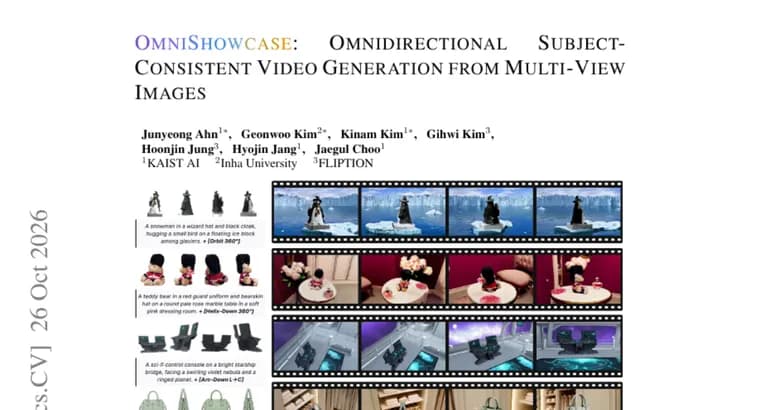
A new paper presents OmniShowcase, a method for generating video of a specific subject from a few reference images, aimed at the hard case where the camera reveals surfaces that the input images never showed.
The authors frame the problem in three steps. Early subject-to-video (S2V) methods condition on a single reference image, so they must infer the subject's unseen appearance and geometry as the viewpoint changes. Recent methods extend S2V to multiple reference views, which gives the model more information from different angles. But, the authors argue, those methods do not explicitly specify the 3D structure that connects the observations. On top of that, existing training data do not guarantee that viewpoint changes preserve the same underlying 3D subject.
OmniShowcase is built on two components. The first is a fully automated data synthesis pipeline that produces training videos along diverse camera trajectories, with viewpoint variation driven by the subject's underlying geometry. It can even span full 360-degree orbits. The second is a geometry-conditioning method: the video model receives a turntable of surface-normal maps reconstructed from the reference views, and these maps do not need to be temporally aligned with the generated frames.
The authors also build two resources. Showcase-4K is a corpus of videos based on 3D assets, covering twelve camera motions across 88 trajectory configurations, with reconstruction-derived surface-normal conditioning. ShowcaseBench is a held-out evaluation set that includes the source meshes and the camera parameters used to render each video.
On results, the paper says experiments show state-of-the-art subject identity and 3D consistency while maintaining competitive video quality and motion. The source gives no numbers behind that claim. A project page is listed at justin4ai.github.io/OmniShowcase.
Key facts
- OmniShowcase extends subject-to-video generation to multiple reference views and adds explicit 3D structure through a turntable of surface-normal maps reconstructed from those views.
- The surface-normal turntable does not need temporal alignment with the generated frames.
- A fully automated data synthesis pipeline produces training videos along diverse camera trajectories, including full 360-degree orbits, with viewpoint changes driven by subject geometry.
- Showcase-4K covers twelve camera motions across 88 trajectory configurations; ShowcaseBench is a held-out set with source meshes and camera parameters for each video.
- The authors claim state-of-the-art subject identity and 3D consistency with competitive, not superior, video quality and motion.
Why it matters
Keeping a specific object looking the same while the camera moves around it is a known weak point of subject-driven video generation, especially once the camera shows sides the reference photos never captured. The paper targets two causes it names: methods that do not tie multiple views to a shared 3D structure, and training data that does not guarantee the same 3D subject across viewpoint changes. Fixing both with synthetic, geometry-driven data and explicit surface-normal conditioning is the contribution.
Who it affects
Researchers working on subject-to-video and multi-view conditioning are the direct audience, since the paper adds a training corpus and a benchmark with meshes and camera parameters. Anyone who wants video of a product or object from a handful of photos is the downstream use case the problem statement points at.
How to use it
The abstract points to a project page at justin4ai.github.io/OmniShowcase. The source does not state any release of code, weights or dataset beyond that project page mention. For practitioners, the practical idea is the input recipe: several reference views of the subject, plus a turntable of surface-normal maps reconstructed from them.
How solid is it
Everything here comes from the paper's abstract, so these are the authors' own claims. The state-of-the-art claim is unquantified: no benchmark scores, baseline names or numeric results are given. No authors or institutions are named in the source text. Video quality and motion are described as competitive, not as better than prior methods.
Risks and caveats
The size of Showcase-4K, measured in number of videos, is not stated. The base video model, model size and training compute are not stated either, so it is unclear what the gains rest on. The corpus is built from 3D assets, so how well the approach carries over to real photographed subjects is not addressed in the source.
“Experiments show state-of-the-art subject identity and 3D consistency while maintaining competitive video quality and motion.”
— OmniShowcase paper abstract