One Table Benchmark tests tabular models on generation, imputation and prediction together
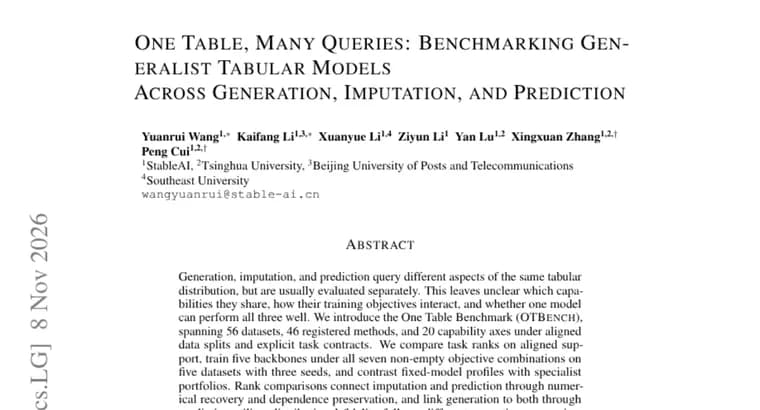
Tabular models are usually judged on one job at a time. The authors of a paper listed on Hugging Face Papers point out that generation, imputation and prediction all query different aspects of the same tabular distribution, yet they are normally evaluated separately. That leaves open which capabilities the three tasks share, how their training objectives interact, and whether a single model can do all three well.
To answer this, the authors introduce the One Table Benchmark. It spans 56 datasets, 46 registered methods and 20 capability axes, with aligned data splits and explicit task contracts. They run three kinds of comparison: task ranks on aligned support; an objective-intervention experiment in which five backbones are trained under all seven non-empty objective combinations on five datasets with three seeds; and fixed-model profiles set against specialist portfolios.
The rank comparisons show a structure. Imputation and prediction are connected through numerical recovery and dependence preservation. Generation is linked to both through predictive utility. Distributional fidelity, however, follows different rankings, sometimes opposing the others.
The objective interventions show that the largest pooled gains come from including the recipient's own objective, meaning a task benefits most from being trained directly for it. Among the auxiliary effects, generation has the broadest coverage of positive pooled effects, while prediction shows potential to improve imputation and synthetic-data utility, with responses that vary across backbones. Cross-addition effects show that objective benefits need not add up and depend on which objectives are already present.
Fixed-model comparisons expose matching trade-offs between utility and fidelity: some generalist models surpass specialist portfolios on utility, while fidelity continues to favor specialization. Frozen foundation models show strong prediction and numerical point imputation, together with promising synthetic-data utility, which the authors take as evidence of potential across all three tasks.
The authors conclude that these findings motivate unified tabular models that share useful conditional information while improving categorical reconstruction and faithful joint sampling.
Key facts
- The One Table Benchmark covers 56 datasets, 46 registered methods and 20 capability axes, with aligned data splits and explicit task contracts.
- Imputation and prediction are connected through numerical recovery and dependence preservation; generation links to both through predictive utility, while distributional fidelity follows different, sometimes opposing, rankings.
- In the objective-intervention experiment (five backbones, seven non-empty objective combinations, five datasets, three seeds), the largest pooled gains come from including the recipient's own objective.
- Objective benefits need not add up and depend on the objectives already present.
- Some generalist models surpass specialist portfolios on utility, but fidelity continues to favor specialization; frozen foundation models show strong prediction and numerical point imputation.
Why it matters
Tabular generation, imputation and prediction are normally benchmarked in isolation, so it has been unclear what the three share and whether one model can serve all of them. This benchmark puts them under one set of aligned splits and task contracts. Its main finding is that the tasks are related, but not uniformly: utility-related measures line up across tasks, while distributional fidelity ranks models differently and sometimes in the opposite order.
Who it affects
Researchers building tabular models for synthetic data, missing-value filling or prediction are the direct audience. The results are also relevant to anyone weighing a single general-purpose tabular model against a set of task-specific ones, since the paper finds the answer depends on whether utility or fidelity matters more.
How to use it
The paper's findings can guide design choices. Training a task with its own objective gives the largest pooled gains, so that objective should not be dropped. Adding objectives does not always stack, so combinations need testing rather than assuming the benefits sum. The authors say frozen foundation models are strong for prediction and numerical point imputation and promising for synthetic-data utility. The source mentions no code or dataset release, link or licence.
How solid is it
This is a preprint-style abstract on Hugging Face Papers, and the findings are reported by the authors themselves. The scale is large (56 datasets, 46 methods, 20 capability axes), but the objective-intervention experiment uses only five datasets, five backbones and three seeds. The source gives no numerical results, effect sizes or scores, so the findings are qualitative, and it does not name the backbones, the foundation models or the datasets used.
Risks and caveats
Some claims are hedged by the authors: prediction shows "potential" to improve imputation and synthetic-data utility, and responses vary across backbones. Generalist gains are on utility only; fidelity still favors specialists. The authors also point to weak spots for unified models: categorical reconstruction and faithful joint sampling need improvement. Without scores or named models, readers cannot judge how large the differences are.
“some generalists surpass specialist portfolios on utility, while fidelity continues to favor specialization”
— Authors of the One Table Benchmark paper, Hugging Face Papers