onPanda cuts LLM annotation time by 52% in small study
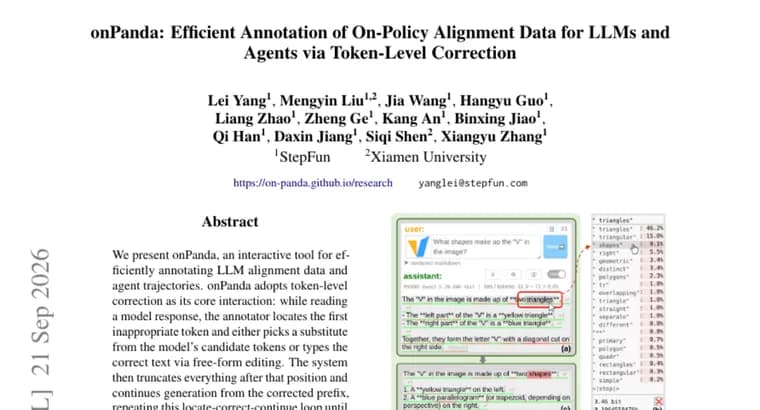
Researchers have released onPanda, an interactive tool for annotating LLM alignment data and agent trajectories built around a technique they call token-level correction. Instead of rewriting a flawed model response by hand, an annotator reads the output, finds the first token that is wrong, and fixes just that token, either by picking a substitute from the model's own candidate tokens or by typing the correct text directly. Everything after that point is then discarded, and the model resumes generation from the corrected prefix. Annotators repeat this locate-correct-continue cycle until the response is acceptable.
The authors report that this approach lets annotators steer model outputs precisely at low cost: a small controlled study found that onPanda cut median annotation time by 52% compared with manual post-editing. Because most of the tokens in a finished response still come from the model itself rather than from the annotator, the resulting data stays close to the model's own output distribution, which the authors say makes it well suited for building on-policy supervised fine-tuning and preference datasets. The correction step also records the exact position of each edit along with a paired original and corrected token, giving fine-grained supervision signal with a naturally matched positive and negative example for every fix. onPanda can additionally connect to external tools and harnesses, so it can be used for interactive annotation of agent trajectories in realistic, tool-using environments rather than only single-turn text responses.
Alongside the tool, the researchers release Panda-CVL, a dataset annotated using onPanda, together with a benchmark for evaluating token-level correction itself.
Key facts
- onPanda replaces full manual rewrites with token-level correction: the annotator fixes only the first wrong token, then the model regenerates the rest from that corrected point.
- A small controlled study found onPanda cut median annotation time by 52% versus manual post-editing.
- Because most tokens in the final response still come from the model, the resulting data stays close to the model's own sampling distribution, which the authors say suits on-policy SFT and preference data.
- Each correction is logged with its exact position and a paired original/corrected token, giving fine-grained, naturally paired positive-negative supervision.
- onPanda can connect to external tools and harnesses for interactive annotation of agent trajectories, and the team is releasing the Panda-CVL dataset plus a token-level correction benchmark alongside it.
Why it matters
Annotating alignment data, having humans mark up or correct model outputs for supervised fine-tuning and preference training, is slow and expensive, and manual rewrites tend to drift away from what the model would actually produce on its own. onPanda's token-level correction keeps most of a response machine-generated while still letting a human steer it at the exact point it goes wrong, which is the combination the authors say makes the resulting data both cheaper to produce and closer to on-policy.
Who it affects
The tool is aimed at teams that build and annotate alignment datasets for LLMs and for agents that use external tools, meaning the people running RLHF or SFT annotation pipelines and anyone assembling preference data for on-policy training. It also affects downstream model builders who consume the released Panda-CVL dataset or use the accompanying benchmark to evaluate correction-based annotation methods.
How to use it
The workflow is a locate-correct-continue loop: an annotator reads a model response, finds the first inappropriate token, replaces it either by choosing from the model's own candidate tokens or by typing free-form text, and the system truncates the response at that point and continues generation from the corrected prefix. This repeats until the response is satisfactory. onPanda also connects to external tools and harnesses, so the same loop can be applied to agent trajectories in interactive, tool-using environments, not just plain text responses.
How solid is it
The central efficiency claim, a 52% cut in median annotation time, comes from what the source describes only as "a small controlled study," without further detail on its size, participants, or setup. That leaves the headline number directionally credible but not yet backed by a large-scale trial. The release does include concrete artifacts beyond the claim itself: the Panda-CVL dataset annotated with onPanda and a dedicated benchmark for token-level correction, which give other researchers a way to test the method independently.
Risks and caveats
The source does not name the authors or their institutional affiliation, give a release date or timeline for onPanda or Panda-CVL, or describe what tasks or domains Panda-CVL covers, so those details cannot be confirmed here. The 52% time-saving figure rests on a study described as small, and results from a small study do not automatically generalize to large-scale annotation pipelines or to tasks very different from those tested.