Optimizely Web snippets served malware on 178 sites, incl. Zoom and GitLab
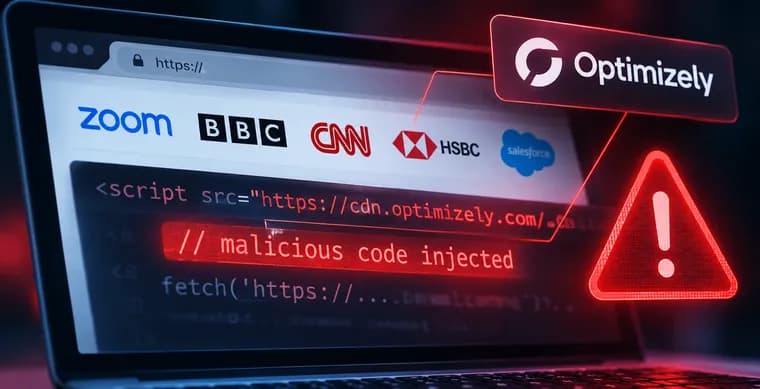
On 16 November 2026, malicious JavaScript was served to visitors of 178 organisations through the Optimizely Web experimentation platform, according to a blog post by the security vendor Report URI. The affected list includes Zoom, the BBC, CNN, Salesforce, GitLab, IKEA, HSBC, Equifax, Air France-KLM, Ledger and Peacock.
Optimizely Web works by having each customer load a JavaScript snippet from Optimizely's CDN, for example from cdn.optimizely.com. The snippet holds Optimizely's code, the customer's experiments and an optional field called Project JavaScript: custom code the customer writes in their Optimizely dashboard, which runs on every page. The attacker wrote their own code into the Project JavaScript of customer projects and left the rest of each snippet untouched. The file was still served from cdn.optimizely.com with Optimizely's certificate, from a host every affected site already trusted. In Zoom's snippet, the additions were a plain script tag pointing at 1688360.cc/track.js (most snippets), the same URL hidden in base64 with atob() so a search for the domain would miss it, and a full inline copy of the payload that runs through eval if 1688360.cc is blocked. Customers who serve the snippet from their own domain, such as opt.scheels.com or www.vodafone.com.au, were affected too, because the content comes from the same Optimizely project.
The payload, track.js, was a multi-purpose kit and every part of it was active at once. First, it found valid wallet addresses (BTC, ETH and EVM chains, TRON, Solana, TON, Litecoin, Bitcoin Cash, Dogecoin), checked their checksums and replaced them with the attacker's in page text, form fields, links, images, the clipboard, outgoing fetch and XHR requests, window.open, navigation and the iOS share sheet. Second, card skimming, added at 13:43 UTC: it watched form submissions and POST requests for a Luhn-valid card number, expiry date and CVV, and sent all three to 1688360.cc/card.php. Cards entered in hosted payment iframes (Stripe, Adyen and similar) were out of its reach; cards typed into a site's own form fields were not. Third, when it swapped an address next to wallet or payment wording, it sent the page URL, document.cookie (cookies not marked HttpOnly), the original addresses and an html2canvas screenshot to 1688360.cc/hit.php. Fourth, on iPhones and iPads it loaded boot.js from two .icu domains and then an exploit chain in a hidden iframe, delivering the Coruna and DarkSword iOS exploit kits. The Coruna loader is byte-identical to a sample Report URI analysed in October from a different campaign. The kit's own comments say iOS 18.7.3 and later, and 26.3 and later, are patched; pages on iOS 18.6 or earlier reload every 60 seconds to retry the exploit, which is a visible symptom.
Money has already been stolen. As of 19:25 UTC on 16 November, the attacker's wallets had received about $7,040, all within roughly nine hours that day. Funds were swept out at 13:03 to 13:05 UTC, and the USDC on Ethereum went to a HitBTC deposit address. The attacker's TRON wallet has been in use since March 2026. Report URI cannot see how many cards or cookies reached the attacker's server. The payload was rebuilt 26 times during the day; the attacker added features and wallets but never removed any.
Report URI fetched 1,611 distinct Optimizely snippets, found mostly through its own crawl data, and checked each for the malicious code. 188 snippets belonging to 178 organisations were infected, and it says the real number is likely higher because it could only check snippets it could find in time. By sector the largest groups were Banking & Finance (32), Technology & SaaS (23), Retail & Fashion (20), Streaming & Entertainment (12) and News & Media (10). Optimizely's own sites, www.optimizely.com and login.optimizely.com, carried the code as well. Smartsheet's snippet was cleaned at one point and then re-infected with the base64 version, which Report URI takes to mean the attacker still had access at that time.
Most of the code has since been removed. At 21:52 UTC Report URI found it in only 1 of the 188 infected snippets (TalkTalk's), down from 169 at 20:56 UTC.
Report URI does not know how the attacker got write access to so many unrelated customer projects. It lists a compromised Optimizely system, a compromised credential with cross-customer access, or something else, and says that is for Optimizely to explain. It stresses that Optimizely's CDN served exactly what it was given and that this was not a CDN cache-poisoning attack. Report URI says it tried to reach Optimizely through various channels and had received no response at the time of publication.
On Content Security Policy, Report URI crawled 256 of the affected organisations' own hosts and evaluated their CSP against what the payload needs. Allowing cdn.optimizely.com was never going to help, since the code came from the trusted host itself. What separated the 24 protected sites from the rest was a restrictive script-src that lists only the hosts a site needs, which blocks 1688360.cc. Two common settings let the attack through: 'strict-dynamic', which trusts any script the Optimizely snippet inserts, and 'unsafe-eval', which Optimizely's own documentation tells customers to allow, so the inline fallback ran through eval even where track.js was blocked. That is what happened at HSBC, whose CSP blocked track.js and the data theft but not the inline copy. 17 sites with partial protection blocked card, cookie and screenshot theft by restricting connect-src, but that does not stop address swapping, which happens inside the page.
Key facts
- On 16 November 2026, malicious JavaScript written into the Project JavaScript field of Optimizely Web customer projects was served from cdn.optimizely.com to visitors of 178 organisations (188 snippets), including Zoom, the BBC, CNN, GitLab, HSBC and Salesforce.
- The kit swapped crypto wallet addresses, skimmed cards typed into a site's own forms, stole non-HttpOnly cookies and screenshots, and delivered the Coruna and DarkSword exploit kits to iPhones and iPads.
- The attacker's wallets had received about $7,040 as of 19:25 UTC on 16 November; the payload was rebuilt 26 times during the day.
- Report URI does not know how the attacker got write access, says Optimizely had not responded at publication, and found the code in only 1 of 188 snippets (TalkTalk's) by 21:52 UTC.
- Of 256 affected hosts whose CSP was checked, 24 were protected by a restrictive script-src; 'unsafe-eval' and 'strict-dynamic' let the attack through elsewhere.
Why it matters
The attack reached sites through a script they already trusted. The code was served from cdn.optimizely.com with Optimizely's certificate, so the affected sites did not need to be breached themselves. Report URI's lesson is that trusted JavaScript doesn't always remain trustworthy and that a website can be compromised through a third-party dependency without its own code or infrastructure ever being breached. The scale is large: 178 organisations across sectors led by Banking & Finance (32), Technology & SaaS (23) and Retail & Fashion (20), with News & Media at 10. The payload also combined theft of money, card data and cookies with iOS exploit kits in one script.
Who it affects
Operators of the 178 listed organisations, and Optimizely Web customers generally, including those serving the snippet from their own domain. Visitors to affected sites on 16 November are exposed too: anyone who copied or pasted a crypto address, anyone who typed a card into a site's own form fields, and iPhone and iPad users on unpatched iOS versions. Cards entered in hosted payment iframes such as Stripe or Adyen were out of the script's reach. Cookie theft covers only cookies not marked HttpOnly. The earlier webshell.lol wave through Kissmetrics, StorifyMe and Minute Media hit other sites and is not in this list.
How to use it
Report URI's advice for sites using Optimizely Web: open every project's Project JavaScript and every experiment's custom code and look for 1688360.cc, atob( and any script you didn't write; review who and what has write access to your Optimizely account (users, API tokens, integrations) and rotate credentials; treat cards entered in your own forms on 16 November as potentially exposed; treat session tokens or secrets in non-HttpOnly cookies as exposed and rotate them; deploy a CSP, restrict connect-src, avoid 'unsafe-eval' where you can and turn on reporting; and consider whether to tell your customers they were served malware. For visitors to an affected site on 16 November: update your iPhone or iPad to iOS 18.7.3 or later, or iOS 26.3 or later; check any crypto transfer, because if the address you pasted doesn't match the one you meant to pay, it may have been swapped; and watch card statements if you paid by card. Report URI also publishes the attacker domains and wallet addresses as indicators of compromise, and says to block the domains including subdomains.
How solid is it
This is a vendor's own write-up. Report URI sells a product that detects unexpected changes to trusted JavaScript and says this is exactly the kind of attack it is designed to detect. The specifics are concrete: it fetched 1,611 distinct snippets, kept a copy of every infected file with response headers, SHA-256 hash and fetch time, says it has verified transactions to the attackers, and offers the archive to affected organisations and CERTs on request. The Coruna loader matching an October sample is its own analysis. No statements from Optimizely, Zoom, GitLab or other affected organisations are given.
Risks and caveats
The real number of affected organisations is likely higher than 178, since only snippets Report URI could find in time were checked. The $7,040 figure is a snapshot as of 19:25 UTC, not a final total. Report URI cannot see how many cards or cookies reached the attacker's server, so the human impact is unknown. How the attacker obtained write access is also unknown: it could be a compromised Optimizely system, a compromised credential with cross-customer access, or something else. Optimizely had not responded at publication. Cleanup is not a guarantee: Smartsheet's snippet was cleaned once and then re-infected, and at 21:52 UTC TalkTalk's snippet still carried the code. On CSP, Report URI says an appropriate policy in enforcement mode could have blocked key parts of the attack, but common settings let it through: 'strict-dynamic', and 'unsafe-eval', which Optimizely's own documentation tells customers to allow. Even sites that blocked data theft remained open to address swapping.
“The important lesson here is that trusted JavaScript doesn't always remain trustworthy.”
— Report URI blog post