OuroWorld turns static 3D Gaussian Splatting scenes into looping 3D cinemagraphs
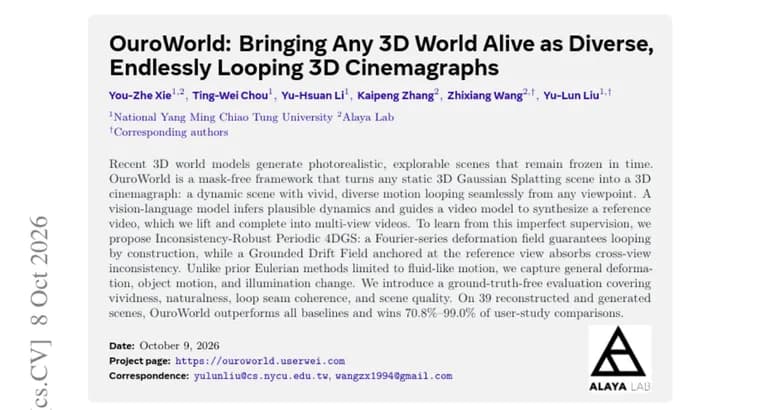
Recent 3D world models can generate photorealistic scenes that a viewer can explore, but those scenes stay frozen in time. OuroWorld, described in a paper listed on Hugging Face, is a framework aimed at that gap. It takes any static 3D Gaussian Splatting scene and turns it into a 3D cinemagraph: a dynamic scene with vivid, diverse motion that loops seamlessly from any viewpoint. The authors call it mask-free.
The pipeline starts with a vision-language model that infers plausible dynamics for the scene. That model guides a video model, which synthesizes a reference video. The reference video is then lifted and completed into multi-view videos. Because these videos are an imperfect source of supervision, the authors propose Inconsistency-Robust Periodic 4DGS. It has two parts: a Fourier-series deformation field that guarantees looping by construction, and a Grounded Drift Field, anchored at the reference view, that absorbs cross-view inconsistency.
The authors contrast their method with prior Eulerian methods, which are limited to fluid-like motion. OuroWorld, they say, captures general deformation, object motion and illumination change. They also introduce a ground-truth-free evaluation that covers four things: vividness, naturalness, loop seam coherence and scene quality.
On 39 reconstructed and generated scenes, the authors report that OuroWorld outperforms all baselines and wins 70.8%-99.0% of user-study comparisons. A project page is at https://ouroworld.userwei.com.
Key facts
- OuroWorld is a mask-free framework that turns any static 3D Gaussian Splatting scene into a 3D cinemagraph that loops seamlessly from any viewpoint.
- A vision-language model infers plausible dynamics and guides a video model to produce a reference video, which is lifted and completed into multi-view videos.
- Inconsistency-Robust Periodic 4DGS combines a Fourier-series deformation field, which guarantees looping by construction, with a Grounded Drift Field that absorbs cross-view inconsistency.
- Unlike prior Eulerian methods limited to fluid-like motion, the method captures general deformation, object motion and illumination change.
- On 39 reconstructed and generated scenes, the authors report that it outperforms all baselines and wins 70.8%-99.0% of user-study comparisons.
Why it matters
Photorealistic, explorable 3D scenes from recent world models are still frozen in time. OuroWorld tries to add motion that is varied and loops cleanly, so a scene keeps moving without a visible seam. The authors say it goes beyond earlier Eulerian approaches, which were limited to fluid-like motion, by handling general deformation, object motion and illumination change.
Who it affects
The work is aimed at 3D scenes in Gaussian Splatting form, both reconstructed and generated ones, since the evaluation covers both. It is most relevant to researchers working on 3D world models, 4D scene representations and video-driven supervision for 3D content.
How to use it
The source points to a project page at https://ouroworld.userwei.com. No code or model release is stated beyond that link, and no runtime, hardware or rendering speed is given, so there is nothing to run from the abstract alone.
How solid is it
The results come from the authors' own evaluation on 39 reconstructed and generated scenes, using an evaluation they introduce themselves, which is ground-truth-free and covers vividness, naturalness, loop seam coherence and scene quality. The user-study win rates are given only as a range of 70.8%-99.0%. The baselines are not named, and the abstract does not say which baseline gives the 70.8% or the 99.0% figure.
Risks and caveats
The source is an abstract, so the details behind the headline claims are missing. The number of user-study participants is not stated, and no quantitative scores for the four evaluation metrics are given. The range from 70.8% to 99.0% is wide, so the margin over baselines varies a lot between comparisons. The method also learns from imperfect supervision, since the multi-view videos are lifted from a synthesized reference video; the paper's own design includes a component to absorb the resulting cross-view inconsistency.
“Recent 3D world models generate photorealistic, explorable scenes that remain frozen in time.”
— OuroWorld paper abstract