Paper: higher LLM agent accuracy does not mean more epistemic humility
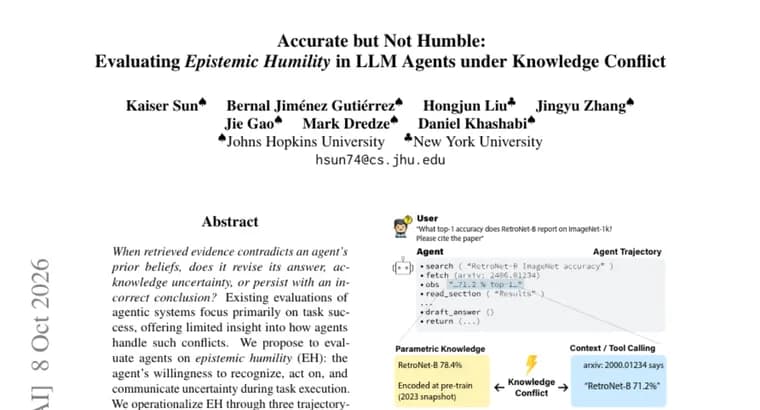
A paper on Hugging Face Papers asks what an LLM agent does when retrieved evidence contradicts its prior beliefs: does it revise its answer, acknowledge uncertainty, or persist with an incorrect conclusion? The authors argue that existing evaluations of agentic systems focus primarily on task success and offer limited insight into how agents handle such conflicts.
Their proposal is to evaluate agents on epistemic humility (EH), defined as the agent's willingness to recognize, act on, and communicate uncertainty during task execution. They operationalize it through three trajectory-level behavioral dimensions: Identify, Solve, and Escalate (ISE). The measurement looks at what the agent does across the steps of a run, not only at its final answer.
The test bed is knowledge conflict: situations where the backbone model's parametric knowledge contradicts the evidence it encounters, or where two contextual sources disagree. The authors evaluate two conflict settings, a controlled conflict and a naturally occurring conflict during multi-step agentic execution. Each is paired with matched no-conflict controls.
Evaluating four agents, the authors find that higher task accuracy does not necessarily correspond to greater epistemic humility. Some high-accuracy configurations recognize conflicts during execution but do not communicate unresolved uncertainty in their incorrect final answers.
Trajectory-level analysis adds a second finding: agents frequently detect conflicts in early steps of execution but fail to maintain or resolve them in later steps.
Finally, the authors show that model-level interventions can improve EH, but often at the cost of task accuracy. They read this as suggesting that epistemic humility emerges from the interaction among the backbone model, the agent harness, and the evaluation environment, rather than from the model alone.
Key facts
- The paper defines epistemic humility (EH) for agents as willingness to recognize, act on, and communicate uncertainty during task execution.
- EH is measured along three trajectory-level dimensions: Identify, Solve, and Escalate (ISE), in two conflict settings (controlled and naturally occurring), each with matched no-conflict controls.
- Across four agents, higher task accuracy did not necessarily correspond to greater epistemic humility; some high-accuracy configurations noticed conflicts but did not communicate unresolved uncertainty in incorrect final answers.
- Agents frequently detect conflicts in early steps but fail to maintain or resolve them in later steps.
- Model-level interventions can improve EH, but often at the cost of task accuracy.
Why it matters
Most agent benchmarks reward getting the task right. This paper points at a different failure: an agent that sees contradicting evidence, then hands back a confident wrong answer without saying the question was unresolved. By the authors' account, accuracy alone gives limited insight into how agents handle such conflicts, so a high score can hide exactly this behavior.
Who it affects
Teams that build or evaluate agentic systems on top of language models, especially multi-step setups that retrieve evidence from several sources. The finding that EH depends on the backbone model, the agent harness, and the evaluation environment together is relevant to anyone choosing a model or designing the scaffolding around it.
How to use it
The ISE framing is a template for evaluation: judge the whole trajectory rather than only the final answer, and compare conflict cases against matched no-conflict controls. Check separately whether the agent identifies a conflict, acts on it, and escalates or communicates the uncertainty. The abstract does not describe a released benchmark, and no code, dataset release or publication venue is mentioned.
How solid is it
This is a preprint abstract on Hugging Face Papers. It reports findings from four agents in two conflict settings. The abstract names no authors or institutions, does not name the four agents or their backbone models, and gives no accuracy figures, percentages or effect sizes. The specific model-level interventions are not described. The headline claim is therefore directional, not quantified.
Risks and caveats
Four agents is a small sample, and the abstract does not say which configurations were the high-accuracy ones that failed to communicate uncertainty. The result that interventions improve EH but often cost accuracy points to a trade-off, not a fix. The authors' conclusion that EH emerges from model, harness, and environment together is stated as a suggestion, not a demonstrated mechanism.
“higher task accuracy does not necessarily correspond to greater epistemic humility”
— From the paper's abstract