PACE dataset tests if AI assistants can spot hidden conflicts in requests
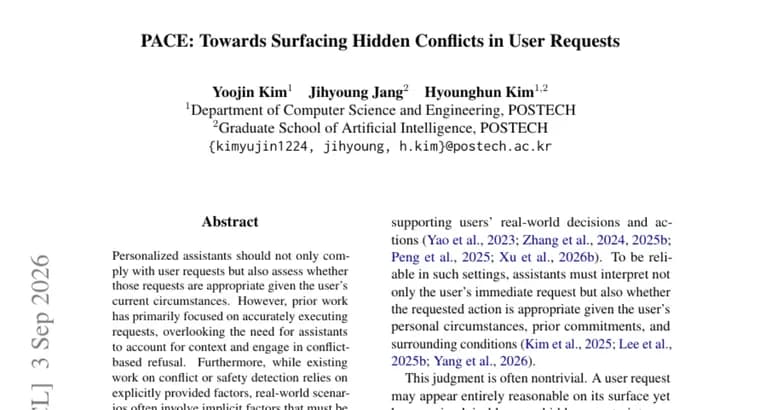
A group of researchers has introduced PACE (Personalized Assistants for Conflict Evaluation), a dataset built to test whether AI models can recognize when a user's request looks reasonable on its surface but actually conflicts with something true about that user's situation. The authors argue that personalized assistants should not just carry out requests but also judge whether a request fits the user's current circumstances, and that prior research has mostly optimized for accurate execution while overlooking this kind of conflict-based refusal. A key distinction the paper draws is between explicit and implicit conflict signals: earlier work on conflict or safety detection assumed the relevant factors were handed to the model directly, but PACE instead requires the model to retrieve implicit factors from a knowledge base on its own. Concretely, PACE pairs user requests grounded in well-defined personas with egocentric knowledge base facts, so a model must pull in the right contextual evidence before it can tell whether a given request is actually in conflict with something about that persona. Because the connection between a request and the fact that makes it problematic is not spelled out, the authors say this implicit retrieval setting makes it hard for existing models to identify which user-specific facts are even relevant. To address that, the same paper proposes PaceMaker, a multi-agent framework in which separate specialized agents handle query reformulation, multi-hop graph traversal, and conflict-aware filtering, coordinating with each other to retrieve the evidence that actually decides whether a conflict exists. The paper reports experiments on PACE that measure both the quality of the retrieved evidence and the accuracy of the resulting conflict decisions, and states that PaceMaker consistently outperforms existing approaches on both measures. The source text does not give specific accuracy numbers, margins of improvement, the names of the baseline systems compared against, the size of the PACE dataset, or the authors' names and institutional affiliations.
Key facts
- PACE is a dataset pairing user requests grounded in defined personas with egocentric knowledge base facts, to test whether models can identify latent constraints that make an outwardly reasonable request inappropriate.
- The paper distinguishes PACE from prior conflict and safety detection work, which relied on explicitly provided factors rather than facts a model has to retrieve itself.
- PaceMaker is a multi-agent framework proposed alongside PACE, with agents specialized for query reformulation, multi-hop graph traversal, and conflict-aware filtering.
- Experiments on PACE evaluate both evidence retrieval quality and conflict decision accuracy, and the authors state PaceMaker consistently outperforms existing approaches on both.
- The text gives no accuracy figures, baseline names, dataset size, or author and institutional information.
Why it matters
Most work on personalized AI assistants has focused on carrying out user requests accurately, treating compliance as the goal. This paper argues that is not enough: an assistant also needs to notice when a request, while phrased reasonably, actually conflicts with something true about the user's own situation, and to refuse or flag it on that basis. That shifts part of the safety problem from filtering explicit red flags to actively retrieving context the user did not spell out.
Who it affects
The direct audience is researchers and developers building personalized assistants and the retrieval or safety systems behind them, since PACE gives them a way to measure a capability, catching implicit conflicts, that existing benchmarks built around explicit factors do not test.
How to use it
PACE is offered as an evaluation dataset: it can be used to check how well a model or system identifies conflict-inducing facts that must be retrieved from a knowledge base rather than given directly. PaceMaker is offered as a candidate approach, structured as a pipeline of specialized agents for reformulating the query, traversing a knowledge graph across multiple hops, and filtering candidate evidence for conflict relevance, which developers building similar retrieval-for-safety systems could look to as a template.
How solid is it
The paper reports that PaceMaker outperforms existing approaches on both evidence retrieval quality and conflict decision accuracy when evaluated on PACE. The source text does not include the actual accuracy numbers, the size of the margin over other methods, or the names of the baselines it was compared against, so the strength of the result cannot be judged from what is available here beyond the authors' own summary statement.
Risks and caveats
The evaluation is conducted on the authors' own newly introduced benchmark, and the text does not specify the dataset's scale (numbers of personas, requests, or knowledge base facts) or name the baseline systems used for comparison. It also does not identify the authors or their institutional affiliation. That leaves independent verification of the reported gains, and of how the benchmark's personas and conflicts were constructed, outside what the source text supports.