Puffin-World fuses physics, geometry and appearance into one 3D model
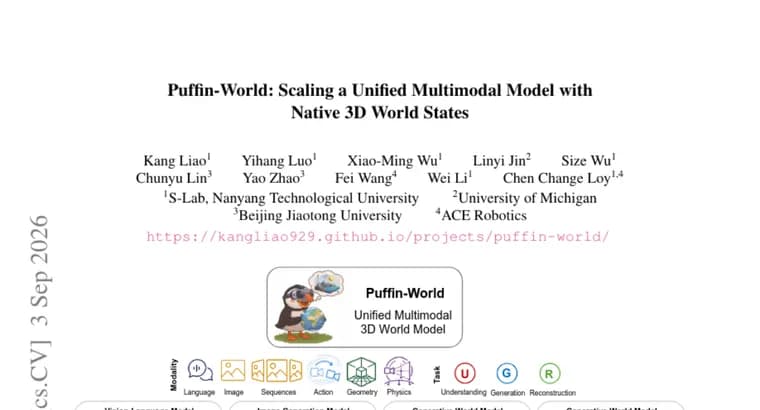
A team behind a new paper proposes Puffin-World, a unified multimodal architecture for building and interacting with 3D worlds that does not rely on any external offline modules. Instead of handling physics, geometry and appearance as separate pipelines, the framework models three native world states together: physics (expressed as a gravity field and latitude), geometry (depth), and appearance (image), tied together with a single Omni-Camera representation that the authors say supports diverse tasks and flexible camera motions.
On top of modeling these states, the authors introduce a strategy for propagating physical dynamics forward across future frames. By grounding absolute camera properties in the real world, they report that Puffin-World produces world generation that is both physically consistent and visually stable over time. The architecture also couples appearance and geometry inside a single generative process, so that each future view is synthesized and its underlying geometry is reconstructed at the same time rather than in separate steps. The authors say this unified design enables interleaved, closed-loop applications that need several of these capabilities working together at once, including tasks they describe as mimicry and self-calibrated world exploration.
To scale the approach to more complex scenarios, the team built a new dataset, Puffin-16M, made up of 15 million vision-language-camera triplets and 1 million motion trajectories covering a variety of challenging movements. The code, trained models and the dataset itself have all been released for further research.
Key facts
- Puffin-World is a single multimodal architecture that jointly models physics, geometry and appearance for 3D world generation and reconstruction, without external offline modules.
- It represents physics as a gravity field and latitude, geometry as depth, and appearance as an image, unified through a single Omni-Camera representation.
- Appearance and geometry are synthesized in one generative process, producing each future view and its underlying geometry together.
- The authors built Puffin-16M, a dataset of 15 million vision-language-camera triplets and 1 million motion trajectories, to scale the model to complex scenarios.
- Code, trained models and the dataset have been released publicly for further research.
Why it matters
Most 3D world generation systems stitch together separate modules for physics simulation, depth estimation and image synthesis. Puffin-World's pitch is to fold all three into one architecture with a shared camera representation, so a system can generate a 3D scene and keep it physically and visually coherent as the viewpoint moves, without bolting on outside tools.
Who it affects
The release is aimed at researchers working on 3D world models, video and scene generation, and embodied-AI or robotics simulation, since those are the kinds of systems that need physics, geometry and appearance to stay consistent together rather than drift apart across separate pipelines.
How to use it
The authors have released the code, the trained models and the Puffin-16M dataset itself, so other researchers can inspect, run or build on the work directly rather than reimplementing it from the paper alone. No pricing, license terms or release timeline are stated.
How solid is it
The claims come from the authors' own description of the architecture and its training data; the abstract does not report benchmark scores, comparisons against prior or competing 3D world models, or evaluation metrics, so how Puffin-World performs against existing approaches is not established here. Model size, training compute, and how the Puffin-16M triplets and trajectories were collected are also not detailed.
Risks and caveats
No author names or institutional affiliations, no release date or license terms, and no named downstream applications beyond the described world-exploration and mimicry tasks appear in the material. Readers should treat the physical-consistency and stability claims as the authors' own characterization pending independent evaluation.