PAD scores driving data per planner, lifting DiffusionDrive EPDMS 3.5 to 5.0 points
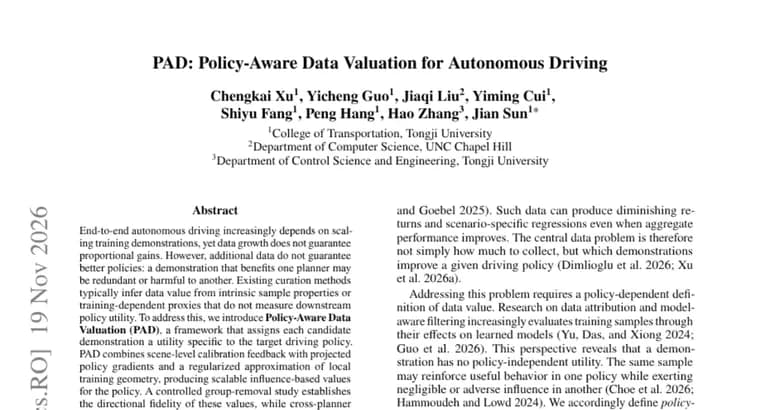
End-to-end autonomous driving leans increasingly on piling up training demonstrations, but the paper argues that more data does not guarantee proportionally better policies. Its central observation is that a demonstration that helps one planner may be redundant or harmful to another. Existing curation methods, the authors say, typically infer a sample's value from its intrinsic properties or from training-dependent proxies, and neither measures how useful the sample is for the downstream driving policy.
The proposed answer is Policy-Aware Data Valuation, or PAD. It is a framework that assigns each candidate demonstration a utility specific to the target driving policy. PAD combines three ingredients: scene-level calibration feedback, projected policy gradients, and a regularized approximation of local training geometry. Together they produce scalable, influence-based values for the policy.
The authors report two kinds of validation. A controlled group-removal study establishes the directional fidelity of the values. A cross-planner analysis shows that the same candidate pool induces markedly different rankings across planner families, which supports the claim that data value depends on the policy.
The headline numbers come from DiffusionDrive. There, PAD improves EPDMS over real-only training by 3.5 points on NavTest and by 5.0 points on NavHard. More broadly, the authors say policy-specific curation consistently outperforms both real-only training and full-pool training across diffusion-, regression-, and flow-matching-based planners, while substantially reducing scene-level regressions.
The authors conclude that these results establish policy-aware data valuation as a basis for replacing indiscriminate data accumulation with targeted policy improvement, enabling more efficient and reliable scaling of autonomous-driving systems.
Key facts
- PAD (Policy-Aware Data Valuation) assigns each candidate driving demonstration a utility specific to the target driving policy.
- The method combines scene-level calibration feedback, projected policy gradients and a regularized approximation of local training geometry to produce influence-based values.
- On DiffusionDrive, PAD improves EPDMS over real-only training by 3.5 points on NavTest and 5.0 points on NavHard.
- The same candidate pool produces markedly different rankings across planner families, according to the cross-planner analysis.
- The authors say policy-specific curation outperforms real-only and full-pool training across diffusion-, regression- and flow-matching-based planners and substantially reduces scene-level regressions.
Why it matters
Scaling up demonstrations is a standard route to better end-to-end driving systems, and this paper challenges the assumption that more data always helps. Its core claim is that a demonstration useful to one planner may be redundant or harmful to another, so value has to be measured against the policy being trained. If that holds, curating a pool for a specific planner could replace indiscriminate accumulation, which the authors frame as a path to more efficient and reliable scaling.
Who it affects
Teams that train end-to-end driving planners and decide which demonstrations to add to their training sets are the direct audience. The paper tests diffusion-, regression- and flow-matching-based planner families, so its claims are aimed at a range of planner designs rather than a single architecture.
How to use it
PAD is a data valuation framework: it scores each candidate demonstration for a target policy, and those scores guide which demonstrations to keep. The paper compares the resulting policy-specific curation with real-only training and with training on the full candidate pool. No code or data release is mentioned.
How solid is it
The evidence is the authors' own reported results, summarized in an abstract. Two checks support the method: a controlled group-removal study that the authors say establishes the directional fidelity of the values, and a cross-planner analysis showing different rankings for different planner families. The quantified gains are for DiffusionDrive: 3.5 points on NavTest and 5.0 points on NavHard, as absolute EPDMS improvements over real-only training. No absolute EPDMS scores or baseline values are given, only the point improvements. The abstract does not say whether the paper is peer-reviewed.
Risks and caveats
The 3.5 and 5.0 point gains are reported for DiffusionDrive only; no numeric gains are given for the regression- or flow-matching-based planners. The size of the reduction in scene-level regressions is not quantified. No dataset sizes, compute cost or training time figures are given, so the cost of computing the values is unclear from the source. The broad conclusion about replacing data accumulation is the authors' own interpretation of their results.