Paper finds agent self-evolution gains are uneven, proposes EvoAudit
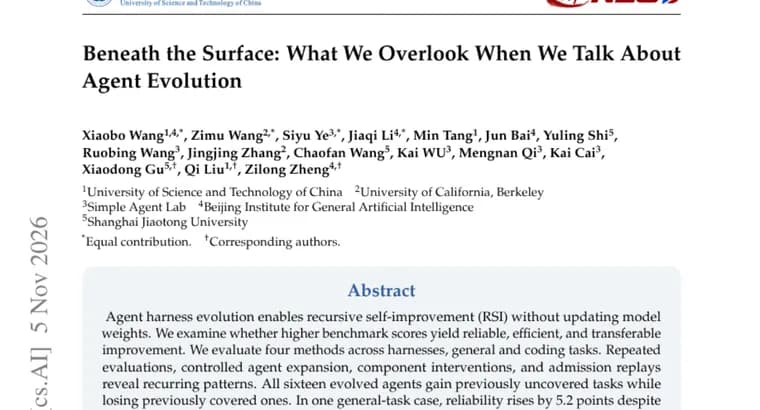
Agent harness evolution is a way for an agent to improve itself recursively without updating the model's weights. A new paper listed on Hugging Face asks whether the higher benchmark scores such methods produce actually amount to improvement that is reliable, efficient and transferable.
The authors evaluate four methods across harnesses, on general and coding tasks. To find patterns they use repeated evaluations, controlled agent expansion, component interventions and admission replays.
The central finding is that a better score hides trade-offs. All sixteen evolved agents gain previously uncovered tasks while losing previously covered ones. In one general-task case, reliability rises by 5.2 points, yet the agent loses ten previously covered tasks. Most reliability gains also increase deployment cost.
Other patterns: specific changes usually outperform generic reminders, but their benefits can change when they are combined. The highest-scoring agent does not yield the largest mean improvement in any of the four pools, and stricter admission can discard useful alternatives.
Transfer is selective. Coverage usually falls on the general-task target across both harness types and paradigms, but it rises on the coding target with the outer-layer-only harness.
The authors say these findings motivate preservation-aware evaluation, tested decision rules and explicit applicability conditions. As a constructive follow-up, they present EvoAudit, which turns the diagnostics into revisions of four steps: select, analyze, mutate and gate. They report that it achieves the best performance.
Key facts
- The paper studies agent harness evolution, which improves an agent recursively without updating model weights, and asks whether higher benchmark scores bring reliable, efficient and transferable gains.
- All sixteen evolved agents gain previously uncovered tasks while losing previously covered ones; in one general-task case reliability rises by 5.2 points despite ten lost tasks.
- The highest-scoring agent does not yield the largest mean improvement in any of the four pools, and most reliability gains also raise deployment cost.
- Transfer is selective: coverage usually falls on the general-task target but rises on the coding target with the outer-layer-only harness.
- EvoAudit revises the select, analyze, mutate and gate steps and, per the authors, achieves the best performance.
Why it matters
Self-improving agents are usually judged by a rising benchmark score. This paper argues that a single score hides what happens underneath: every one of the sixteen evolved agents picked up tasks it could not do before and dropped tasks it used to handle. If the finding holds, a leaderboard number alone is a poor guide to whether an evolved agent is really better. The authors frame this as a case for preservation-aware evaluation, meaning evaluation that tracks what an agent keeps as well as what it gains.
Who it affects
People building or evaluating agents that rewrite their own harness, the scaffolding around a model, rather than retraining the model. It also concerns anyone who picks an evolved agent by its top score, since the paper reports that the highest-scoring agent did not give the largest mean improvement in any of its four pools.
How to use it
The paper offers directions rather than a recipe. Its authors call for preservation-aware evaluation, tested decision rules and explicit applicability conditions. EvoAudit is their proposed follow-up: it revises the select, analyze, mutate and gate steps of the evolution loop. Their practical observations: specific changes usually beat generic reminders, but combining them can change the benefit, and a stricter admission rule can throw away useful alternatives.
How solid is it
The material here is the paper's abstract as listed on Hugging Face, so every claim is the authors' own. They say the patterns recur across repeated evaluations, controlled agent expansion, component interventions and admission replays. The claim that EvoAudit achieves the best performance is also theirs. The abstract does not define 'reliability', 'coverage', 'admission' or 'outer-layer-only harness'. No numbers are given for the size of the cost increase, or for EvoAudit's margin over the other methods.
Risks and caveats
The names of the four methods, the benchmarks and the models are not given. The source does not say which general-task case the 5.2-point reliability rise refers to, nor its baseline reliability. No authors or institutions are named, so the work cannot be placed from this text. The results come from four methods and four pools, and the abstract itself says that transfer differs by target: coverage usually falls on the general-task target but rises on the coding one. Treat the conclusions as scoped to that setup.