Paper: multi-turn agentic RL gains shrink when turn budgets tighten
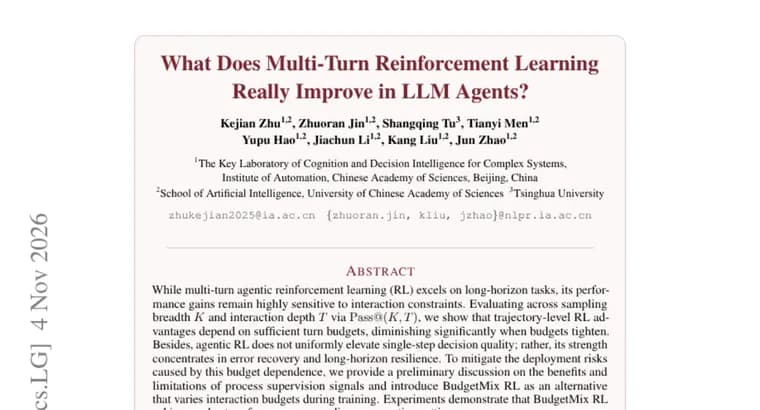
A paper listed on Hugging Face Papers asks what multi-turn agentic reinforcement learning (RL) actually improves in LLM agents. Its starting point is that this kind of RL does well on long-horizon tasks, but its performance gains remain highly sensitive to interaction constraints.
To test this, the authors evaluate across two axes: sampling breadth K and interaction depth T, scored with a metric called Pass@(K,T). Their first finding is that the advantages of trajectory-level RL depend on sufficient turn budgets. When the budget of turns tightens, those advantages diminish significantly.
The second finding concerns where the gains come from. Agentic RL does not uniformly elevate single-step decision quality. Instead, its strength concentrates in error recovery and long-horizon resilience. In other words, a trained agent is not simply better at every individual step; it is better at recovering from mistakes and sustaining performance over many turns.
Because real deployments often limit how many turns an agent may take, the authors treat this budget dependence as a deployment risk. To mitigate it, they offer a preliminary discussion of the benefits and limitations of process supervision signals, and they introduce BudgetMix RL as an alternative. BudgetMix RL varies the interaction budget during training. According to the authors, experiments demonstrate that it achieves robust performance across diverse execution settings. A project page is at https://rethinking-agentic-rl.github.io/.
Key facts
- The paper reports that multi-turn agentic RL excels on long-horizon tasks, but its gains are highly sensitive to interaction constraints.
- Evaluation spans sampling breadth K and interaction depth T using the Pass@(K,T) metric.
- Trajectory-level RL advantages depend on sufficient turn budgets and diminish significantly when budgets tighten.
- Agentic RL does not uniformly improve single-step decision quality; its strength concentrates in error recovery and long-horizon resilience.
- BudgetMix RL, which varies interaction budgets during training, is proposed to reduce this budget dependence and is said to perform robustly across diverse execution settings.
Why it matters
Multi-turn RL is a common way to train LLM agents for long tasks. This paper questions what that training really buys. Its answer is that the gain is not a general lift in step-by-step decisions but a stronger ability to recover from errors and stay on track over a long horizon, and that this gain fades when the agent has fewer turns to work with.
Who it affects
Teams that train or deploy LLM agents with reinforcement learning, especially where the number of interaction turns is capped at run time. Researchers who compare agentic RL methods may also care about the Pass@(K,T) framing, which reports results over both sampling breadth and interaction depth.
How to use it
The abstract gives no explicit advice, but two practical takeaways follow from its findings, as this summary's own inference. First, evaluate an agent at several turn budgets rather than one, since the benefit of RL may look different when budgets tighten. Second, consider BudgetMix RL, which varies interaction budgets during training, as an alternative to training at a single budget. The authors point to a project page at https://rethinking-agentic-rl.github.io/.
How solid is it
This is a preprint summarized from its abstract. The authors say experiments demonstrate robust performance for BudgetMix RL across diverse execution settings. The abstract gives no numerical results, benchmark names, model names, baselines or size of the improvement, so the strength of the claims cannot be judged from it alone. The process supervision discussion is described by the authors as preliminary.
Risks and caveats
The authors frame budget dependence as a deployment risk: an agent trained under generous turn budgets may lose much of its advantage when budgets are tight. BudgetMix RL is their proposed remedy, but its claimed robustness rests on experiments whose details are not given in the abstract. The treatment of process supervision signals is explicitly only a preliminary discussion of benefits and limitations.
“agentic RL does not uniformly elevate single-step decision quality; rather, its strength concentrates in error recovery and long-horizon resilience”
— From the paper's abstract, Hugging Face Papers