Paper proposes on-policy self-training that lets LLMs improve with no human data
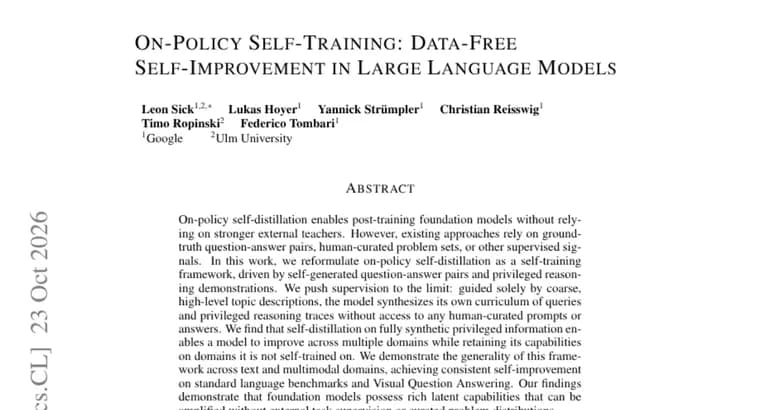
A paper listed on Hugging Face Papers, titled "On-Policy Self-Training: Data-Free Self-Improvement in Large Language Models", proposes a way to improve a foundation model without any human-curated training data.
The starting point is on-policy self-distillation, which the authors say already allows post-training of foundation models without relying on stronger external teachers. Their complaint is that existing approaches of this kind still depend on ground-truth question-answer pairs, human-curated problem sets, or other supervised signals.
The paper reformulates on-policy self-distillation as a self-training framework driven by self-generated question-answer pairs and privileged reasoning demonstrations. The authors describe this as pushing supervision to the limit. The only human input is a set of coarse, high-level topic descriptions. From those alone, the model synthesizes its own curriculum of queries and privileged reasoning traces, with no access to any human-curated prompts or answers.
The authors report two main findings. First, self-distillation on fully synthetic privileged information lets a model improve across multiple domains while retaining its capabilities on domains it was not self-trained on. Second, the framework generalizes across text and multimodal domains, with what they call consistent self-improvement on standard language benchmarks and on Visual Question Answering.
Their conclusion is that foundation models possess rich latent capabilities that can be amplified without external task supervision or curated problem distributions.
The source is the paper's abstract. It names no benchmarks, scores or improvement sizes, and gives no model names or sizes.
Key facts
- The paper reformulates on-policy self-distillation as a self-training framework driven by self-generated question-answer pairs and privileged reasoning demonstrations.
- The only guidance is coarse, high-level topic descriptions; the model builds its own curriculum of queries and reasoning traces with no human-curated prompts or answers.
- The authors report improvement across multiple domains while retaining capabilities on domains the model was not self-trained on.
- The framework is shown on text and multimodal domains, with consistent self-improvement on standard language benchmarks and Visual Question Answering.
- The authors conclude that foundation models have rich latent capabilities that can be amplified without external task supervision or curated problem distributions.
Why it matters
Post-training usually needs question-answer pairs, curated problem sets or other supervised signals, even when the method avoids a stronger teacher model. This paper tests how far that dependence can be reduced: the only human input is coarse topic descriptions. If the authors' claim holds, the cost of collecting and curating training data drops sharply for improving a model on a topic. Their own framing is that models hold latent capabilities that self-generated supervision can amplify.
Who it affects
The work is aimed at people who post-train foundation models, particularly where human-curated data or a stronger external teacher is unavailable or costly. The abstract also covers multimodal models, through Visual Question Answering, so it is relevant to vision-language work as well as text-only models.
How to use it
The abstract describes the idea but not a recipe. In outline: supply coarse topic descriptions, have the model generate its own questions, answers and privileged reasoning traces, and distill from them on-policy. No code, dataset or model release is mentioned, so anyone wanting to try it would need the full paper for details.
How solid is it
This is a preprint listed on Hugging Face Papers, and the account here rests on its abstract. The claims are the authors' own. The abstract states only "consistent self-improvement" on standard language benchmarks and Visual Question Answering. It gives no benchmark names, scores, improvement magnitudes, model names or sizes, and it quotes no comparison against baselines or against supervised or teacher-based methods. The size and reliability of the gains cannot be judged from it.
Risks and caveats
The abstract describes no limitations or failure cases. The number of domains and the topics used are not specified, so how broadly the retention of untrained domains holds is unclear. The conclusion about latent capabilities is the authors' interpretation, and the abstract alone gives no way to check it. Results on specific models and benchmarks need to be read in the full paper before relying on them.