Paper uses sparse autoencoders to make AI-text detectors auditable
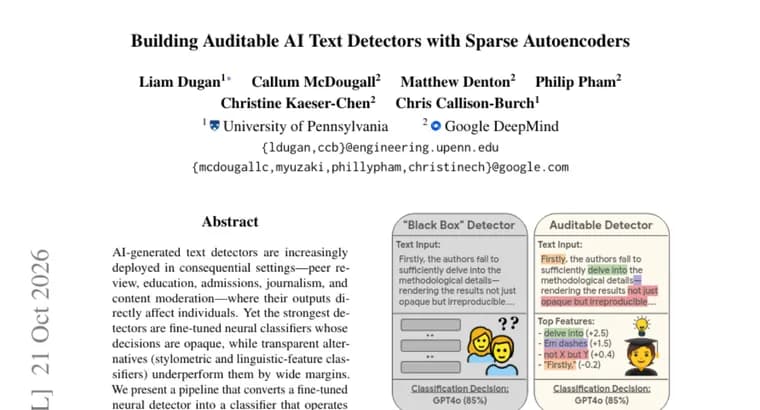
AI-text detectors are now used in settings where their verdicts directly affect people: peer review, education, admissions, journalism and content moderation. The paper starts from a trade-off the authors describe. The strongest detectors are fine-tuned neural classifiers whose decisions are opaque. Transparent alternatives, such as stylometric and linguistic-feature classifiers, underperform them by wide margins.
The authors present a pipeline meant to remove that trade-off by converting a fine-tuned neural detector into a classifier that operates on human-readable concepts. It has four steps. First, they train sparse autoencoders (SAEs) directly on the detector's residual stream. Second, they assign auto-interpretation labels to each SAE feature, that is, generated text descriptions of what the feature represents. Third, they keep only the features whose generated descriptions pass a global fidelity threshold. Fourth, they train a lightweight classifier on just those interpretable features.
The authors report two findings. Their SAEs recover latent concepts that correspond to highly specific and predictive linguistic "tells" of AI-generated text. And the classifiers built on these extracted features are not only highly interpretable but perform better on out-of-distribution texts than either neural or stylometric alternatives.
The source is the paper's abstract only. It gives no numeric results, and it does not name the detector, the datasets or the specific tells that were found.
Key facts
- The pipeline trains sparse autoencoders on the residual stream of a fine-tuned neural AI-text detector.
- Each SAE feature gets an auto-interpretation label, and only features whose descriptions pass a global fidelity threshold are kept.
- A lightweight classifier is trained on just those interpretable features, so its decisions rest on human-readable concepts.
- The authors report that the SAEs recover specific, predictive linguistic "tells" of AI-generated text.
- They also report stronger out-of-distribution performance than both neural and stylometric alternatives.
Why it matters
Detectors of AI-written text are used in peer review, education, admissions, journalism and content moderation, where a verdict can directly affect a person. The paper's starting point is that the most accurate detectors are opaque, while the transparent ones are far weaker. A method that keeps the detector's strength but exposes the concepts behind a decision would speak to that gap. Whether it does is for the paper's full results to show.
Who it affects
The abstract says detector outputs directly affect individuals but names no groups of people. Judging by the settings it lists, those on the receiving end would be reviewers, students and applicants, writers and editors, and moderated users. Detectors also affect the institutions that deploy detectors and need to justify decisions. Researchers working on interpretability and on AI-text detection are the direct audience for the method.
How to use it
The abstract describes a recipe rather than a product. Train SAEs on a detector's residual stream, label each feature automatically, filter by a global fidelity threshold, then fit a lightweight classifier on the surviving features. The abstract does not mention released code or a deployment.
How solid is it
This is a preprint listed on Hugging Face Papers, and the retelling rests on its abstract. The claims about interpretability and out-of-distribution performance are the authors' own. No numeric results are given in the text available here, so the size of the improvement over neural and stylometric baselines cannot be judged from it.
Risks and caveats
The abstract does not say whether the interpretable classifier matches the original neural detector on in-distribution texts. It does not say how the auto-interpretation labels are generated or how fidelity is measured, and it does not name the datasets or out-of-distribution test sets. The specific linguistic tells are not listed. Treat the out-of-distribution advantage as a reported result until the full paper's evidence is checked.
“Classifiers built on these extracted features are not only highly interpretable but exhibit stronger performance on out-of-distribution texts than either neural or stylometric alternatives.”
— From the paper's abstract