Paper tests rewriting past reasoning into compact records to cut future tokens
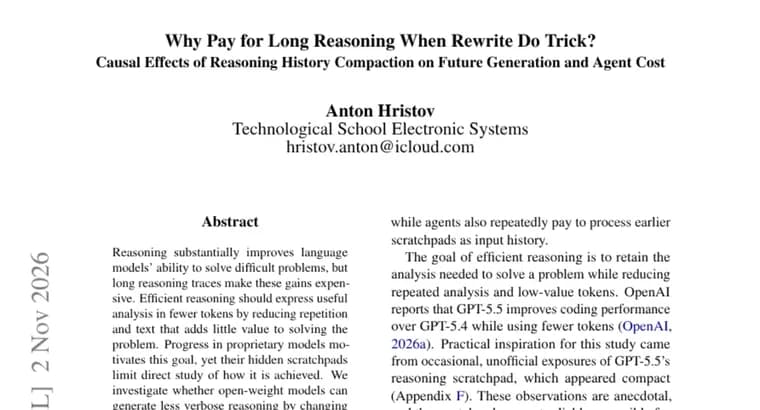
A preprint listed on Hugging Face Papers looks at a cost problem in reasoning models. Long reasoning traces make the gains from reasoning expensive, and efficient reasoning should say the same useful analysis in fewer tokens by cutting repetition and text that adds little to solving the problem. The authors note that proprietary models have made progress here, but their hidden scratchpads limit direct study of how that efficiency is achieved.
So the authors turn to open-weight models and ask whether they can produce less verbose reasoning by changing the form of their own earlier thoughts, without any retraining. The intervention rewrites prior reasoning into compact state records before pending tool results are revealed. The authors then compare continuations generated from the original history with continuations generated from the compact one.
The reported results are qualitative. Across the tested models, accepted compact histories usually shorten future reasoning. A coding case study also shows less repeated verification after a shared candidate solution. In software-agent deployments, compaction can reduce total spending, although task quality and rewrite-inclusive time depend on the target and compressor.
The authors conclude that reasoning history is one way to reduce future reasoning-token use. They say the findings motivate model-specific compaction policies that are evaluated for both efficiency and retained capability.
Key facts
- The method rewrites a model's earlier reasoning into compact state records before pending tool results are revealed, with no retraining.
- Continuations from the original and the compact history are compared directly.
- Across the tested models, accepted compact histories usually shorten future reasoning.
- A coding case study shows less repeated verification after a shared candidate solution.
- In software-agent deployments compaction can reduce total spending, but task quality and rewrite-inclusive time depend on the target and compressor.
Why it matters
Reasoning improves how well models solve hard problems, but long traces make that expensive. This work targets the cost from a different angle than retraining: it changes how a model's earlier thoughts are written down and checks whether later reasoning gets shorter. It also works on open-weight models, which the authors say allows the kind of direct study that hidden scratchpads in proprietary models limit.
Who it affects
The setting is open-weight models and software-agent deployments, so teams running such agents and paying for reasoning tokens are the natural audience. The abstract does not name the models, compressors or agent systems tested.
How to use it
The abstract describes the idea, not a recipe: rewrite prior reasoning into compact state records before pending tool results arrive, then continue from the compact history. The authors point toward model-specific compaction policies judged on both efficiency and retained capability, rather than one policy for every model.
How solid is it
The claims come from the paper's abstract as listed on Hugging Face Papers. The findings are stated qualitatively: accepted compact histories usually shorten future reasoning, and compaction can reduce total spending. No numerical results are given, such as token reductions, dollar savings or accuracy figures. The abstract does not define what makes a compact history accepted.
Risks and caveats
The savings are not guaranteed. Compaction can reduce total spending, but task quality and rewrite-inclusive time depend on the target model and the compressor. The abstract does not say quality is preserved, and shorter reasoning is only the usual outcome, not the universal one. The authors themselves call for evaluating compaction policies for retained capability as well as efficiency.
“In software-agent deployments, compaction can reduce total spending, although task quality and rewrite-inclusive time depend on the target and compressor.”
— Paper abstract, Hugging Face Papers