Parallel Power Tempering samples stronger reasoning from base LLMs without RL
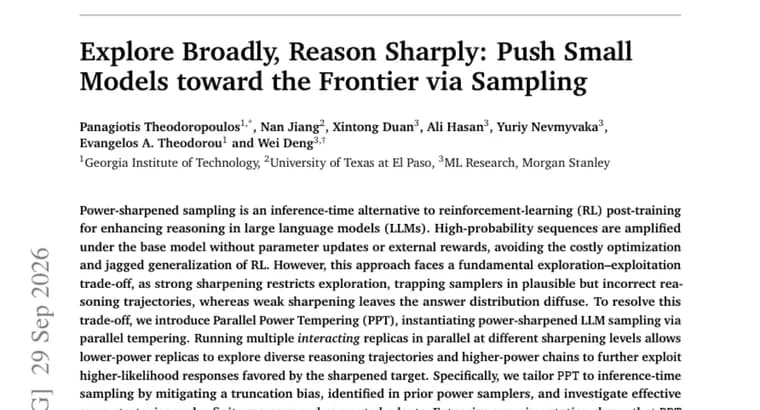
The paper starts from power-sharpened sampling, an inference-time alternative to reinforcement-learning (RL) post-training for improving reasoning in large language models. The idea is to amplify high-probability sequences under the base model, with no parameter updates and no external rewards. The authors say this avoids the costly optimization and jagged generalization of RL.\n\nThe approach has a built-in exploration-exploitation trade-off. Strong sharpening restricts exploration and traps samplers in plausible but incorrect reasoning trajectories. Weak sharpening leaves the answer distribution diffuse.\n\nTo resolve this, the authors introduce Parallel Power Tempering (PPT), which instantiates power-sharpened LLM sampling via parallel tempering. Multiple interacting replicas run in parallel at different sharpening levels. Lower-power replicas explore diverse reasoning trajectories, while higher-power chains further exploit the higher-likelihood responses favored by the sharpened target.\n\nThe authors say they tailor the method to inference-time sampling in two ways. They mitigate a truncation bias that they identify in prior power samplers, and they investigate effective swap strategies under finite memory and compute budgets.\n\nOn results, the abstract says extensive experimentation shows PPT substantially improves single-chain power-sharpened sampling and outperforms RL-post-trained models. It also reports higher-quality reasoning traces and performance comparable to frontier models. The abstract gives no benchmark names or figures.
Key facts
- Parallel Power Tempering (PPT) applies parallel tempering to power-sharpened LLM sampling, an inference-time alternative to RL post-training.
- Replicas run in parallel at different sharpening levels: lower-power ones explore diverse reasoning trajectories, higher-power ones exploit higher-likelihood responses.
- The method mitigates a truncation bias the authors identify in prior power samplers and studies swap strategies under finite memory and compute budgets.
- The authors report that PPT substantially improves single-chain power-sharpened sampling and outperforms RL-post-trained models.
- They also claim higher-quality reasoning traces and performance comparable to frontier models; no numbers are given in the abstract.
Why it matters
RL post-training is the usual route to better reasoning, and the authors describe it as costly to optimize and prone to jagged generalization. Power-sharpened sampling skips it: it works at inference time on the base model, with no parameter updates and no external rewards. Its weak point is the trade-off between exploring and exploiting. PPT is presented as a way to get both by running replicas at different sharpening levels, and the authors report results that beat RL-post-trained models and approach frontier models.
Who it affects
Researchers working on LLM reasoning and inference-time methods are the direct audience, particularly those weighing sampling-based approaches against RL post-training. Teams that cannot or do not want to run RL optimization on a base model may find the framing relevant. The abstract does not say which base models or model sizes were used.
How to use it
The abstract describes a sampling procedure, not a product. The practical shape is: run several replicas of the base model at different sharpening levels, let them interact, and use swap strategies that fit a finite memory and compute budget. No code release or availability is mentioned.
How solid is it
This rests on the abstract alone, and every claim is the authors' own. The abstract says extensive experimentation supports the results but names no benchmarks, scores or accuracy figures. It does not say which base models or model sizes were used, nor which RL-post-trained models or frontier models were compared. The abstract names no authors or institutions. Treat the headline claims, beating RL-post-trained models and matching frontier models, as unverified until the full paper's tables are checked.
Risks and caveats
No compute cost, latency or number of replicas is stated, so the inference-time overhead relative to RL or single-chain sampling is unknown. The abstract itself says strong sharpening can trap samplers in plausible but incorrect reasoning trajectories, which is the failure PPT is meant to reduce rather than a problem the abstract claims to remove entirely. The phrase "comparable to frontier models" is vague without named models or numbers.
“Running multiple interacting replicas in parallel at different sharpening levels allows lower-power replicas to explore diverse reasoning trajectories and higher-power chains to further exploit higher-likelihood responses favored by the sharpened target.”
— Paper abstract, Hugging Face Papers