Parallel Tube Decoding cuts video-grounding latency 79x
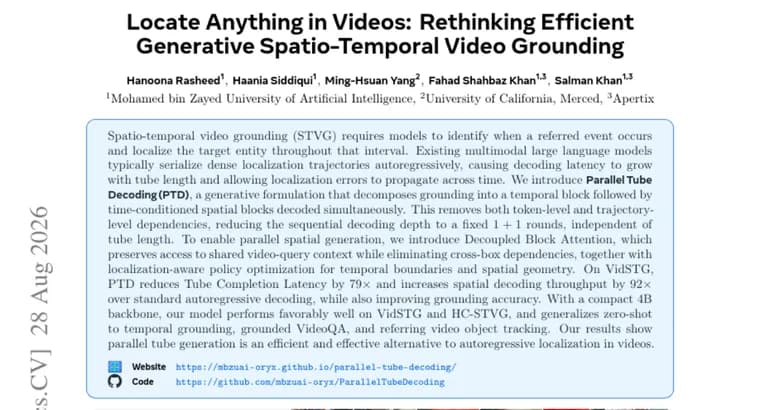
Researchers introduce Parallel Tube Decoding (PTD), a new approach to spatio-temporal video grounding (STVG), the task of identifying when a referred event happens in a video and tracking the target entity's location throughout that time window. Existing multimodal large language models handle this by serializing dense localization trajectories autoregressively, generating one step after another. That approach has two problems: decoding latency grows as the tracked interval (the tube) gets longer, and localization errors made early on propagate forward through the rest of the sequence. PTD restructures the process into two stages: a temporal block that identifies the event's time window, followed by time-conditioned spatial blocks that are decoded all at once rather than one after another. A new mechanism called Decoupled Block Attention makes the simultaneous spatial decoding possible: it keeps each spatial block's access to the shared video and query context while removing the dependencies between individual bounding boxes that previously forced sequential generation. The model is also trained with localization-aware policy optimization, which targets both the temporal boundaries and the spatial geometry directly. Together these changes cut the sequential decoding depth to a fixed 1 + 1 rounds, no longer growing with the length of the tracked interval. On the VidSTG benchmark, PTD reduces Tube Completion Latency by 79x and increases spatial decoding throughput by 92x compared with standard autoregressive decoding, while also improving grounding accuracy, though no absolute accuracy figures are given. Built on a compact 4B-parameter backbone, the model performs favorably on both VidSTG and HC-STVG, and the same architecture generalizes zero-shot to three related tasks it was not specifically trained for: temporal grounding, grounded video question answering, and referring video object tracking.
Key facts
- Parallel Tube Decoding (PTD) replaces autoregressive, step-by-step video grounding with a temporal block followed by simultaneously decoded spatial blocks.
- On VidSTG, PTD cuts Tube Completion Latency by 79x and raises spatial decoding throughput by 92x versus standard autoregressive decoding.
- Decoupled Block Attention removes cross-box dependencies while keeping access to shared video-query context, enabling the parallel spatial decoding.
- Sequential decoding depth is fixed at 1 + 1 rounds regardless of how long the tracked interval (tube) is.
- With a 4B-parameter backbone, the model generalizes zero-shot to temporal grounding, grounded video QA, and referring video object tracking.
Why it matters
Spatio-temporal video grounding asks a model to pinpoint when a described event occurs in a video and to keep tracking the target's location for the whole duration. The standard approach generates that trajectory autoregressively, one piece at a time, so latency scales with how long the event lasts and any early localization mistake carries forward through the rest of the output. PTD breaks that dependency by splitting the job into a single temporal block plus spatial blocks that are all decoded at once, which is why the sequential depth stays fixed at 1 + 1 rounds no matter how long the tube is.
Who it affects
The work targets builders of video-language systems that need to locate objects or events in video over time, such as video question answering, video object tracking, and other multimodal grounding pipelines, where per-frame or per-step autoregressive decoding has been a throughput bottleneck.
How to use it
PTD is implemented on a compact 4B-parameter backbone and evaluated on the VidSTG and HC-STVG benchmarks. The same model, without task-specific retraining, generalizes zero-shot to temporal grounding, grounded video question answering, and referring video object tracking. The source does not mention a release date or code availability.
How solid is it
The headline results are relative: on VidSTG, PTD delivers a 79x reduction in Tube Completion Latency and a 92x increase in spatial decoding throughput compared with standard autoregressive decoding, alongside an improvement in grounding accuracy. The source states the model 'performs favorably well' on VidSTG and HC-STVG but does not give absolute accuracy numbers for either benchmark, and it does not define what baseline latency the 79x/92x ratios are measured against beyond 'standard autoregressive decoding.'
Risks and caveats
The accuracy improvement PTD claims over autoregressive decoding is stated qualitatively, with no absolute or percentage figure attached, and the zero-shot generalization to the three additional tasks is likewise described without supporting numbers. No information is given about code release, dataset access, or authorship and institutional affiliation.