PDRVLA robot model predicts physical dynamics without generating video
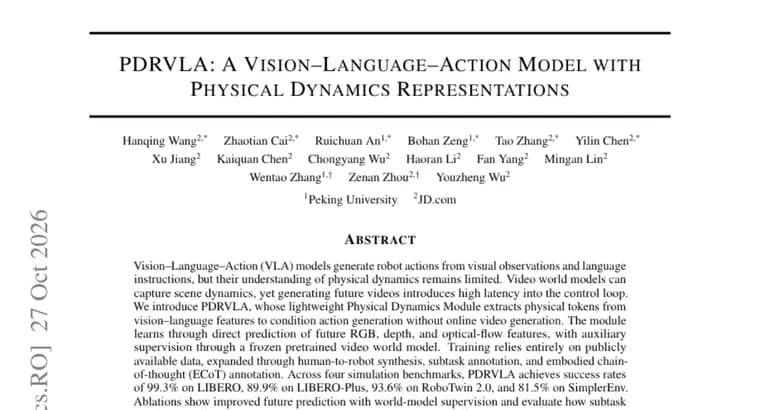
Vision-Language-Action (VLA) models turn visual observations and language instructions into robot actions. The authors of this paper say their understanding of physical dynamics remains limited. Video world models can capture how a scene changes, but generating future videos adds high latency to the control loop.
The paper introduces PDRVLA, which tackles this with a lightweight Physical Dynamics Module. The module extracts physical tokens from the vision-language features and uses them to condition action generation, so no video has to be generated online while the robot acts.
The module learns by directly predicting future RGB, depth and optical-flow features. It also gets auxiliary supervision from a frozen, pretrained video world model. Training relies entirely on publicly available data, expanded through three steps: human-to-robot synthesis, subtask annotation and embodied chain-of-thought (ECoT) annotation.
Across four simulation benchmarks, PDRVLA reaches success rates of 99.3% on LIBERO, 89.9% on LIBERO-Plus, 93.6% on RoboTwin 2.0 and 81.5% on SimplerEnv. Ablations show improved future prediction with world-model supervision. They also evaluate how subtask conditioning, future object-pose supervision and ECoT training affect action success.
Key facts
- PDRVLA is a Vision-Language-Action model with a lightweight Physical Dynamics Module that extracts physical tokens from vision-language features.
- The tokens condition action generation without online video generation, which the authors say avoids the latency of generating future videos in the control loop.
- The module learns by predicting future RGB, depth and optical-flow features, with auxiliary supervision from a frozen pretrained video world model.
- Reported success rates on four simulation benchmarks: 99.3% on LIBERO, 89.9% on LIBERO-Plus, 93.6% on RoboTwin 2.0, 81.5% on SimplerEnv.
- Training uses only publicly available data, expanded by human-to-robot synthesis, subtask annotation and ECoT annotation.
Why it matters
Robot policies built on VLA models struggle with physical dynamics, and the obvious fix, a video world model that imagines the future, slows down the control loop because it must generate video. PDRVLA tries a middle route: learn to predict future RGB, depth and optical-flow features during training, then give the policy compact physical tokens at run time instead of generated video. If the approach holds up, it offers a way to add dynamics awareness without paying the latency cost that the authors describe.
Who it affects
Robotics researchers working on VLA models and on world-model-based control are the direct audience, especially anyone weighing video generation against lighter alternatives. Teams that train on public data may also care, since the paper says training relies entirely on publicly available data.
How to use it
This is a research paper, and the abstract names no code or weights release, so there is nothing to download from it. The practical takeaways are the design ideas: a small module that predicts future RGB, depth and optical-flow features, auxiliary supervision from a frozen pretrained video world model, and data expansion through human-to-robot synthesis, subtask annotation and ECoT annotation. The ablations on subtask conditioning, future object-pose supervision and ECoT training indicate which parts the authors tested.
How solid is it
The success rates are the authors' own figures on four simulation benchmarks: 99.3% on LIBERO, 89.9% on LIBERO-Plus, 93.6% on RoboTwin 2.0 and 81.5% on SimplerEnv. No comparison with baseline or competing models is given, so no improvement margin can be stated. The ablations are said to show improved future prediction with world-model supervision; the abstract does not say how much the ablations improved action success. This account rests on the abstract alone.
Risks and caveats
No results on real robots are mentioned; all reported numbers are from simulation benchmarks. No latency figures or inference speed numbers are given, so the claimed speed advantage over video generation is not quantified here. No authors, institutions, model size or code/weights release are named in the abstract. Benchmark success rates in simulation may not carry over to physical robots.