Platonic Representation Hypothesis holds for newer models if captions are clean, paper finds
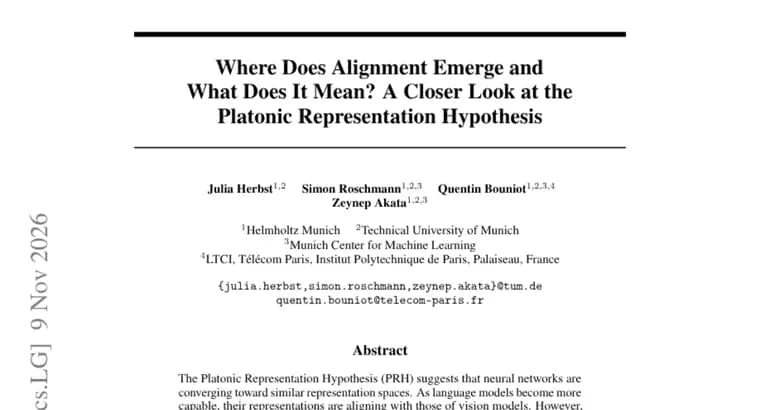
The Platonic Representation Hypothesis (PRH) suggests that neural networks are converging toward similar representation spaces. An earlier finding behind it is that as language models become more capable, their representations align more closely with those of vision models. Recent work has questioned whether that trend continues to hold for newer language models. Separately, it has been shown that representation similarity metrics can be confounded by model depth and width, so interpreting them requires appropriate baselines.
This paper, described in an abstract on Hugging Face Papers, takes a closer look in three steps. First, the authors investigate where alignment emerges between unimodal models, across model layers and across representation dimensions. Second, they find that the PRH capability-alignment trend persists for newer models, but only as long as the captions are sufficiently clean and informative. That makes the result conditional on caption quality. Third, they put cross-modal alignment in context by introducing unimodal and multimodal baselines on various datasets.
The headline result of the baselines: the cross-modal representational alignment of unimodal models can surpass that of explicitly aligned vision-language models, but it remains substantially behind the alignment observed for models of the same modality. In other words, models trained separately on text and on images can line up with each other better than some models trained to be aligned, yet neither comes close to the alignment seen between two models of the same modality.
The code is available at https://github.com/ExplainableML/prh-closer-look.
Key facts
- The paper re-examines the Platonic Representation Hypothesis, the idea that neural networks are converging toward similar representation spaces.
- It studies where alignment emerges between unimodal models across model layers and representation dimensions.
- The capability-alignment trend persists for newer models only as long as captions are sufficiently clean and informative.
- Cross-modal alignment of unimodal models can surpass that of explicitly aligned vision-language models, but stays substantially behind same-modality alignment.
- The authors introduce unimodal and multimodal baselines on various datasets, and code is released on GitHub.
Why it matters
The PRH is a popular claim about how different networks end up representing the world in similar ways. Its support rested on the observation that more capable language models align more closely with vision models. Recent work questioned whether that holds for newer language models, and similarity metrics are known to be confounded by model depth and width. This paper addresses both worries: it says the trend does persist for newer models, but with a condition on caption quality, and it adds baselines so that alignment numbers can be read in context.
Who it affects
Mainly researchers who study representation similarity and cross-modal alignment, and anyone who builds or evaluates alignment measurements between language and vision models. The caption-quality condition is relevant to anyone who pairs images with text to measure alignment.
How to use it
The code is public at https://github.com/ExplainableML/prh-closer-look, so the layer-wise and dimension-wise analyses and the baselines can be inspected and reused. A practical reading for experiments: report alignment against same-modality and cross-modal baselines, and check caption quality before drawing conclusions about the trend.
How solid is it
The only material available is the paper's abstract, so the claims below are the authors' own summary. The abstract gives no numerical results, alignment scores, or effect sizes. It does not name the specific models, datasets, or alignment metrics used. It does not say what counts as 'sufficiently clean and informative' captions or how caption quality was measured. No authors or institutions are named in the abstract. Code release allows others to check the work.
Risks and caveats
'Can surpass' is a possibility, not a general result: the abstract does not say how often or by how much unimodal models beat vision-language models. It does not say which layers or dimensions alignment emerges in; it only says the paper investigates this. The abstract does not claim that the PRH is confirmed or refuted overall. The persistence of the trend is conditional on caption quality, so it should not be read as holding for any data.
“the cross-modal representational alignment of unimodal models can surpass that of explicitly aligned vision-language models, but remains substantially behind the alignment observed for models of the same modality”
— Paper abstract, Hugging Face Papers