Paper finds LLM decision models can drop final six layers, proposes adaptive-depth exit
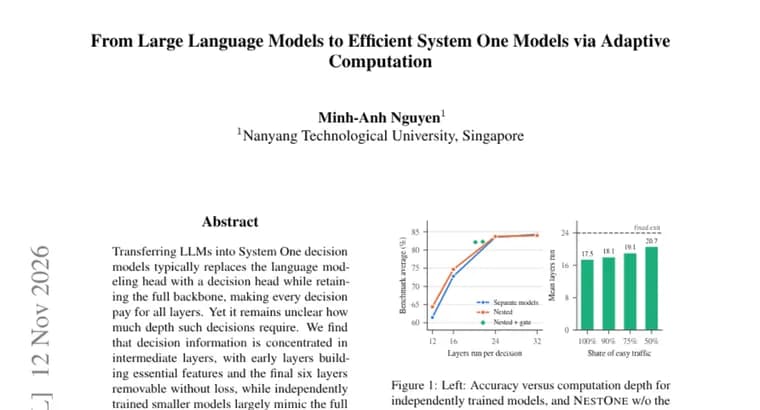
The paper starts from a common practice: when an LLM is turned into a System One decision model, the language modeling head is typically replaced with a decision head, but the full backbone is kept. Every decision therefore pays for all layers. The authors say it has been unclear how much depth such decisions actually need.
Their analysis finds that decision information is concentrated in intermediate layers. Early layers build essential features, and the final six layers can be removed without loss. They also find that independently trained smaller models largely mimic the full model instead of developing specialized decision capabilities. From this they suggest that efficiency requires not simply smaller backbones, but shared computation across different depths.
Building on that, they propose a method that jointly trains a full model together with prefix sub-models. The sub-models share the full model's final layers and decision head, and training uses self-distillation. A lightweight gate reads the hidden state at each exit and decides whether more computation is needed. This lets a single model operate at multiple layers.
Across seven decision benchmarks, the authors report that the approach matches or outperforms independently trained models at every depth, and gives better accuracy-efficiency trade-offs through adaptive computation. The method's name does not survive in the abstract text we have.
Key facts
- Standard conversion of an LLM into a System One decision model swaps the language modeling head for a decision head but keeps the full backbone, so every decision pays for all layers.
- The authors find decision information concentrated in intermediate layers, with the final six layers removable without loss.
- Independently trained smaller models largely mimic the full model rather than developing specialized decision capabilities.
- The proposed method trains a full model and prefix sub-models jointly, sharing final layers and the decision head via self-distillation, with a lightweight gate at each exit.
- Across seven decision benchmarks, the authors report matching or beating independently trained models at every depth, with better accuracy-efficiency trade-offs.
Why it matters
Decision models built from LLMs usually carry the whole backbone for every decision. This work argues that much of that depth is unnecessary and that the fix is not simply a smaller model but shared computation across depths. One model that can stop early when the gate says more computation is not needed would replace a set of separately trained models of different sizes.
Who it affects
Researchers and engineers who adapt LLMs into decision models by swapping the language modeling head for a decision head. The abstract does not name the decision tasks, so the exact applications are not stated.
How to use it
The abstract describes the recipe: jointly train the full model with prefix sub-models that share its final layers and decision head through self-distillation, then add a lightweight gate that reads the hidden state at each exit to decide whether to continue. No code, models or data release is mentioned.
How solid is it
This is an abstract-level claim from a paper listed on Hugging Face Papers. The authors report results across seven decision benchmarks, but the text gives no accuracy figures, speedups or compute savings. It does not say which LLMs or backbone sizes were used, so the six removable layers are not tied to a share of the model. The results are the authors' own.
Risks and caveats
Without numeric results, the size of the efficiency gain cannot be judged. The finding that the final six layers are removable without loss is not tied to a particular model size or task type in the abstract, so it may not carry over to other setups. The claim that the approach matches or outperforms independent models rests on the authors' evaluation alone.