ProAR teaches autoregressive video models to reason toward a goal frame
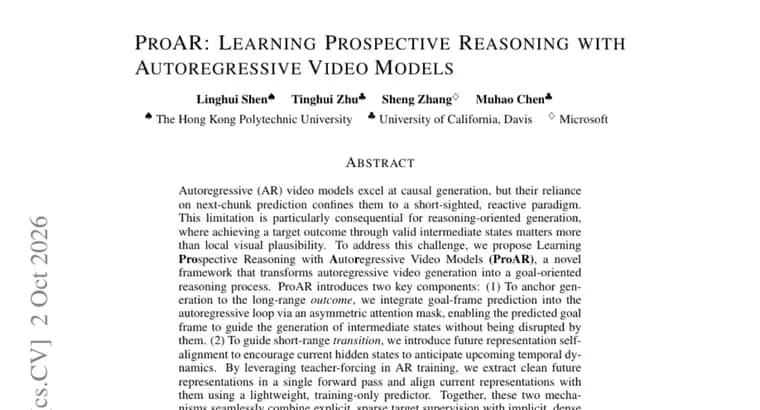
A paper titled "Learning Prospective Reasoning with Autoregressive Video Models" proposes a framework called ProAR. It starts from a limitation the authors see in autoregressive (AR) video models: they excel at causal generation, but their reliance on next-chunk prediction confines them to a short-sighted, reactive paradigm. That matters most for reasoning-oriented generation, where reaching a target outcome through valid intermediate states counts for more than local visual plausibility.\n\nProAR is described as a framework that turns autoregressive video generation into a goal-oriented reasoning process. It has two components.\n\nThe first anchors generation to the long-range outcome. Goal-frame prediction is built into the autoregressive loop through an asymmetric attention mask. The mask lets the predicted goal frame guide the generation of intermediate states without being disrupted by them.\n\nThe second guides short-range transitions. Called future representation self-alignment, it encourages the current hidden states to anticipate upcoming temporal dynamics. It relies on teacher-forcing in AR training: clean future representations are extracted in a single forward pass, and current representations are aligned with them through a lightweight predictor that is used only during training.\n\nTogether, the authors say, the two mechanisms combine explicit, sparse target supervision with implicit, dense step-wise guidance. They describe the result as coherent, goal-directed reasoning progress at modest computational cost.\n\nOn results, the paper says ProAR's complementary components consistently improve performance across diverse visual reasoning benchmarks. It also says the framework is highly training-efficient, surpassing fully trained standard AR baselines using only 25% of the training steps. Finally, the authors say the paradigm shows promising applicability to embodied reasoning tasks.
Key facts
- ProAR is a framework that turns autoregressive video generation into a goal-oriented reasoning process, instead of purely next-chunk prediction.
- Component one: goal-frame prediction inside the AR loop, using an asymmetric attention mask so the goal frame guides intermediate states without being disrupted by them.
- Component two: future representation self-alignment, which uses teacher-forcing to get clean future representations in one forward pass and aligns current ones with them through a lightweight, training-only predictor.
- The authors report consistent gains across diverse visual reasoning benchmarks and say ProAR surpasses fully trained standard AR baselines using only 25% of the training steps.
- The authors call the paradigm promisingly applicable to embodied reasoning tasks.
Why it matters
Autoregressive video models generate well step by step, but the authors argue that next-chunk prediction leaves them reactive and short-sighted. ProAR targets that gap by giving the model an explicit end goal and a signal about what comes next. The most concrete claim is about efficiency: it surpasses fully trained standard AR baselines using only 25% of their training steps. That figure is the share of the baseline's training steps, not a performance gain.
Who it affects
The paper is aimed at people building autoregressive video models, especially for reasoning-oriented generation where reaching a target outcome through valid intermediate states is the point. The authors also point to embodied reasoning tasks as a possible area of use.
How to use it
ProAR is a training recipe rather than a product. A team would add goal-frame prediction through an asymmetric attention mask and attach a lightweight predictor for future representation self-alignment, which is used only in training. The source does not mention any code or model release.
How solid is it
The evidence here is the authors' own summary of their experiments. They report that ProAR's components consistently improve performance across diverse visual reasoning benchmarks and that it beats fully trained standard AR baselines with 25% of the training steps. The source gives no benchmark names, no benchmark scores or size of the improvement, and does not name the baselines. It also gives no model size or base model. The 25% claim cannot be checked from this text alone.
Risks and caveats
The gains are described only as "consistent", with no figures attached. "Modest computational cost" is not quantified: no GPU hours, wall-clock time or absolute training cost is given. The embodied reasoning claim is worded as "promising applicability", and the embodied tasks are not specified and no results for them are given.
“The framework proves highly training-efficient, surpassing fully trained standard AR baselines using only 25% of the training steps.”
— ProAR paper abstract