Qwen3.8-Flash-Next matches a bigger model on a ninth of the training FLOPs
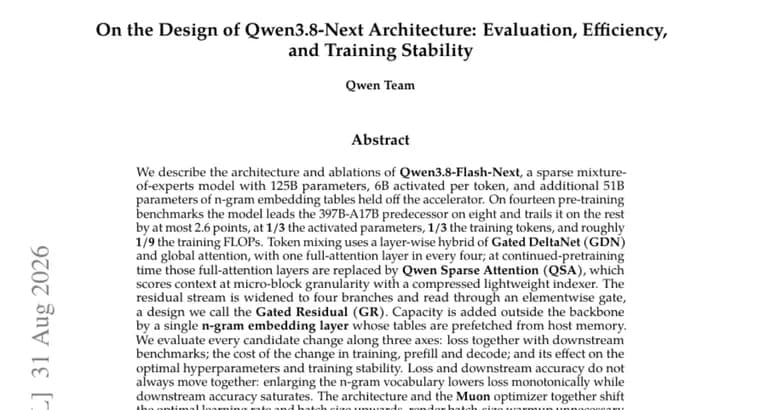
A paper posted to Hugging Face's papers section describes the architecture, ablations and training-stability work behind Qwen3.8-Flash-Next, a sparse mixture-of-experts model with 125B total parameters and 6B activated per token. A further 51B parameters sit in n-gram embedding tables kept off the accelerator, prefetched from host memory, adding capacity without adding it to the accelerator's compute budget.
Across fourteen pre-training benchmarks, the new model leads its predecessor, named 397B-A17B for its 397B total and 17B activated parameters, on eight of the fourteen and trails on the rest by at most 2.6 points. It reaches that result using a third of the activated parameters, a third of the training tokens, and roughly a ninth of the training FLOPs the larger model used. The individual benchmarks are not named, and no absolute loss or accuracy figures are given, only the relative outcome.
Token mixing runs a layer-wise hybrid of Gated DeltaNet (GDN) and global attention, with one full-attention layer in every four. During continued pretraining those full-attention layers are swapped for Qwen Sparse Attention (QSA), which scores context at micro-block granularity through a compressed, lightweight indexer. The residual stream is widened to four branches and read through an elementwise gate, a design the authors call the Gated Residual (GR).
The authors say they evaluated every candidate change on three axes at once: loss and downstream benchmarks; the cost the change adds in training, prefill and decode; and its effect on the optimal hyperparameters and on training stability. The two headline findings: loss and downstream accuracy do not always move together (enlarging the n-gram vocabulary lowers loss monotonically while downstream accuracy saturates), and the architecture combined with the Muon optimizer shifts the optimal learning rate and batch size upward, removes the need for batch-size warmup, and substantially improves stability under stress tests. Their conclusion is that loss, benchmarks, efficiency and stability are one design problem, and solving them jointly produces a model that is simultaneously more efficient, more capable and more stable.
Key facts
- Qwen3.8-Flash-Next: 125B total parameters, 6B activated per token, plus 51B extra parameters in n-gram embedding tables held off the accelerator.
- It leads a 397B-A17B predecessor on eight of fourteen pre-training benchmarks and trails by at most 2.6 points on the rest, using a third of the activated parameters, a third of the training tokens, and roughly a ninth of the training FLOPs.
- Token mixing hybridises Gated DeltaNet with global attention (one full-attention layer per four), replacing those full-attention layers with Qwen Sparse Attention during continued pretraining.
- A new Gated Residual (GR) design widens the residual stream to four branches read through an elementwise gate.
- Enlarging the n-gram vocabulary lowers loss monotonically while downstream accuracy saturates, showing the two metrics can diverge; the architecture plus the Muon optimizer raises the optimal learning rate and batch size, drops the need for batch-size warmup, and improves stability under stress tests.
Why it matters
The paper argues that architecture and optimizer choices, treated as one joint design problem rather than tuned separately, can substitute for raw scale: a model with a third of the activated parameters and roughly a ninth of the training compute reaches parity with a much larger predecessor on most of fourteen benchmarks. That is a direct efficiency claim about how far sparse mixture-of-experts and hybrid attention designs can push training and inference cost down without giving up capability.
Who it affects
The audience is model builders and ML researchers designing or training large sparse MoE language models, not end users. Lower activated parameters also mean cheaper inference, which matters to anyone serving a model like this at scale, but the paper itself is a design and evaluation study, not a product announcement.
How to use it
This is an architecture and evaluation paper, not a release. No release date, availability, weights, code or checkpoints for Qwen3.8-Flash-Next are stated in the text, so there is nothing here to deploy or license yet.
How solid is it
The claims come from the paper's own authors, evaluated on fourteen unnamed pre-training benchmarks with only relative outcomes reported (leads on eight, trails by at most 2.6 points on the rest); no absolute loss or accuracy numbers, no institution or lab affiliation, and no independent replication are given in the text.
Risks and caveats
The results are self-reported ablations against the authors' own predecessor model, without named benchmarks or absolute figures to check them against, and without a stated compute or timescale budget for training. How the efficiency gains hold up outside the paper's own test suite, or once the model is actually released, is not addressed.
“Loss and downstream accuracy do not always move together.”
— the paper's authors