Qwen3-8B jumps from 15.5% to 99% on 24-line chains with a tiny LoRA
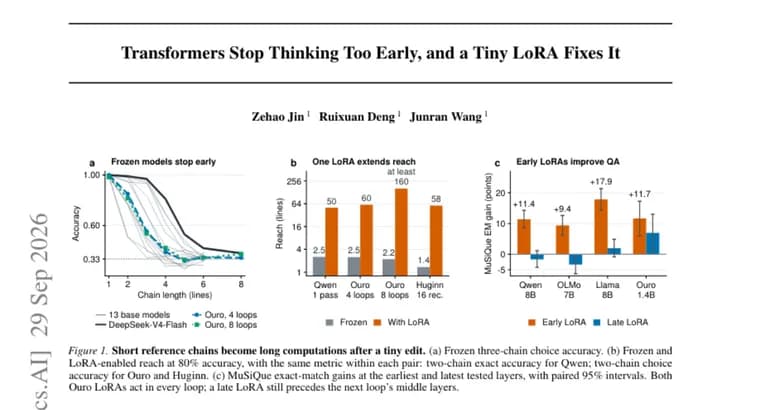
A paper listed on Hugging Face papers (2609.36585) argues that pretrained transformers use little of their depth when they follow references in context. The test is a chain of program lines, each pointing back to a parent line. Thirteen base models reliably follow only 1.4 to 3.6 lines of such a chain, and adding extra pretrained loops helps little.
The fix is small. A task-trained rank-8 LoRA, placed at one early layer with all model weights frozen, extends this computation. With it, Qwen3-8B goes from 15.5% to 99% exact accuracy on 24-line chains. A longer-trained LoRA reaches 50 lines. Ouro-1.4B reaches 60 lines after four loops and at least 160 after eight.
The paper also looks inside the model to see what the LoRA does. It starts a relay: program lines pass on their chain identity through a short range of middle layers. Frozen heads read progressively further up the chain, and removing parent-line attention stops the relay. A measurement on the frozen model locates the last useful intervention layer within tolerance in three of four held-out models. Task-specific LoRAs also improve MuSiQue.
The conclusion in the abstract is that default answers understate the computation accessible through a tiny edit. Code and an interactive demo are available at lunamos.github.io/stop-thinking-too-early.
Key facts
- Thirteen base models reliably follow only 1.4 to 3.6 lines of a reference chain, and extra pretrained loops add little.
- A task-trained rank-8 LoRA at one early layer, with all model weights frozen, takes Qwen3-8B from 15.5% to 99% exact accuracy on 24-line chains.
- A longer-trained LoRA reaches 50 lines; Ouro-1.4B reaches 60 lines after four loops and at least 160 after eight.
- The LoRA starts a relay through a short range of middle layers; removing parent-line attention stops it.
- Task-specific LoRAs also improve MuSiQue, and code plus an interactive demo are public.
Why it matters
The paper claims that what a model does by default understates what it can compute. If a rank-8 LoRA at a single early layer can move Qwen3-8B from 15.5% to 99% exact accuracy on 24-line chains, the limit on following references in context is not simply a lack of depth. The pretrained network leaves much of its depth unused for this job, and a tiny edit can put it to work. The paper frames its conclusion that way: default answers understate the computation accessible through a tiny edit.
Who it affects
Interpretability and model-architecture researchers get a concrete mechanism to study: a relay across a short range of middle layers, with frozen heads reading progressively further up the chain. People working on looped or recurrent-depth models are also addressed, since the paper reports that extra pretrained loops add little while Ouro-1.4B reaches 60 lines after four loops and at least 160 after eight. Anyone fine-tuning open models for multi-step lookups in context may find the MuSiQue result relevant.
How to use it
Code and an interactive demo are available at https://lunamos.github.io/stop-thinking-too-early/. The method as described is a task-trained rank-8 LoRA at one early layer with all model weights frozen, so the base model is untouched. The paper also reports that a measurement on the frozen model locates the last useful intervention layer within tolerance in three of four held-out models, which points to a way of choosing where to place the edit.
How solid is it
The numbers are specific and come with a mechanistic story: removing parent-line attention stops the relay, which is the kind of ablation that supports the explanation. The headline gain is measured as absolute exact accuracy on 24-line chains for Qwen3-8B. Layer selection worked in three of four held-out models, so it is not universal. The source does not mention peer review or independent replication, and it does not give MuSiQue figures. Public code and a demo make checking possible.
Risks and caveats
The headline result is on synthetic chains of program lines, and the only other benchmark named is MuSiQue, where the paper says only that task-specific LoRAs improve it, with no figures given. The LoRA is task-trained, so the gain is tied to the task it was trained on. The layer-finding measurement missed in one of four held-out models. The source gives no accuracy for the 50-line LoRA or for Ouro-1.4B at 60 or 160 lines, and no training cost, so the practical price of the fix is unclear.
“Default answers therefore understate the computation accessible through a tiny edit.”
— Paper abstract, Hugging Face papers 2609.36585