RefCaptioner grounds video captions in multiple reference images
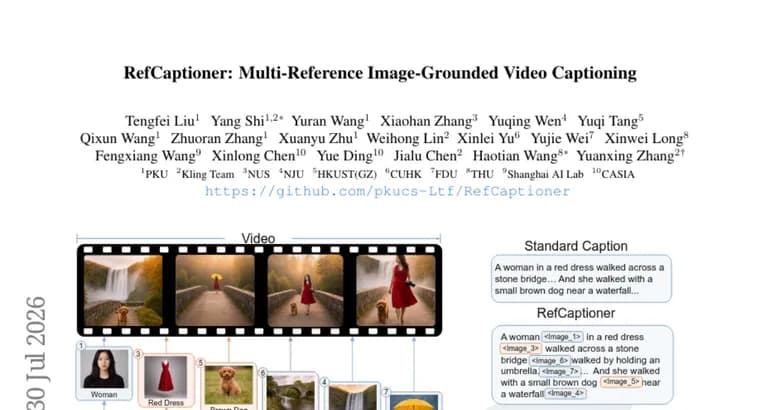
Video captioning models can already write natural-language descriptions of what happens in a video, but they have no way to explicitly link a piece of that description to a specific reference image, such as a photo of the exact person, object or location shown. Researchers introduce a new task called multi-reference image-grounded video captioning, which requires a caption to stay factually accurate while grounding phrases in the caption to the correct reference images, and propose RefCaptioner, a two-stage post-training framework built for that task. RefCaptioner combines supervised fine-tuning on mixed data with a reinforcement learning method called Hierarchical Coverage-Discounted GRPO. Together these two stages are meant to improve four things at once: picking the right reference image for a given phrase, binding phrases to references at a fine-grained level, rejecting distractor images that do not actually match, and keeping references consistent across the caption, all without degrading the model's general video-captioning ability. To train and evaluate the approach, the researchers built a corpus of 20,000 videos paired with 171,354 reference images, and introduced a benchmark called MRVBench for measuring caption factuality and multi-reference grounding on both real-world and AI-generated videos. According to the paper, RefCaptioner achieves the best overall performance among open-source models on this task while staying competitive on standard video-captioning benchmarks, and human evaluators preferred its captions and found they enabled more source-faithful video reconstruction when used with both open-source and proprietary video generators. The text does not name the authors or their institutions, give a release timeline, or report specific benchmark scores.
Key facts
- The paper introduces multi-reference image-grounded video captioning, a task requiring captions that ground specific phrases in specific reference images while staying factually accurate.
- RefCaptioner is a two-stage post-training framework combining mixed-data supervised fine-tuning with Hierarchical Coverage-Discounted GRPO, targeting reference selection, phrase-level binding, distractor rejection and cross-reference consistency.
- The training corpus built for the task contains 20,000 videos and 171,354 reference images.
- A new benchmark, MRVBench, evaluates caption factuality and multi-reference grounding on both real-world and AI-generated videos.
- The paper reports RefCaptioner as the best-performing open-source model on this task, with human evaluators preferring its captions and finding they support more source-faithful video reconstruction.
Why it matters
Video captioning models today describe what is happening in a video, but they cannot point to why: they have no mechanism for tying a claim in the caption, such as the identity of a person or object, to a concrete reference image that backs it up. That gap is what lets captions drift into plausible-sounding but ungrounded description. By defining multi-reference image-grounded video captioning as a distinct task and building RefCaptioner to handle it, the work targets factuality directly rather than treating it as a side effect of better language modeling.
Who it affects
The immediate audience is researchers and engineers building video-understanding and video-generation systems, particularly anyone whose pipeline needs a caption to serve as a reliable, checkable input, for example feeding captions back into a video generator to reconstruct or edit a scene faithfully. The paper reports that RefCaptioner's captions helped both open-source and proprietary video generators reconstruct source video more faithfully, so the effect is not confined to captioning alone.
How to use it
The text describes a research framework and an accompanying corpus and benchmark rather than a shipped product: no pricing, license terms or release date are given for RefCaptioner, the 20,000-video training corpus, or MRVBench. Teams interested in the approach would need to consult the paper itself for implementation and availability details, which are not covered in the material reviewed here.
How solid is it
The claims come from the paper's own experiments and a human evaluation: RefCaptioner is reported as the best-performing open-source model on the new task while remaining competitive on standard video-captioning benchmarks, and human annotators are said to have preferred its captions. No specific numeric scores or margins over competing models are given in the text, so the size of the reported advantage cannot be independently assessed from this material.
Risks and caveats
The source text does not name the authors or their institutional affiliations, nor does it give a timeline for release or broader adoption. The performance claims rest on the authors' own experiments and evaluation setup, including a human evaluation whose methodology is not detailed here; independent verification of the reported gains is not possible from the text alone.