Representation Guidance pushes pixel diffusion transformers to FID 1.55 on ImageNet
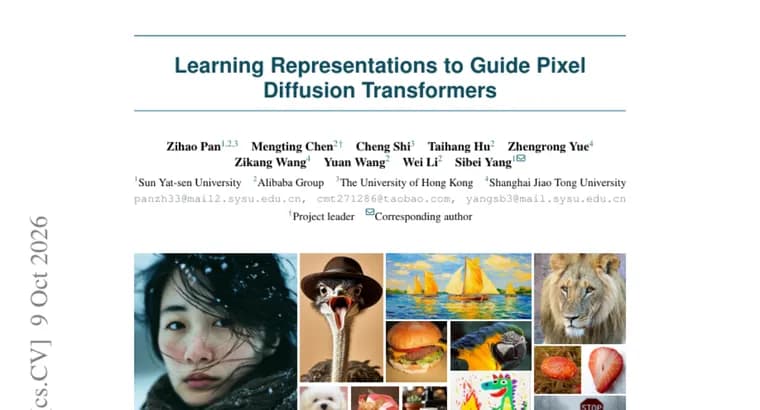
The paper starts from a gap in current practice: visual representations are mostly developed for understanding, and it is unclear what makes them useful for generation. The authors study this question in pixel diffusion transformers and report two insights.
First, better representation quality does not necessarily translate into greater generative utility, because externally aligned semantics can be progressively lost during pixel synthesis. Second, architectural separation with specialized pixel decoders mainly redistributes semantic and spatial modeling, without necessarily yielding representations better suited to generation. Together, the insights suggest that a useful generative representation must be both properly formed and actively exploited.
From that the authors build Representation Guidance (RG). It forms and exploits internal representations directly, while keeping a plain Transformer architecture. A low-dimensional bottleneck forces generation-relevant information into a compact representation. That representation is then used explicitly to guide decoder generation, by modifying the flow-matching target according to its induced prediction offset. The authors say RG learns clearer semantic and spatial structure and scales efficiently in both parameters and computation.
The reported results are on ImageNet and in text-to-image generation. On ImageNet 256x256, RG-L/16 with 459M parameters outperforms substantially larger pixel diffusion transformers, and RG-XL/16 achieves an FID of 1.55 (lower is better). RG further reaches an FID of 1.74 at 512x512. It also extends to text-to-image generation, with a GenEval score of 0.89 and a DPG-Bench score of 87.1.
Key facts
- Representation Guidance (RG) uses a low-dimensional bottleneck to form a compact representation, then uses it to guide the decoder by modifying the flow-matching target.
- The method keeps a plain Transformer architecture instead of adding a specialized pixel decoder.
- On ImageNet 256x256, RG-XL/16 reports an FID of 1.55, and RG-L/16 with 459M parameters is said to outperform substantially larger pixel diffusion transformers.
- RG reports an FID of 1.74 at 512x512 resolution.
- In text-to-image generation, RG reports 0.89 on GenEval and 87.1 on DPG-Bench.
Why it matters
Pixel diffusion models generate images directly in pixel space, and the paper asks what kind of internal representation actually helps them. Its answer cuts against two common assumptions: that a stronger representation automatically gives better generation, and that a separate specialized pixel decoder is the way to get good representations. The authors say externally aligned semantics can fade during pixel synthesis, and that a decoder split mainly moves semantic and spatial modeling around. RG is their alternative: shape the representation inside a plain Transformer and use it to guide generation.
Who it affects
The work is aimed at researchers building and training diffusion transformers for image generation, especially in pixel space. The reported text-to-image numbers suggest relevance beyond class-conditional ImageNet generation, but the source does not say which model variant produced them.
How to use it
The source is a paper abstract describing a training approach, not a product. A low-dimensional bottleneck produces a compact representation, and the flow-matching target is modified according to that representation's induced prediction offset. No code or weights release is mentioned.
How solid is it
The claims come from the authors' own abstract, with specific benchmark figures: FID 1.55 for RG-XL/16 and 1.74 at 512x512 on ImageNet, 0.89 on GenEval and 87.1 on DPG-Bench for text-to-image. The names or sizes of the larger pixel diffusion transformers that RG-L/16 outperforms are not given, nor are the baseline FID values. The model variant behind the 512x512, GenEval and DPG-Bench results is not stated.
Risks and caveats
The abstract does not give the parameter count of RG-XL/16, so the 1.55 FID cannot be directly compared by size with the 459M RG-L/16 claim. The comparison to larger models is stated without baselines in the source. No training compute or cost figures are given, so the efficiency claim about scaling in parameters and computation cannot be checked from the abstract alone.
“These insights suggest that a useful generative representation must be both properly formed and actively exploited.”
— Paper abstract