RSI-Anything uses predictive world models to steer recursive self-improvement
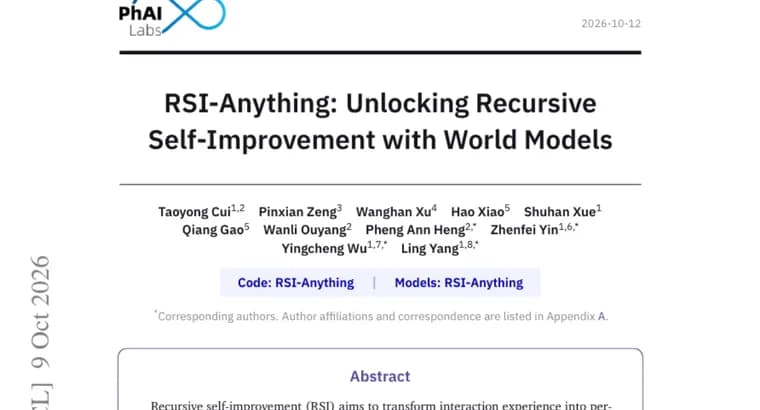
The paper introduces RSI-Anything, a domain-general framework for recursive self-improvement (RSI), which the authors describe as turning interaction experience into persistent improvements. They frame the problem this way: external feedback is costly, and a world model's predictions may become unreliable as the policy it serves evolves.
RSI-Anything is built on JEPA-Anything and uses predictive world models to guide two things: which action to take and which learning data to select. Observed feedback drives improvement of the policy or workflow, and it also triggers conditional adaptation of the world model. Component and compatibility checks then decide whether an updated policy-model pair is retained.
The abstract reports results across several domains. In code repair, with the coder held fixed, success rises from 26.3% with a static verifier to 29.2% through predictive selection and 31.2% after world-model adaptation, at comparable test usage. In graphical user interface (GUI) evaluations, task completion was higher and the average number of actions fell by 39.4%; no figure is given for the completion gain. In laboratory planning, scores more than double across five successive policy versions, from 21.80% to 46.01%. In reaction optimization, RSI-Anything reaches a mean best observed yield of 96.15%, against 82.16% for Bayesian optimization under the same 40-experiment budget.
The paper also describes an end-to-end immune-science application that connects workflow evolution and predictive modeling with therapeutic hypothesis generation. The abstract gives no numeric result for it. The authors conclude that predictive world models and retained system updates enable recursive improvement across diverse environments.
Key facts
- RSI-Anything is a domain-general recursive self-improvement framework built on JEPA-Anything, using predictive world models to guide action and learning-data selection.
- In code repair with a fixed coder, success rises from 26.3% (static verifier) to 29.2% (predictive selection) and 31.2% (after world-model adaptation), at comparable test usage.
- Laboratory-planning scores more than double across five successive policy versions, from 21.80% to 46.01%; GUI evaluations show a 39.4% drop in average actions.
- In reaction optimization, RSI-Anything reaches 96.15% mean best observed yield versus 82.16% for Bayesian optimization under the same 40-experiment budget.
- Updated policy-model pairs are kept only if component and compatibility checks pass, which is the paper's answer to world-model predictions drifting as policies change.
Why it matters
Self-improving systems run into two practical limits: real feedback is expensive, and a model used to predict outcomes can go stale as the policy it evaluates changes. RSI-Anything targets both at once. It uses a predictive world model to decide what to try and what to learn from, adapts that model only conditionally, and gates every update behind checks. The paper's pitch is that one framework covers very different settings, from code repair and GUI control to wet-lab style planning and chemistry.
Who it affects
Researchers working on self-improving agents, world models and verifier design are the direct audience. The reported domains point to teams building code-repair tools, GUI agents, laboratory automation and reaction-optimization pipelines, where each real evaluation or experiment costs time or money. The immune-science application is aimed at those working on therapeutic hypothesis generation.
How to use it
The abstract describes the method and its results rather than a product. What a practitioner can take from it is the pattern: rank candidate actions and training data with a predictive model before spending costly external feedback, adapt that model only when observed feedback calls for it, and keep an updated policy-model pair only after component and compatibility checks pass. The code-repair result shows the effect of each step with the coder fixed: predictive selection alone adds 2.9 points over a static verifier, and world-model adaptation adds another 2.0.
How solid is it
This is a preprint abstract on a Hugging Face papers page, and it names no authors or institutions. The figures are specific, and several come with a baseline: 26.3% for a static verifier in code repair, 82.16% for Bayesian optimization in reaction optimization. But the abstract does not say which coder model, GUI benchmark or laboratory-planning benchmark was used, and it does not say whether the results are peer reviewed or independently reproduced. It is also not stated whether the code-repair percentages are pass rates on a named benchmark, or how many test runs were used beyond 'comparable test usage'.
Risks and caveats
The gain in code repair is modest in absolute terms: 4.9 percentage points from 26.3% to 31.2%. The GUI task-completion improvement is not quantified; only the 39.4% drop in average actions is given, and the abstract does not say whether that average is a mean or a median. The laboratory-planning figures come from one domain over five policy versions, and the reaction-optimization comparison holds to a fixed 40-experiment budget, so neither amounts to a claim of unbounded or autonomous self-improvement. The immune-science application reports no numeric result and no validated therapeutic hypothesis. The paper itself names the core risk: world-model predictions may become unreliable as policies evolve, which is why retention checks are part of the design.
“These results demonstrate how predictive world models and retained system updates enable recursive improvement across diverse environments.”
— RSI-Anything paper abstract