Resolution Hypothesis: agent evolution stalls on noisy evaluation, paper says
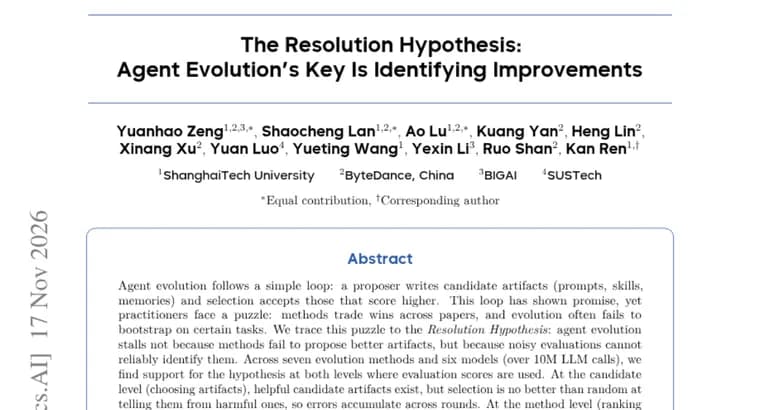
A paper listed on Hugging Face proposes what it calls the Resolution Hypothesis, an explanation for why self-improving agents so often stop getting better.
The setup is simple. In agent evolution, a proposer writes candidate artifacts such as prompts, skills or memories, and a selection step accepts the ones that score higher. The loop has shown promise, but practitioners face a puzzle: methods trade wins across papers, and evolution often fails to bootstrap on certain tasks.
The authors trace this to evaluation noise. Their claim is that agent evolution stalls not because methods fail to propose better artifacts, but because noisy evaluations cannot reliably identify them. They report finding support for this across seven evolution methods and six models, with over 10M LLM calls in total, and at both levels where evaluation scores are used.
At the candidate level, where artifacts are chosen, helpful candidates do exist. But selection is no better than random at telling them from harmful ones, so errors accumulate across rounds.
At the method level, where methods are ranked against each other, the typical margins are a few percentage points. That is smaller than the difference between two independent runs of the same method, so the authors conclude that published rankings often rest on luck.
Taken together, the findings indicate that agent evolution is often bottlenecked by reliably identifying improvements. The authors call for a shift in how self-improving agents are developed and evaluated: away from designing ever more candidate improvement systems, and toward making true improvements detectable and accumulable.
Key facts
- The Resolution Hypothesis says agent evolution stalls not because methods fail to propose better artifacts, but because noisy evaluations cannot reliably identify them.
- The study covers seven evolution methods and six models, with over 10M LLM calls in total.
- At the candidate level, helpful artifacts exist, but selection is no better than random at telling them from harmful ones, so errors accumulate across rounds.
- At the method level, typical margins of a few percentage points are smaller than the gap between two independent runs of the same method, so published rankings often rest on luck.
- The authors call for making true improvements detectable and accumulable, rather than designing ever more candidate improvement systems.
Why it matters
Self-improving agents are an active line of work, and this paper offers one explanation for two things practitioners keep running into: methods that trade wins from paper to paper, and evolution that fails to get started on some tasks. If the explanation holds, adding cleverer proposers will not fix the problem on its own, because the weak link is the step that decides which candidate to keep. The authors frame this as a change of focus, from generating more candidate improvements to detecting real ones.
Who it affects
Teams building agents that rewrite their own prompts, skills or memories, since their selection step may be accepting changes at close to random. It also touches researchers who publish and compare evolution methods, because the paper says rankings built on margins of a few percentage points often rest on luck.
How to use it
The abstract describes no tool or fix beyond the call to make improvements detectable and accumulable. The practical reading is about interpretation: treat small score gaps between evolution methods, or between candidate artifacts, with caution, since two runs of the same method can differ by more than those gaps.
How solid is it
The scale is large, with seven methods, six models and over 10M LLM calls, and the claim is tested at two levels. Still, this is an abstract only. The seven methods and six models are not named, and no concrete accuracy figures, variance values or benchmark names are given beyond 'a few percentage points'. The authors say they find support for the hypothesis, which is not proof.
Risks and caveats
The conclusion is that evolution is often bottlenecked by identifying improvements, not always. The abstract does not say which tasks evolution fails to bootstrap on. No authors or institutions are named in the text, so the work cannot be placed from the abstract alone. Details of the experiments and any checks of the claim would need the full paper.
“agent evolution stalls not because methods fail to propose better artifacts, but because noisy evaluations cannot reliably identify them”
— Abstract of the Resolution Hypothesis paper, Hugging Face