RL paper trains one model to act, reflect and curate agent playbooks
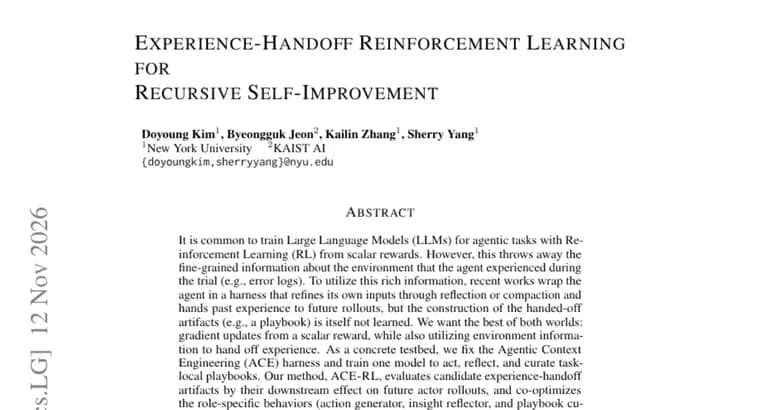
The paper starts from a common practice: training large language models for agentic tasks with reinforcement learning from scalar rewards. Its complaint is that a single reward number throws away the fine-grained information about the environment that the agent experienced during the trial, such as error logs.
Recent work tries to keep that information by wrapping the agent in a harness. The harness refines the agent's own inputs through reflection or compaction and hands past experience to future rollouts. But in those systems, the authors say, the construction of the handed-off artifacts, for example a playbook, is itself not learned.
The authors want both: gradient updates from a scalar reward, and use of environment information to hand off experience. As a concrete testbed they fix the Agentic Context Engineering harness and train one model to do three jobs: act, reflect, and curate task-local playbooks.
Their method evaluates each candidate experience-handoff artifact by its downstream effect on future actor rollouts. It co-optimizes the three role-specific behaviors, the action generator, the insight reflector and the playbook curator, under a fixed scaffold.
Across agentic benchmarks, the abstract says, the method achieves higher held-out performance than baseline methods. The results suggest that agent training should optimize not only the actions in the current rollout, but also the model-written experience that future rollouts inherit.
Key facts
- Scalar-reward RL discards fine-grained environment information from a trial, such as error logs.
- Existing harnesses hand past experience to future rollouts, but the construction of the handed-off artifacts (for example a playbook) is not learned.
- The testbed fixes the Agentic Context Engineering harness and trains one model to act, reflect and curate task-local playbooks.
- Each candidate playbook is scored by its downstream effect on future actor rollouts, and the action generator, insight reflector and playbook curator are co-optimized under a fixed scaffold.
- The abstract claims higher held-out performance than baseline methods across agentic benchmarks, with no figures given.
Why it matters
Agent training usually optimizes the actions an agent takes and ignores the experience notes that agent systems pass to later attempts. This work treats those notes, such as playbooks, as something to be trained too. The authors suggest that training should optimize both the current rollout's actions and the model-written experience that future rollouts inherit. It is an attempt to combine the gradient signal of RL with the richer feedback, such as error logs, that harness-based approaches use.
Who it affects
Mainly researchers and engineers who train LLM agents with reinforcement learning, and those who build harnesses that carry reflections or compacted context from one attempt to the next. The abstract does not describe any product or end-user effect.
How to use it
The abstract describes a training recipe rather than a tool. One model plays three roles (action generator, insight reflector and playbook curator) inside a fixed Agentic Context Engineering harness, and playbook candidates are rewarded by how they change later actor rollouts. No code release, dataset release or date is mentioned.
How solid is it
This is an abstract on Hugging Face Papers, so the evidence is the authors' own summary. It states that the method beats baseline methods on held-out performance across agentic benchmarks, but it gives no numeric results, effect sizes, baseline names, benchmark names or model sizes. The title mentions Recursive Self-Improvement, yet the abstract does not say the system actually improves itself recursively.
Risks and caveats
The claim of higher held-out performance is qualitative, so the size of the gain cannot be judged from the abstract. The testbed fixes one harness, and the abstract does not say whether the method was tested outside the fixed Agentic Context Engineering harness. The conclusion is phrased as a suggestion, not a proof.
“The results suggest that agent training should optimize not only the actions in the current rollout, but also the model-written experience that future rollouts inherit.”
— Paper abstract, Hugging Face Papers