RoAR-VAE tokenizer trains on corrupted latents to help diffusion models
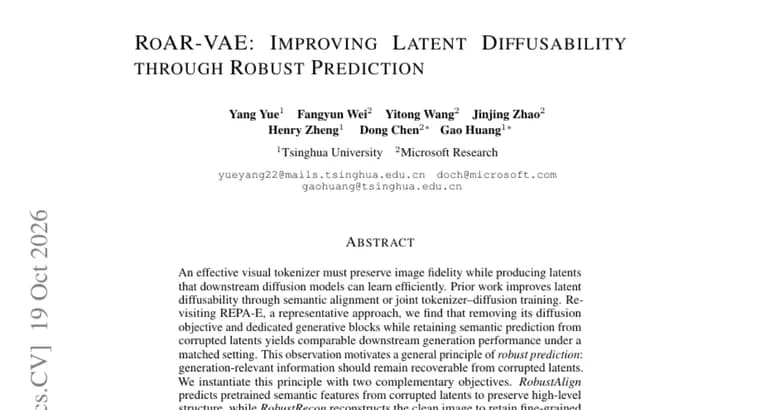
A paper listed on Hugging Face Papers tackles a familiar tension in image generation. A visual tokenizer has to preserve image fidelity, yet it also has to produce latents that a downstream diffusion model can learn efficiently. That second property is called latent diffusability.
The authors note that earlier work improves diffusability through semantic alignment or through joint tokenizer-diffusion training. They revisit REPA-E, which they call a representative approach, and run an ablation: remove its diffusion objective and its dedicated generative blocks, but keep the semantic prediction from corrupted latents. Under a matched setting, this stripped-down version gives comparable downstream generation performance.
From that observation the authors draw a general principle, which they call robust prediction: generation-relevant information should remain recoverable from corrupted latents. They build the principle into two complementary objectives. RobustAlign predicts pretrained semantic features from corrupted latents, which preserves high-level structure. RobustRecon reconstructs the clean image from the corrupted latents, which retains fine-grained spatial and appearance information. Combined, the two form Robust Alignment and Reconstruction VAE, or RoAR-VAE.
On why this works, the authors say their analysis suggests that robust prediction makes useful information more accessible in high-variance latent directions, and diffusion models tend to learn those directions earlier.
The reported results are two numbers. Under the same training budget, RoAR-VAE improves average generation benchmark performance by 2.19 points over the strongest baseline tokenizer. It also improves small-text reconstruction accuracy by 16.93 percentage points over FLUX.1-VAE. The authors conclude that RoAR-VAE strikes a favorable balance between reconstruction fidelity and downstream generative learnability.
Key facts
- RoAR-VAE combines two objectives: RobustAlign predicts pretrained semantic features from corrupted latents, and RobustRecon reconstructs the clean image from them.
- Stripping REPA-E of its diffusion objective and dedicated generative blocks, while keeping semantic prediction from corrupted latents, gave comparable generation performance in a matched setting.
- Under the same training budget, RoAR-VAE improves average generation benchmark performance by 2.19 points over the strongest baseline tokenizer.
- Small-text reconstruction accuracy is 16.93 percentage points higher than with FLUX.1-VAE.
- The authors' analysis suggests the gain comes from useful information being more accessible in high-variance latent directions, which diffusion models tend to learn earlier.
Why it matters
Image generators built on latent diffusion depend on the tokenizer that maps pixels to latents. A tokenizer can reconstruct images well and still give diffusion models latents that are hard to learn from. This paper argues that a simpler recipe than joint tokenizer-diffusion training can help: make the latents robust, so that semantic features and the clean image can still be predicted from corrupted versions of them. The authors' own REPA-E ablation is the core of the argument, since dropping the diffusion objective and generative blocks gave comparable results.
Who it affects
The work is aimed at researchers and engineers who train visual tokenizers and latent diffusion models. Anyone choosing between tokenizers such as FLUX.1-VAE for image generation, especially where small text must survive reconstruction, is the closest audience. Everyday users of image generators are affected only indirectly.
How to use it
The abstract describes the training recipe in two parts: add RobustAlign, which predicts pretrained semantic features from corrupted latents, and RobustRecon, which reconstructs the clean image from corrupted latents. A practitioner would read the full paper for details on the corruption used and the setup. The abstract does not mention a code or weights release.
How solid is it
The claims come from the authors' own abstract, with two headline numbers: a 2.19-point average gain over the strongest baseline under the same training budget, and a 16.93 percentage-point gain in small-text reconstruction accuracy against FLUX.1-VAE. The 2.19 figure is in absolute points, not a percentage of the baseline. The source names no benchmarks, does not name the strongest baseline tokenizer, and gives no baseline scores, so the size of the gains cannot be judged from the abstract alone. The explanation about high-variance latent directions is described by the authors as something their analysis suggests, not as something proven.
Risks and caveats
The source does not specify the type of corruption applied to latents, model sizes, datasets, training budget or compute. The small-text comparison is only against FLUX.1-VAE, and its base accuracy values are not given. Without benchmark names and baseline values, the results should be treated as the authors' reported claims until the full paper is read and checked.