RoboTok mines web video for robot manipulation training
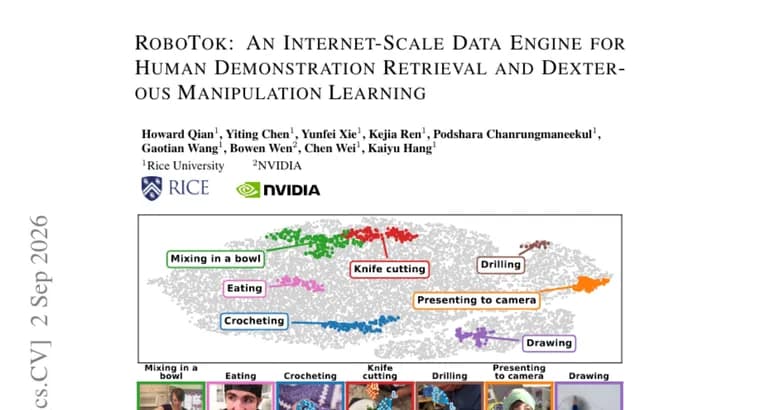
Robot learning needs broad, diverse demonstrations to work well, but researchers say collecting robot data directly remains expensive and poorly suited to covering the long tail of real-world tasks a robot might eventually face. To get around that bottleneck, the authors introduce RoboTok, an internet-scale data engine that takes a query video of a human performing a manipulation task and retrieves matching, manipulation-relevant human demonstration videos from the web, which are then used to train dexterous robot policies instead of collecting new robot-specific data.
The core of the system is a latent motion space learned from 3D hand trajectories, expressed in reference frames centered on the person performing the action rather than on the camera. This lets RoboTok compare manipulation behaviors even when camera viewpoint, scene appearance, or occlusion of the actor differ between videos, while keeping the representation compact enough to search efficiently and to keep indexing new footage continuously across internet-scale video collections.
The authors evaluated RoboTok against existing robot-data retrieval approaches, testing it both on retrieval benchmarks and on downstream robot policy performance. They report that RoboTok retrieves more relevant manipulation demonstrations than the compared methods and improves downstream task success, and they present this as evidence that hand-pose trajectory-aware retrieval can turn ordinary web video into a scalable, continuously growing source of supervision for robot learning.
Key facts
- RoboTok is an internet-scale data engine that, given a query video of a human manipulation task, retrieves matching human demonstration videos from the web to train dexterous robot policies.
- It learns a latent motion space from 3D hand trajectories in actor-centered reference frames, so it can match manipulation behavior across differences in camera viewpoint, scene appearance, and actor occlusion.
- The representation stays compact enough for efficient search and continual indexing over internet-scale video collections.
- Against existing robot-data retrieval approaches, on both retrieval benchmarks and downstream robot-policy performance, the authors report RoboTok retrieves more relevant demonstrations and improves downstream task success.
- The motivation is that collecting robot-specific demonstration data is expensive and cannot practically cover the long tail of real-world manipulation tasks.
Why it matters
Robot manipulation policies improve with broader, more varied demonstrations, but the authors say gathering that data by recording robots directly is expensive and poorly suited to covering the long tail of tasks a robot needs to eventually handle. RoboTok's pitch is to substitute the web's existing, ever-growing supply of human manipulation video for that costly bespoke collection, using hand-pose trajectory matching to find footage relevant to a given task.
Who it affects
Researchers and engineers building dexterous robot manipulation policies, and robot-learning teams currently limited by how much demonstration data they can physically collect for each new task.
How to use it
The source describes a retrieval method and evaluation, not a released product: no timescale or deployment context for RoboTok is given in the text, and no code, dataset, or pricing information is mentioned.
How solid is it
The authors compared RoboTok against existing robot-data retrieval approaches on retrieval benchmarks and on downstream robot-policy performance, reporting that it retrieves more relevant demonstrations and improves task success. The text gives no specific benchmark names, dataset sizes, or numeric results, so the size of the improvement cannot be judged from what is stated here.
Risks and caveats
The abstract names no authors, affiliations, or institutions, and states no publication venue or date, so provenance and independent scrutiny of the work rest on details outside the text reviewed here. Claims of improved retrieval and task success are the authors' own report on their evaluation, not an independently verified result.
“collecting robot data remains expensive and poorly suited to covering the long tail of real-world tasks”
— the authors