RoPE flaw explains why video diffusion models break physics
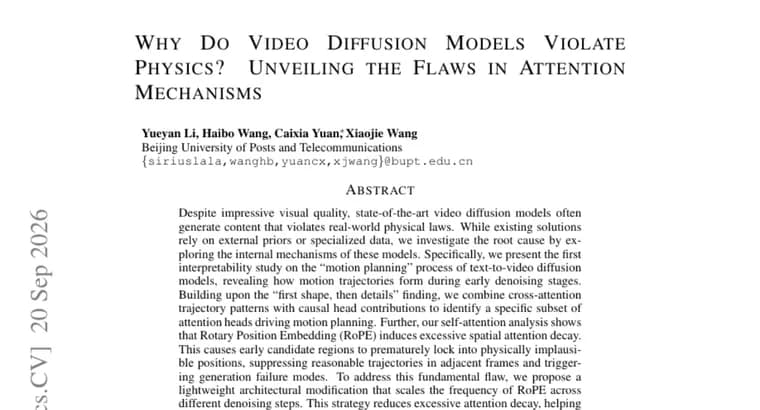
Text-to-video diffusion models can produce visually striking clips that still break basic physics: objects snapping into impossible positions, motion that ignores real-world constraints. The authors present what they describe as the first interpretability study of the 'motion planning' process inside these models, looking at how motion trajectories take shape during the early denoising steps. Building on a 'first shape, then details' pattern they observed, the researchers combined cross-attention trajectory analysis with causal head contributions to isolate a specific subset of attention heads responsible for planning motion. Their self-attention analysis then identified the root cause: Rotary Position Embedding (RoPE), the positional encoding scheme used in these models, induces excessive spatial attention decay. In practice, this makes early candidate regions in a scene lock prematurely into positions that are physically implausible, which suppresses more reasonable trajectories in neighboring frames and triggers the generation failures that show up as physics violations on screen. To address the flaw, the authors propose a lightweight architectural change that scales the frequency of RoPE across the different denoising steps, which reduces the excessive attention decay and lets the model explore better candidate regions before settling on a trajectory. They report that both training-free and training-based versions of this modification improved the physical commonsense of generated videos in their experiments, though the abstract does not give specific benchmark numbers, named models tested, or comparisons against other fixes.
Key facts
- The paper presents the first interpretability study of the internal 'motion planning' process in text-to-video diffusion models
- Motion trajectories form during the early denoising stages, following a 'first shape, then details' pattern
- A specific subset of attention heads, found via cross-attention trajectory patterns and causal head analysis, drives motion planning
- Rotary Position Embedding (RoPE) causes excessive spatial attention decay, locking candidate regions into physically implausible positions early and triggering failure modes
- The proposed fix scales RoPE frequency across denoising steps; both training-free and training-based versions improved physical plausibility in the authors' experiments
Why it matters
Video diffusion models already generate visually convincing footage, but they routinely violate physics in ways that are obvious to viewers: objects teleporting, motion that contradicts basic mechanics. Most existing fixes bolt on external priors or specialized training data rather than explaining why the failure happens. This paper instead opens up the model's internals and traces the problem to a specific mechanism, RoPE-induced attention decay, giving the field a causal explanation rather than another workaround.
Who it affects
The direct audience is researchers and engineers building or fine-tuning text-to-video diffusion models, who now have a specific attention-mechanism target to address rather than treating physics violations as an unexplained side effect. It also matters to anyone evaluating or deploying text-to-video tools downstream, since the failure mode described here (objects locking into implausible positions early in generation) is a recognizable source of the physically wrong output those tools sometimes produce.
How to use it
The authors' fix is architectural: scaling the frequency of RoPE across the denoising steps reduces the excessive attention decay that causes premature, implausible lock-in. They tested both a training-free version of the change and a training-based one, and report both improved physical commonsense in generated video. The abstract does not name a specific base model the method was applied to, nor does it give pricing, licensing, or release details, so it reads as a research finding rather than a shipped tool.
How solid is it
The claims rest on a structured interpretability pipeline: cross-attention trajectory analysis combined with causal head contribution analysis to isolate the responsible attention heads, followed by self-attention analysis to identify the RoPE decay effect. The authors say training-free and training-based experiments confirmed the fix works, but the abstract text does not include quantitative results, benchmark scores, or comparisons against other approaches, so the size of the improvement cannot be judged from the source alone.
Risks and caveats
The abstract names no specific video diffusion model that was studied or fixed, no authors, institutions, or affiliations, and no publication venue, release date, or code or dataset availability. Without benchmark numbers or a named base model, it is not yet possible to judge how broadly the fix generalizes or how it compares to prior mitigations.
“Despite impressive visual quality, state-of-the-art video diffusion models often generate content that violates real-world physical laws.”
— the paper