RynnUnify: 16B embodied model joins scene understanding, video planning and robot control
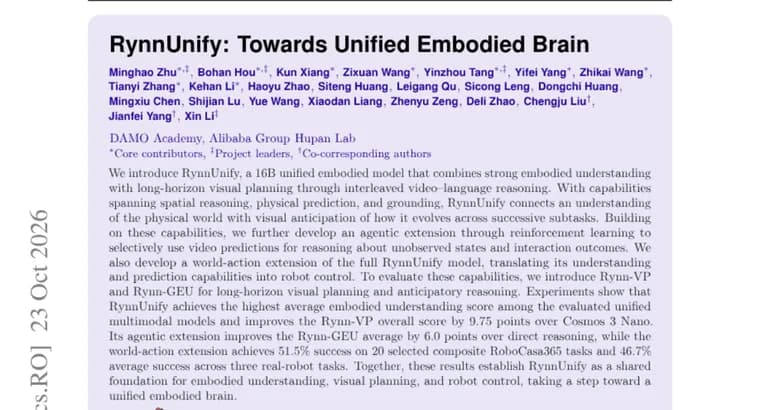
A paper on Hugging Face introduces RynnUnify, a 16B unified embodied model. It aims to put two things in one system: strong embodied understanding, and long-horizon visual planning done through interleaved video and language reasoning. Its capabilities span spatial reasoning, physical prediction and grounding. In the authors' framing, the model connects an understanding of the physical world with visual anticipation of how that world evolves across successive subtasks.
The work builds two extensions on top of the base model. The first is an agentic extension, developed through reinforcement learning, which learns to use video predictions selectively when reasoning about unobserved states and the outcomes of interactions. The second is a world-action extension of the full RynnUnify model, which turns its understanding and prediction abilities into robot control.
To test these abilities, the authors also introduce two benchmarks: Rynn-VP, for long-horizon visual planning, and Rynn-GEU, for anticipatory reasoning.
The reported results are as follows. RynnUnify achieves the highest average embodied understanding score among the unified multimodal models the authors evaluated. On Rynn-VP it improves the overall score by 9.75 points over Cosmos 3 Nano. The agentic extension improves the Rynn-GEU average by 6.0 points over direct reasoning. The world-action extension reaches 51.5% success on 20 selected composite RoboCasa365 tasks and 46.7% average success across three real-robot tasks.
The authors conclude that these results establish RynnUnify as a shared foundation for embodied understanding, visual planning and robot control, and describe it as a step toward a unified embodied brain.
Key facts
- RynnUnify is a 16B unified embodied model that combines embodied understanding with long-horizon visual planning through interleaved video and language reasoning.
- It improves the Rynn-VP overall score by 9.75 points over Cosmos 3 Nano and has the highest average embodied understanding score among the unified multimodal models the authors evaluated.
- An agentic extension trained with reinforcement learning improves the Rynn-GEU average by 6.0 points over direct reasoning.
- A world-action extension for robot control reaches 51.5% success on 20 selected composite RoboCasa365 tasks and 46.7% average success across three real-robot tasks.
- The authors introduce two new benchmarks, Rynn-VP and Rynn-GEU, for long-horizon visual planning and anticipatory reasoning.
Why it matters
Embodied AI work often treats understanding a scene, imagining what happens next and acting as separate problems. RynnUnify tries to cover all three with one foundation: understanding, visual planning through predicted video, and robot control via a world-action extension. The authors present this as a step toward a unified embodied brain. The agentic extension is a further idea: it uses video predictions selectively, to reason about states the robot cannot observe and about how interactions will turn out.
Who it affects
Mainly researchers working on embodied AI, world models and robot learning, who get a model and two new benchmarks, Rynn-VP and Rynn-GEU, aimed at long-horizon visual planning and anticipatory reasoning. Robotics teams interested in tying prediction to control are the other natural audience for the RoboCasa365 and real-robot results.
How to use it
The text gives no release details, so nothing can be said here about code, weights or a licence. For now it is a paper to read. Teams studying long-horizon planning can look at the two benchmarks the authors introduce, and those working on robot control can look at how the world-action extension is built on the full model.
How solid is it
It is a preprint, and all results are the authors' own. The claim of the highest average embodied understanding score holds only among the unified multimodal models they chose to evaluate. The gains of 9.75 points over Cosmos 3 Nano on Rynn-VP and 6.0 points over direct reasoning on Rynn-GEU are on benchmarks the authors created themselves. The robot results (51.5% on 20 selected composite RoboCasa365 tasks, 46.7% average across three real-robot tasks) come from selected tasks, and the text gives no comparison baselines for them.
Risks and caveats
Several things that would help judge the work are not given in the text: the baseline scores and RynnUnify's own absolute scores on Rynn-VP and Rynn-GEU (only the point differences), whether the point gains are on a 100-point scale, the other models compared on understanding, the real-robot tasks and hardware, and whether 16B is total or active parameters. The success rates of roughly half on the robot tasks also suggest the control side is far from solved. The unified embodied brain is the authors' aspiration, not a demonstrated result.