SplatLab runs 3D Gaussian Splatting research end to end, reports up to +3.78 dB PSNR
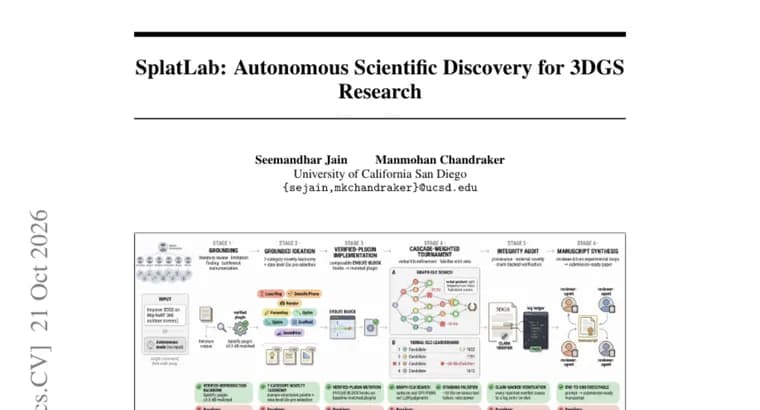
SplatLab is an autonomous research system for 3D Gaussian Splatting (3DGS), described in a preprint listed on Hugging Face Papers. The authors start from a practical complaint: reproducing a published 3DGS paper takes weeks of expert engineering before anyone can propose an extension. Earlier autonomous-research systems read papers, draft hypotheses and write code, but the authors say they are limited by short fixed templates, low executability and weak traceability. None, they add, has been demonstrated end to end in a live computer-vision subfield with intense activity.
SplatLab takes a research prompt, a target-paper URL, or no input at all. From there it reproduces a published baseline, proposes an extension, trains and ablates across the Mip-NeRF 360 and LLFF datasets, writes the manuscript, and binds every reported number to a logged training run.
The authors name five design choices. First, candidates mutate plugins from a verified-reproduction backbone that is matched to published baselines. Second, a cascade-weighted Elo tournament across eight islands scores candidates on measured GPU PSNR, with verbal-gradient feedback. Third, a standing falsifier subtracts Elo when a candidate fails, so survival under stress tests feeds into selection. Fourth, every reported number is tied to a logged training run, and the run cannot terminate while any claim is unbacked. Fifth, a seven-category 3DGS taxonomy wraps EVOLVE-BLOCK markers in domain-aligned scaffolds that can transfer across 3DGS repositories.
On PSNR-targeted runs, the authors report that SplatLab's manuscripts beat their reproduced targets by +0.18 to +3.78 dB. The top figure, +3.78 dB, comes from astrophotographic nebula rendering, a task for which, the authors say, no prior 3DGS method exists. They also claim the research cycle shrinks from months of graduate-student time to days of mostly autonomous compute. Code, all manuscripts, experiment ledgers and the cross-run paper store are said to be available on the project page.
Key facts
- SplatLab is an autonomous research system for 3D Gaussian Splatting: it reproduces a published baseline, proposes an extension, trains and ablates on Mip-NeRF 360 and LLFF, and writes the manuscript.
- Candidates are scored in a cascade-weighted Elo tournament across eight islands on measured GPU PSNR, and a standing falsifier subtracts Elo on failure.
- Every reported number is bound to a logged training run, and the run cannot terminate while any claim is unbacked.
- On PSNR-targeted runs the manuscripts beat their reproduced targets by +0.18 to +3.78 dB, with the top gain on astrophotographic nebula rendering.
- The authors say the research cycle drops from months of graduate-student time to days of mostly autonomous compute, and that code, manuscripts and experiment ledgers are on the project page.
Why it matters
Reproducing a 3DGS paper is slow work before any new idea can be tried. The authors say it takes weeks of expert engineering. SplatLab targets that bottleneck and aims to cover the whole loop in a field with heavy ongoing activity. Its distinguishing feature is traceability: every number in a manuscript is tied to a logged training run, and the run cannot finish while a claim lacks backing. The authors also claim the cycle compresses from months of graduate-student time to days of mostly autonomous compute.
Who it affects
The work is aimed at researchers and engineers in 3D Gaussian Splatting and neighbouring computer-vision areas, who currently spend weeks reproducing baselines. It also bears on anyone building autonomous-research systems, since the paper describes how it handles fixed templates, executability and traceability.
How to use it
According to the authors, the system accepts a research prompt, a target-paper URL, or no input at all. They say code, all manuscripts, experiment ledgers and the cross-run paper store are available on the project page. Teams interested in trying it should start there.
How solid is it
The evidence is the authors' own report: manuscripts beat reproduced targets by +0.18 to +3.78 dB PSNR on PSNR-targeted runs. No baseline names or per-dataset PSNR values are given, only that range. The source says nothing about independent or human evaluation of the manuscripts. The largest gain is on nebula rendering, a task the authors say has no prior 3DGS method, so the comparison there is against a reproduced target and not an established method. This is a preprint summary, not a peer-reviewed result.
Risks and caveats
The gains cover PSNR-targeted runs only; no other metrics such as SSIM or LPIPS are mentioned. The number of runs or manuscripts is not stated, nor is the compute budget, the hardware, or the language model behind the system. The reported range is wide, from +0.18 dB to +3.78 dB, and the biggest figure comes from a niche task. The claim of days instead of months is the authors' own, with no exact duration given. Readers should check the released ledgers before relying on the numbers.