SAEScientist-Bench finds AI agents lag experts at interpretability
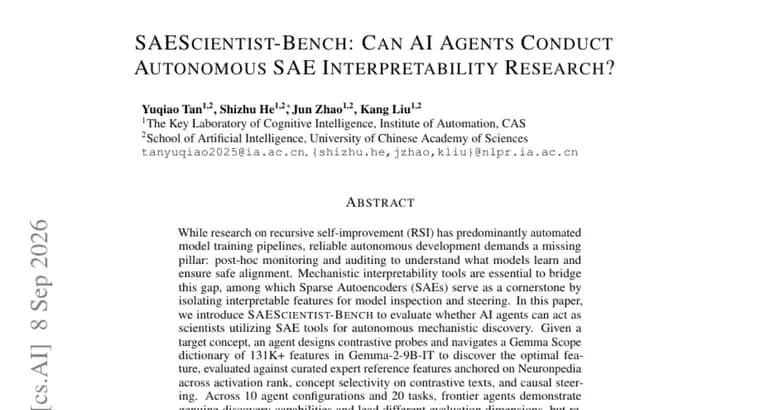
Work on recursive self-improvement (RSI) has so far mostly automated the model training pipeline itself. The researchers behind a new paper argue that reliable autonomous development still needs a missing piece: post-hoc monitoring and auditing that lets someone, or something, understand what a model has learned and check that it stays safely aligned. Mechanistic interpretability tools are the technology they point to for closing that gap, and Sparse Autoencoders (SAEs) are described as a cornerstone of that toolkit, since they isolate interpretable features inside a model that can be inspected or used to steer its behavior.
To test whether AI agents can themselves carry out that kind of interpretability work, the researchers introduce SAEScientist-Bench. Given a target concept, an agent designs contrastive probes and searches a Gemma Scope dictionary of 131K+ features inside Gemma-2-9B-IT to find the single feature that best captures the concept. Each agent's pick is then scored against curated expert reference features anchored on Neuronpedia, across three measures: activation rank, how selectively the feature separates the target concept from contrastive text, and causal steering, whether nudging that feature actually changes the model's output the way the concept would predict.
The benchmark tested 10 agent configurations across 20 tasks. Frontier agents showed genuine discovery ability and led on different evaluation dimensions, but stayed well behind the expert baseline overall. They came closest to expert performance on separating a target concept from contrastive controls, while lagging substantially on causal steering. The text gives no numeric accuracy, score or percentage for any of these comparisons; the ranking is stated only in qualitative terms.
Further analysis found that agents are able to design contrastive probes that correctly rule out spurious feature candidates, but that they frequently misinterpret their own experimental measurements once they have them. The authors take the overall result as evidence that experimental model understanding, an AI system's ability to investigate and correctly interpret another model, is now a measurable capability for closed-loop autonomous AI R&D, the kind of pipeline in which AI systems would audit or improve other AI systems on their own. Code for the benchmark is public on GitHub, at Trae1ounG/SAEScientist. The text does not name the paper's authors, their institutions, or a publication date.
Key facts
- SAEScientist-Bench tests whether AI agents can act as autonomous scientists, using Sparse Autoencoders (SAEs) to find interpretable features inside a target model.
- Given a target concept, an agent designs contrastive probes and searches a Gemma Scope dictionary of 131K+ features in Gemma-2-9B-IT to find the feature that best matches it.
- Each agent's pick is scored against curated expert reference features anchored on Neuronpedia across three measures: activation rank, concept selectivity on contrastive texts, and causal steering.
- Across 10 agent configurations and 20 tasks, frontier agents approached expert-level performance at separating target concepts from contrastive controls but lagged substantially at causal steering.
- Agents could design contrastive probes that correctly ruled out spurious feature candidates, but the authors found they frequently misinterpret their own experimental measurements.
Why it matters
Work on recursive self-improvement (RSI) has so far mostly automated a model's own training pipeline. The researchers behind SAEScientist-Bench argue that leaves a piece missing: post-hoc monitoring and auditing that lets someone understand what a model has actually learned and check that it stays safely aligned. Sparse Autoencoders (SAEs) are the tool they point to for that job, since they isolate interpretable features inside a model that can be inspected or used to steer its behavior. The benchmark asks a sharper question: can an AI agent do that interpretability work itself, without a human running the analysis? The authors treat a capable answer as a building block for closed-loop autonomous AI R&D, where AI systems audit or improve other AI systems on their own, and their results suggest that capability is real but still uneven, especially at the step where a found feature has to actually control the model's output.
Who it affects
The direct audience is mechanistic interpretability researchers and anyone building or evaluating autonomous AI R&D and AI safety auditing pipelines, since the benchmark is framed explicitly around using AI agents to monitor and understand other AI systems. It also speaks to teams working with the Gemma Scope feature dictionary, Gemma-2-9B-IT, or Neuronpedia's curated features, since the benchmark's tasks are built directly on that ecosystem. The paper does not center on a company or a deployed product, so there is no direct consumer-facing impact yet.
How to use it
SAEScientist-Bench is a benchmark, not a shipped product, but its code is public on GitHub at Trae1ounG/SAEScientist. An agent is handed a target concept, then has to design contrastive probes and search the Gemma Scope dictionary of 131K+ features inside Gemma-2-9B-IT to find the feature that best matches it; the resulting pick is scored against curated expert reference features anchored on Neuronpedia. Researchers can use the released code to run their own agent configurations against the benchmark's 20 tasks. The text gives no pricing or licensing information, since this is a research artifact rather than a commercial release.
How solid is it
The benchmark spans 10 agent configurations tested across 20 tasks, scored on three separate axes: activation rank, concept selectivity on contrastive text, and causal steering, against curated expert reference features rather than a single anecdote. But the text gives no numeric accuracy, score or percentage for how close any agent came to the expert baseline: the comparison is stated only in qualitative terms such as 'well behind', 'approaching expert levels', and 'lagging substantially'. It also does not name which specific agents or models made up the 10 agent configurations, does not explain how the curated expert reference features were themselves selected or validated, and does not name the paper's authors, their institutions, or a publication date.
Risks and caveats
Agents could design contrastive probes that correctly ruled out spurious feature candidates, but the authors found they frequently misinterpret their own experimental measurements once they have them, a distinct failure mode from simply picking the wrong feature. The weakest evaluation axis, causal steering, is arguably the one that matters most for any real auditing use: finding a feature that correlates with a concept is not the same as reliably using it to change the model's behavior. The paper's motivating claim is that this kind of interpretability work is needed for safe, autonomous AI development, but no discussion of downstream safety outcomes or real-world RSI deployment is given: the claim about monitoring and safe alignment is not followed by evidence of either happening. The benchmark measures discovery capability, not a demonstrated safety outcome.
“Frontier agents demonstrate genuine discovery capabilities and lead different evaluation dimensions, but remain well behind the expert baseline.”
— the authors of the SAEScientist-Bench paper