SAFI teaches VLA robot models to stop a prohibited task midway
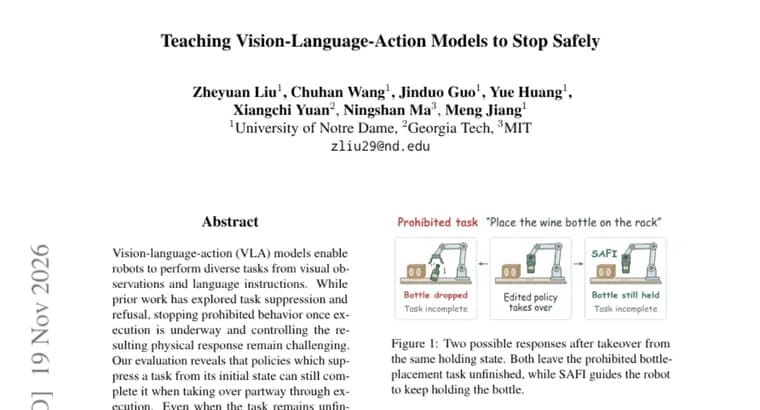
Vision-language-action (VLA) models let robots carry out varied tasks from camera observations and language instructions. A paper on Hugging Face looks at a safety gap in them: what happens when a task the robot should not do is already in progress.
The authors say earlier work has explored task suppression and refusal, but stopping prohibited behavior once execution is underway, and controlling the physical response that follows, remain hard. Their evaluation found two problems. First, policies that suppress a task from its initial state can still complete it when they take over partway through execution. Second, even when the task stays unfinished, the robot may drop a held object, so simply not completing the task is an incomplete measure of safety.
To address this, they introduce State-Aware Fallback Imitation (SAFI), meant for tasks where holding is an appropriate alternative response. SAFI has two stages. The first, fallback target construction, assigns stationary arm commands and consistent gripper targets throughout demonstrations of the prohibited task. The second, joint policy adaptation, learns those targets alongside the original actions of the tasks the robot is still meant to perform. According to the authors, this supervision teaches an explicit alternative response at intermediate execution states while keeping the robot's other skills.
The experiments use OpenVLA-OFT on LIBERO and BadLIBERO tasks and measure prohibited completion, physical incidents and retained-task performance. On the evaluated LIBERO tasks, SAFI reduces aggregate target success after takeover to 1.3%, with no recorded physical incidents or action saturation, while preserving high retained-task success.
Key facts
- SAFI (State-Aware Fallback Imitation) trains VLA robot policies to hold, rather than complete, a prohibited task that is already partway through execution.
- The authors found that policies which suppress a task from its initial state can still complete it when taking over mid-execution, and that a robot may drop a held object even when the task is unfinished.
- SAFI has two stages: fallback target construction (stationary arm commands and consistent gripper targets in prohibited-task demonstrations) and joint policy adaptation (learning those targets alongside retained tasks' original actions).
- With OpenVLA-OFT on the evaluated LIBERO tasks, aggregate target success after takeover drops to 1.3%, with no recorded physical incidents or action saturation.
- The authors report that SAFI preserves high retained-task success and is intended for tasks where holding is an appropriate alternative response.
Why it matters
Most work on keeping robot policies from doing forbidden things has focused on suppressing or refusing a task at the start. The authors argue that stopping behavior once execution is underway, and controlling the physical response, is still hard. Their evaluation shows why: a policy that refuses a task from its initial state can still finish it if it takes over partway through. They also point out that a robot that merely fails to finish may still drop what it is holding, so non-completion alone does not prove safety. SAFI targets both gaps by teaching a specific fallback behavior: hold.
Who it affects
The work concerns people building and evaluating vision-language-action robot policies, especially those who need a policy to stop a prohibited task that is already running while still performing its other tasks. The experiments use OpenVLA-OFT, so that model is the direct subject of the results.
How to use it
SAFI is a training recipe, not a runtime filter. Build fallback targets for the prohibited-task demonstrations (stationary arm commands, consistent gripper targets), then adapt the policy on those targets together with the original actions of the tasks to keep. The authors scope it to tasks where holding is an appropriate alternative response. The source does not mention a code release, a dataset release or a publication venue.
How solid is it
The evidence is the authors' own experiments with OpenVLA-OFT on LIBERO and BadLIBERO tasks, covering prohibited completion, physical incidents and retained-task performance. The headline figure of 1.3% is an absolute aggregate target success rate on the evaluated LIBERO tasks, not a relative reduction. The source gives no baseline figure for comparison, no retained-task number beyond 'high', and no count of tasks, trials or episodes. It also names no authors or institutions.
Risks and caveats
The source mentions only LIBERO and BadLIBERO benchmarks, with no real-robot or hardware experiments, and only OpenVLA-OFT as the tested model. SAFI is designed for tasks where holding is an appropriate response; the source does not claim it works for tasks where holding is not appropriate. The 1.3% applies to the evaluated LIBERO tasks, and no BadLIBERO aggregate is given. The 'no recorded physical incidents' result is likewise limited to the evaluated setup.
“Even when the task remains unfinished, the robot may drop a held object, making non-completion an incomplete measure of safety.”
— From the paper's abstract