Self-WSP: Qwen3.5-0.8B edits its own weights, with large but unexplained gains
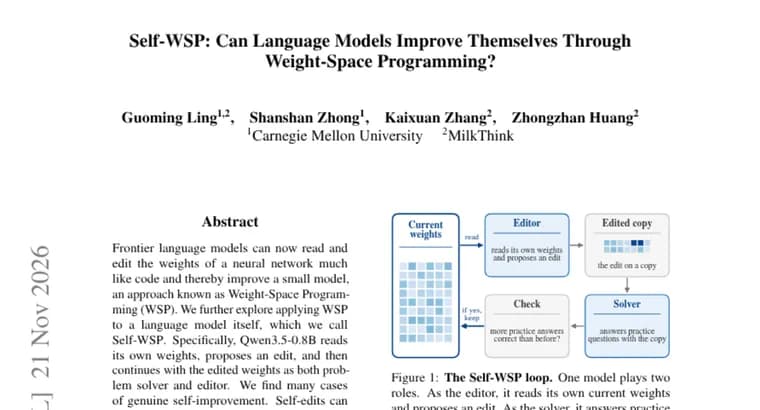
A paper listed on Hugging Face Papers introduces Self-WSP, a way for a small language model to modify itself. It builds on Weight-Space Programming (WSP), an approach in which, as the authors put it, frontier language models can now read and edit the weights of a neural network much like code and thereby improve a small model. Self-WSP turns that idea on the model itself.
The setup is specific. Qwen3.5-0.8B reads its own weights, proposes an edit, and then continues with the edited weights as both problem solver and editor. So the same model that solves the problems is also the one that decides how to change itself, and the loop can repeat.
The authors report finding many cases of genuine self-improvement. Self-edits can raise GSM8K accuracy from 11.8% to 62.2% and MATH500 accuracy from 7.0% to 32.2%. These are absolute accuracies and describe the best cases: the wording is "can raise". The gains sometimes come from changing only 16 parameters. In some cases, repeated self-editing keeps improving the model.
Then comes the caveat, which the authors state themselves. A closer look reveals that the gains lack interpretability. The model shows little understanding of the edits it makes, and WSP driven by random search sometimes performs comparably. In other words, the improvement does not appear to come from the model reasoning its way to a good change.
The authors conclude that Self-WSP holds promise as a path toward recursive self-improvement (RSI), but that realizing this promise requires further exploration. They do not claim RSI has been achieved.
Key facts
- In Self-WSP, Qwen3.5-0.8B reads its own weights, proposes an edit, then continues with the edited weights as both problem solver and editor.
- Self-edits can raise GSM8K accuracy from 11.8% to 62.2% and MATH500 accuracy from 7.0% to 32.2%, sometimes by changing only 16 parameters.
- In some cases, repeated self-editing keeps improving the model.
- The authors say the gains lack interpretability: the model shows little understanding of its edits, and random-search WSP sometimes performs comparably.
- The authors present Self-WSP as a promising path toward recursive self-improvement that needs further exploration.
Why it matters
Recursive self-improvement, a model making itself better, is a long-discussed goal. This paper tests a literal version at small scale: a 0.8B model edits its own weights. The reported jumps are large, from 11.8% to 62.2% on GSM8K and from 7.0% to 32.2% on MATH500, and sometimes only 16 parameters were changed. But the authors' own analysis undercuts the headline: the model barely understands what it changes, and random search can sometimes do about as well. That makes the result more a curiosity about how sensitive small models are to weight edits than evidence of a model that improves itself by design.
Who it affects
Mainly researchers working on self-improving systems, model editing and interpretability. The paper builds on Weight-Space Programming, where stronger models edit the weights of a smaller one, and extends it to a model editing itself. The abstract names no authors or institutions and no major lab.
How to use it
This is a research method, not a product. The practical takeaway is the idea itself: a language model can be handed its own weights as something to read and edit, and a loop of propose, apply and continue can be run on a small model such as Qwen3.5-0.8B. The abstract describes no tool or release to try.
How solid is it
The evidence is an abstract only. The numbers are stated as best cases ('can raise', 'sometimes'), not typical or average results. Typical or average gains are not stated. The abstract does not say how many trials or runs were made, or how often the large gains occurred. It also does not say which edits were made, or whether the 16-parameter edits are the ones behind the 11.8% to 62.2% and 7.0% to 32.2% gains. Random search is only said to 'sometimes' perform comparably, with no figures. Whether the gains hold on other models, benchmarks or larger sizes is not stated.
Risks and caveats
The authors themselves flag that the gains lack interpretability and that the model shows little understanding of its edits. Random-search WSP sometimes matches the approach, which suggests the gains may not need the model's own judgment. Repeated self-editing keeps helping only in some cases, not all. Calling this a step to recursive self-improvement is the authors' framing of a possible path; they say realizing it requires further exploration, and no claim is made that RSI has been achieved.
“The model shows little understanding of the edits it makes, and WSP driven by random search sometimes performs comparably.”
— Self-WSP paper abstract, Hugging Face Papers