Sakana AI's MASS trains Qwen3.6-27B on its own best team workflows
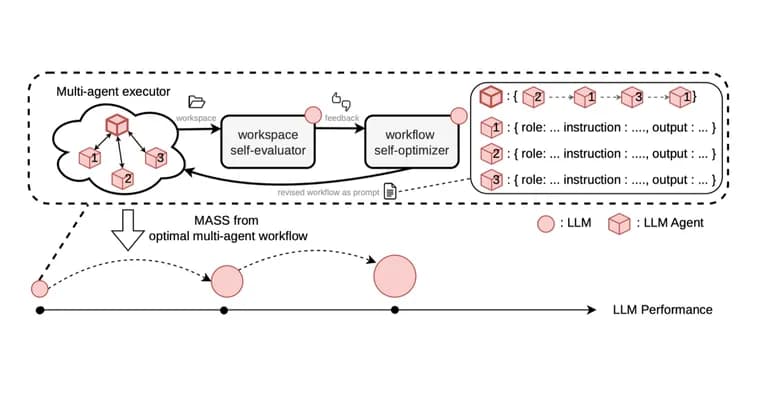
A Sakana AI publication (the work was done during an internship at Sakana AI) introduces Multi-Agent Self-Supervision, or MASS, a recursive self-improvement (RSI) loop for language models. The motivation is stated up front: the authors want frontier models to take us beyond the body of knowledge humanity has built, but at that frontier even human experts may struggle to assess results and guide progress, particularly on non-verifiable tasks. Borrowing an analogy from human societies, which expanded their capabilities by dividing work, combining ideas and passing on what they learn, the authors ask whether a model can learn from its own team's collective intelligence, something a lone agent may not reliably show.
In MASS one shared model fills three roles. As the agent (the optimizee) it solves the task and produces a workspace with results, plots and a research report. As the workflow optimizer it uses the evaluator's feedback to revise how agents divide the task, exchange results and check each other's work. As the evaluator it compares two workspaces, picks the one that better satisfies the task and explains why. An inner loop optimizes the team's workflow while the model weights stay fixed, with the model itself judging which workflow is best. An outer loop then updates the weights by training on executions of that optimized workflow, and the updated model takes all three roles again. A workflow is a written plan for how a multi-agent team should work, added to the task prompt, with an orchestrator that assigns work to subagents and integrates their results. For each training task MASS keeps a champion, the best workflow found so far by the current model's judgment. Because long-horizon research quality varies from run to run, champions are executed with multiple random seeds, the current model ranks the resulting workspaces, and the highest-ranked trajectories (messages, tool calls and tool results of the orchestrator and subagents) are kept for training. The workflow is removed from the orchestrator's training prompt, so the model learns to organize the work from the task itself.
The training tasks are non-verifiable research tasks: no automatic rule-based signal exists, and only a self-evaluation signal of unknown correctness guides the loop. To measure progress from outside, the authors separately ask GPT-5.5 and Claude Opus 4.8 to assess the finished work; those judgments are withheld from MASS. One example is an evolved finance workflow that runs data preparation, feature construction, modeling and backtesting in sequence, followed by an audit, reconciliation and a report. Its data specialist must return a validation report with flags such as no_future_leakage, train_end_before_val_start and val_end_before_test_start, which guards against a backtest that quietly uses information from the future.
The experiments run two complete rounds of MASS starting from Qwen3.6-27B in the qwen-code coding-agent environment, on a synthetic research suite of 12 tasks in finance, robotics and pharmacy, each needing code, quantitative results and a research report. On the three synthetic test tasks, the win rate against the base model rises from 53.9% after one round to 69.9% after two, and the second-round model wins 60.8% of comparisons against the first-round model. On public benchmarks, score per output token after two rounds reaches 1.2 to 1.6 times the base model across MLR-Bench, DSBench, ScienceAgentBench and AstaBench. It is slightly below the base on Terminal-Bench 2.0 (0.96×) and SWE-bench Verified (0.94×); the authors say gains are strongest on the four research benchmarks that resemble the training tasks.
The authors report several further findings. Training only on task-solving trajectories also improved the workflow optimizer and the evaluator (role generalization), which they say makes the loop sustainable. They concede that their comparison showing the optimizer finding successful workflows sooner is not fully fair, since optimizer and optimizee both change; in a control, the base model given first-round workflows wins 64% of comparisons against the base model with base workflows. The evaluator's agreement with the strong external judges rises from 73% to 93% across the three cycles. In a comparison of students trained from the same base model, the first-round MASS model (M+) reaches a 68.3% win rate against the base after 28.8M supervised training tokens, while a single-agent student (S++) reaches 64.0% after 42M tokens, so MASS needs 31% fewer tokens (pooled across four training tasks and one test task). External judges prefer multi-agent work over single-agent outputs in 85.1% of comparisons, though team runs generate about 2.4× as many tokens on average.
Two more observations concern the loop itself. With the base model as solver, swapping in GPT-5.5 as evaluator only helps a little, while upgrading the optimizer as well helps a lot, so the bottleneck can be the optimizer rather than the evaluator; the strictly homogeneous loop still finds winning workflows for 11 of 12 tasks, just more slowly. Workflow search is also noisy, and the authors suggest the LLM optimizer may need an equivalent of a learning-rate scheduler. Analyzing champion workflows across iterations, task information shifts toward contracts and hops and away from roles and instructions. The article closes by quoting Tennyson's Ulysses and posing the open research question of how AI can turn incomplete human guidance, as with expert writers who recognize strong writing but cannot write it into a reliable rubric, into useful criteria for learning.
Key facts
- MASS uses a single shared model as executor, workflow optimizer and evaluator, then retrains it on trajectories from its own self-judged best multi-agent workflows; GPT-5.5 and Claude Opus 4.8 judge progress from outside but are withheld from training.
- Two rounds from Qwen3.6-27B on three synthetic test tasks: win rate against the base model went from 53.9% after one round to 69.9% after two; the second-round model beat the first-round model in 60.8% of comparisons.
- Score per output token reached 1.2 to 1.6 times the base on MLR-Bench, DSBench, ScienceAgentBench and AstaBench, but sat at 0.96× on Terminal-Bench 2.0 and 0.94× on SWE-bench Verified.
- Multi-agent trajectories were more token-efficient for training: 68.3% win rate after 28.8M supervised tokens versus 64.0% after 42M for single-agent data, 31% fewer tokens.
- The optimizer, not the evaluator, can be the bottleneck: upgrading only the evaluator helped a little, upgrading the optimizer as well helped a lot.
Why it matters
The paper tackles a hard version of self-improvement: how a model can keep learning where no automatic checker exists and even human experts may struggle to judge the output. MASS answers with a self-supervision signal built from the model's own team, so the same model proposes workflows, judges them and then learns from the best ones. The authors frame it as a step toward what they call AI's Odyssean moment, continual self-learning in which the optimizee is the evaluator and the optimizer is the optimizee. The concrete novelty is distilling multi-agent collective experience into a single shared model rather than only using teams at test time.
Who it affects
Mainly researchers working on recursive self-improvement, self-supervision without verifiers, and multi-agent systems. Builders of agent teams may find the findings on contracts and hops, and on what makes a workflow effective, relevant. The experiments use one open base model, Qwen3.6-27B, on research-style tasks in finance, robotics and pharmacy, so the nearest audience is anyone training or evaluating models for long-horizon research work.
How to use it
This is a research result, not a product. The visible text does not mention any release of code, weights or data. What it offers practitioners are findings from the experiments: under a limited budget one may have to prioritize the optimizer over the evaluator in an RSI loop; multi-agent trajectories can supply more effective supervision per training token than long single-agent ones; and effective workflows put task information into output contracts and hand-off hops more than into role descriptions. The setup itself ran inside the qwen-code coding-agent environment, with champion workflows executed over multiple seeds and ranked by the current model.
How solid is it
This is first-party work done at Sakana AI, with results on a synthetic suite plus public benchmarks, and the authors flag some of their own weak spots. They call their optimizer-progress comparison technically not very fair and add a control (64% wins for the base model given first-round workflows). External judges, GPT-5.5 and Claude Opus 4.8, provide an independent measure that is kept out of training, and evaluator agreement with them rose from 73% to 93%. Results cover one base model only, absolute benchmark scores are not given (only ratios to the base), and no training compute, cost or wall-clock time is stated.
Risks and caveats
The learning signal is self-evaluation whose correctness is unknown, so gains depend on the model's own judgments tracking real quality. Benefits are uneven: score per output token fell slightly on Terminal-Bench 2.0 (0.96×) and SWE-bench Verified (0.94×), and the authors say gains are strongest on benchmarks resembling the training tasks. Team runs generate about 2.4× as many tokens as single-agent runs on average. Workflow search is noisy, and the authors suggest it may need something like a learning-rate scheduler. The claim that multi-agent trajectories help RSI is worded as 'can be more effective', not as a general rule, and the win rates come from a small suite of three test tasks.
“Beyond the utmost bound of human thought.”
— Tennyson's Ulysses, quoted in the Sakana AI article