Self-Evolving Agent Harness paper formalizes how agents revise their own scaffolding
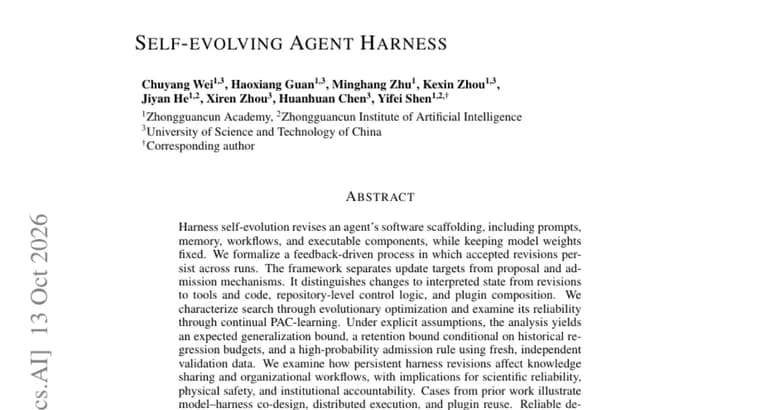
A paper titled "Self-Evolving Agent Harness", listed on Hugging Face Papers, sets out a formal account of how an AI agent's surrounding software can improve itself over time without any change to the underlying model. The abstract defines harness self-evolution as revising an agent's software scaffolding, including prompts, memory, workflows and executable components, while keeping model weights fixed.
The core move is a formalization of a feedback-driven process in which accepted revisions persist across runs. The framework separates update targets (what gets changed) from the proposal and admission mechanisms (how changes are suggested and accepted). It also distinguishes several kinds of change: edits to interpreted state, revisions to tools and code, repository-level control logic, and plugin composition.
On the theory side, the authors characterize the search for better harnesses through evolutionary optimization and examine its reliability through continual PAC-learning. Under explicit assumptions, the analysis yields three results: an expected generalization bound, a retention bound conditional on historical regression budgets, and a high-probability admission rule that uses fresh, independent validation data.
The paper then turns to consequences. It examines how persistent harness revisions affect knowledge sharing and organizational workflows, with implications for scientific reliability, physical safety and institutional accountability. Cases from prior work illustrate model-harness co-design, distributed execution and plugin reuse. The authors conclude that reliable deployment requires continual validation as task distributions and evaluators change, with independent safeguards for learning, runtime privileges and consequential actions.
The authors provide a comprehensive 66-page discussion of related work, theory, algorithms, evaluation, applications and the broader impact of what they call Harness RSI, together with continuously updated code and supplementary materials on GitHub at zgcagi/Harness-RSI.
Key facts
- Harness self-evolution revises an agent's prompts, memory, workflows and executable components while model weights stay fixed.
- The framework separates update targets from proposal and admission mechanisms, and distinguishes interpreted-state changes from revisions to tools and code, repository-level control logic and plugin composition.
- Search is characterized through evolutionary optimization and its reliability through continual PAC-learning, yielding an expected generalization bound, a retention bound tied to historical regression budgets, and a high-probability admission rule using fresh, independent validation data.
- The authors say reliable deployment needs continual validation as task distributions and evaluators change, plus independent safeguards for learning, runtime privileges and consequential actions.
- A 66-page discussion and continuously updated code are hosted on GitHub at zgcagi/Harness-RSI.
Why it matters
An agent's scaffolding, meaning its prompts, memory, workflows and code, can be revised while the model weights stay fixed. This paper tries to put that practice on a formal footing: if an agent's prompts, memory, workflows and code are revised and the revisions persist across runs, what should count as an accepted change, and what can be guaranteed about it? The framework offers vocabulary (update targets, proposal, admission) and bounds for those questions.
Who it affects
Teams building agents whose scaffolding changes over time, and researchers working on self-improving or continual-learning systems. The authors also point to wider effects on knowledge sharing and organizational workflows, with implications for scientific reliability, physical safety and institutional accountability.
How to use it
The authors host code and supplementary materials, which they say are continuously updated, at github.com/zgcagi/Harness-RSI, alongside a 66-page discussion covering related work, theory, algorithms, evaluation and applications. Their practical takeaway is that changes should pass an admission rule based on fresh, independent validation data, with validation continuing as tasks and evaluators change.
How solid is it
The claims are theoretical and hold under explicit assumptions stated by the authors. The source text is a Hugging Face Papers abstract; it gives no experimental results, benchmark scores or numeric values for the bounds, and it names no authors or institutions. The cases it cites come from prior work, and the abstract does not say that agents have actually been deployed with self-evolving harnesses.
Risks and caveats
The authors themselves warn that persistent revisions raise questions of scientific reliability, physical safety and institutional accountability. They state that reliable deployment requires continual validation as task distributions and evaluators change, with independent safeguards for learning, runtime privileges and consequential actions. The bounds depend on assumptions, so how well they hold in a given real system is not shown in the abstract.
“Reliable deployment requires continual validation as task distributions and evaluators change, with independent safeguards for learning, runtime privileges, and consequential actions.”
— Paper abstract, Hugging Face Papers