Self-Retrospection Distillation lifts RLVR agents by up to 24.2 pp
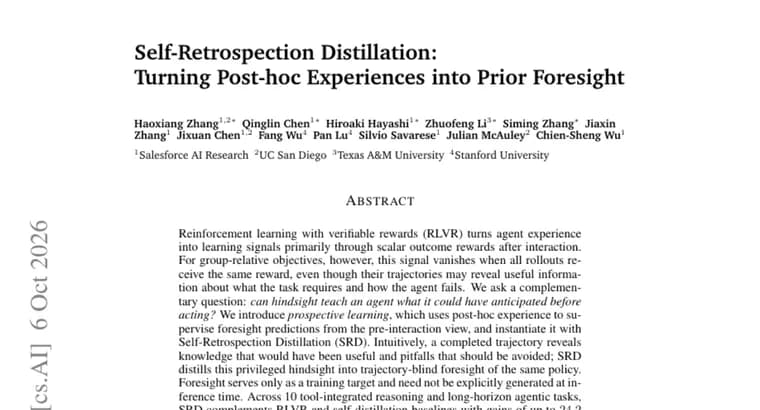
A paper on Hugging Face Papers (2610.08077) starts from a known weakness of reinforcement learning with verifiable rewards (RLVR). RLVR turns agent experience into learning signals mainly through a scalar outcome reward given after the interaction. For group-relative objectives, that signal vanishes when all rollouts in a group receive the same reward, even though the trajectories themselves may show what the task requires and how the agent fails.
The paper asks a complementary question: can hindsight teach an agent what it could have anticipated before acting? Its answer is "prospective learning", which uses post-hoc experience to supervise foresight predictions made from the pre-interaction view. The concrete method is Self-Retrospection Distillation (SRD). The intuition is that a completed trajectory reveals knowledge that would have been useful and pitfalls that should have been avoided. SRD distills this privileged hindsight into trajectory-blind foresight of the same policy. Foresight is only a training target and does not have to be generated explicitly at inference time.
The authors evaluate SRD on 10 tool-integrated reasoning and long-horizon agentic tasks. There, SRD complements RLVR and self-distillation baselines, with gains of up to 24.2 percentage points. They say its advantage is especially pronounced when reward contrast is scarce. Across model scales, 37 to 98% of rollout groups are reward-uniform, yet SRD can still draw learning signal from the sampled trajectories.
The starkest example is the 2B setting, where 98% of groups are all-failure. RLVR training alone ends at 0.0% success, while adding SRD reaches 60.6% under the same rollout budget. The authors conclude, in hedged terms, that their results suggest post-hoc agent experience is useful not only for evaluating or improving behavior, but also for shaping predictive representations before available interaction.
Key facts
- Self-Retrospection Distillation (SRD) distills hindsight from a completed trajectory into trajectory-blind foresight of the same policy; foresight is only a training target and need not be generated at inference time.
- It targets a gap in group-relative RLVR: the learning signal vanishes when all rollouts in a group receive the same reward.
- Across 10 tool-integrated reasoning and long-horizon agentic tasks, SRD complements RLVR and self-distillation baselines with gains of up to 24.2 pp.
- Across model scales, 37 to 98% of rollout groups are reward-uniform; the advantage of SRD is especially pronounced when reward contrast is scarce.
- In the 2B setting, where 98% of groups are all-failure, RLVR alone ends at 0.0% success while adding SRD reaches 60.6% under the same rollout budget.
Why it matters
Group-relative RLVR objectives learn nothing from a group of rollouts that all get the same reward, and the paper reports that 37 to 98% of rollout groups are reward-uniform across model scales. SRD tries to recover signal from those wasted trajectories by treating them as evidence of what the task requires and how the agent fails. The reported extreme case is the 2B setting with 98% all-failure groups: 0.0% success with RLVR alone against 60.6% with SRD added, at the same rollout budget.
Who it affects
The work is aimed at people training agents with RLVR on tool-integrated reasoning and long-horizon tasks, particularly where rewards are sparse and most rollouts fail. The paper frames SRD as complementary to RLVR and to self-distillation baselines, not a replacement for them.
How to use it
The abstract describes the idea rather than a recipe: after a rollout completes, use the trajectory as privileged hindsight and train the same policy, which does not see that trajectory, to predict that foresight from the pre-interaction view. Foresight serves only as a training target, so it need not be generated at inference time. The abstract gives no code or model release, compute cost or training time.
How solid is it
The numbers are the authors' own, reported in the abstract of a Hugging Face Papers entry. The 24.2 pp figure is a maximum ("up to"), and the abstract does not say which task or baseline it came from, nor the typical or average gain. The 60.6% against 0.0% comparison is stated only for the 2B setting, not for other model scales. The abstract does not name the 10 tasks, the benchmarks, the base models or the specific baselines. The authors' wider conclusion is phrased as "suggest", not as a proof.
Risks and caveats
The abstract names no authors or institutions and no date, and it does not name the tasks, benchmarks or base models, so the results cannot be checked against known setups from this text alone. The headline jump comes from a single 2B setting where 98% of groups are all-failure, an extreme regime, and it should not be read as the expected gain elsewhere. The 24.2 pp figure is an upper bound, not a typical result.
“Foresight serves only as a training target and need not be explicitly generated at inference time.”
— Paper abstract, Hugging Face Papers 2610.08077