ShallowStream cuts streaming video latency up to 52x by indexing shallow layers
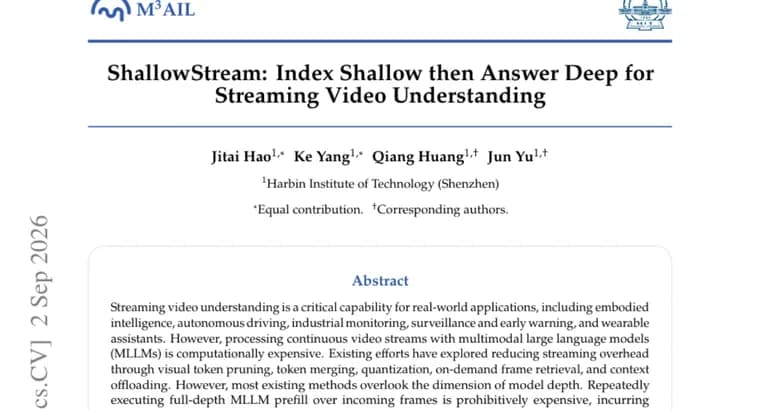
Researchers have proposed ShallowStream, a framework for streaming video understanding with multimodal large language models (MLLMs) that targets a bottleneck other methods have largely ignored: model depth. Streaming video understanding matters for embodied intelligence, autonomous driving, industrial monitoring, surveillance and early warning, and wearable assistants, but feeding a continuous video stream through an MLLM is computationally expensive. Prior work has attacked the cost through visual token pruning, token merging, quantization, on-demand frame retrieval, and context offloading, but the authors argue most of these methods overlook the dimension of model depth: repeatedly running full-depth MLLM prefill over every incoming frame is prohibitively expensive, and it makes the KV cache grow at a rate directly proportional to prefill depth.
ShallowStream's fix is to stop pushing every frame through the full model. Instead, it uses only the shallow layers of the MLLM to do two things at once as the stream comes in: encode each frame, and build an always-on, lightweight retrieval index from the KV cache those shallow layers produce. When a query arrives, ShallowStream reuses the attention scores generated by those same shallow layers to score how relevant each context frame is, then applies a diversity-aware selection strategy to pull out evidence that is both precise and comprehensive rather than redundant.
According to the authors, ShallowStream matches the performance of the strongest existing streaming methods while cutting per-frame prefill latency by up to 52.1x and 10-second end-to-end latency by up to 11.9x. The abstract does not name the baseline methods it was compared against, the benchmarks or datasets used, or give absolute latency figures in milliseconds or seconds; only the multiplicative "up to" reduction factors and the qualitative claim of on-par accuracy are stated. Code for ShallowStream is released on GitHub at CURRENTF/ShallowStream.
Key facts
- ShallowStream uses only the shallow layers of an MLLM to encode incoming video frames and simultaneously build an always-on lightweight retrieval index from their KV cache.
- At query time, it reuses shallow-layer attention scores to rank context frames and applies a diversity-aware selection strategy to retrieve evidence.
- It cuts per-frame prefill latency by up to 52.1x and 10-second end-to-end latency by up to 11.9x versus running full-depth prefill on every frame.
- The authors report accuracy on par with the strongest existing streaming methods, though no baseline names, benchmarks, or absolute latency numbers are given.
- Code is publicly available on GitHub at CURRENTF/ShallowStream.
Why it matters
Most efforts to make streaming video understanding cheaper have squeezed the same lever: how many tokens or how much precision each frame carries into the model (pruning, merging, quantization, retrieval, offloading). ShallowStream instead targets how deep into the model each frame has to travel. The authors' core complaint about existing methods is that repeated full-depth prefill on every frame is expensive on its own terms and also makes the KV cache balloon in proportion to that depth. Cutting prefill down to shallow layers attacks both problems in the same move, which is a different axis of optimization than the one the field has mostly worked on.
Who it affects
The framework targets applications that have to process video continuously rather than as isolated clips: embodied intelligence and robotics, autonomous driving, industrial monitoring, surveillance and early warning systems, and wearable assistants. These are settings where a model must keep watching a live feed and answer questions about it without redoing full-depth computation on every single frame, and where prefill cost and KV cache growth directly limit how long a stream can run before latency or memory becomes a problem.
How to use it
The authors have released the code on GitHub at CURRENTF/ShallowStream, so the method can be inspected or reproduced directly rather than taken only on the abstract's word. No licensing terms, pricing, or product packaging are mentioned; this is a research release, not a commercial offering.
How solid is it
The claims come from the paper's own abstract: the 52.1x per-frame and 11.9x end-to-end latency reductions are stated as "up to" figures, meaning best-case rather than typical improvements, and the accuracy claim is only that ShallowStream is "on par with the strongest existing streaming methods" without naming those methods or the benchmarks used to make the comparison. The presence of public code is a meaningful solidity signal since it lets outside groups verify the numbers, but the abstract itself withholds the specifics needed to judge the comparison independently.
Risks and caveats
The abstract gives no absolute latency numbers, so it is not possible to tell from it alone how fast ShallowStream actually runs in wall-clock terms, only the relative speedup over an unspecified full-depth baseline. It also does not name the benchmarks, datasets, or the specific competing methods used for the accuracy comparison, nor does it give any accuracy or quality metric values, only the qualitative claim of parity. Readers who need concrete performance numbers or want to judge how the comparison was set up will need to consult the full paper and code rather than the abstract alone.