SRMA algorithm grounds multi-agent LLM memory updates, lifts SWE-bench to 72.2%
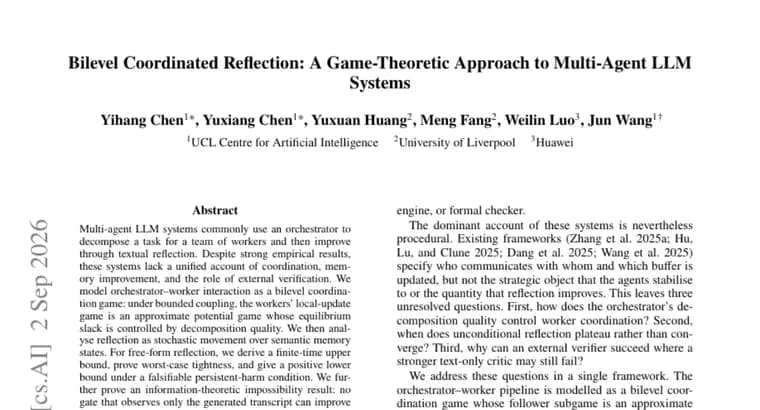
Multi-agent LLM systems commonly use an orchestrator to break a task into pieces for a team of worker models, then improve over time through textual reflection, models writing notes to themselves about what went wrong. According to Yihang Chen and co-authors, these systems already produce strong empirical results, but nobody has a unified account of how coordination, memory improvement and external verification actually work together, so builders have largely been guessing at what makes reflection succeed or fail.
The authors formalize orchestrator-worker interaction as a bilevel coordination game. Under bounded coupling between the orchestrator's decomposition and the workers' behavior, they show the workers' local-update game is an approximate potential game, meaning it has a stable structure whose equilibrium slack, how far the system sits from an ideal coordinated outcome, is controlled by how good the task decomposition is. They then treat reflection itself as stochastic movement over semantic memory states: for free-form reflection they derive a finite-time upper bound on how much it can help, prove that bound is tight in the worst case, and give a positive lower bound under a falsifiable condition they call persistent harm.
The paper's central theoretical result is an information-theoretic impossibility proof: no gate that observes only the generated transcript can improve uniformly over environments that look the same in text but differ underneath, while a gate grounded in the environment itself can. In plain terms, an LLM critiquing its own output text has a provable ceiling on how reliably that self-critique can help, no matter how the critique is designed, because two situations can read identically in the transcript while actually calling for different corrections.
Motivated by that separation, the authors introduce Stochastic Reflective Memory Ascent (SRMA), which accepts a candidate memory update only after a grounded evaluation shows the risk has strictly decreased, rather than trusting the model's own transcript-based judgment. Under calibration and non-degenerate corrective mass (conditions ensuring the grounded signal is informative enough), they prove SRMA converges exactly, at either a geometric or a polynomial rate, and construct matching examples showing both rate regimes are order-tight, meaning the bounds cannot be improved in general. They also add confidence gating for evaluations that are themselves noisy, and re-anchoring guarantees for environments that shift in a piecewise-stationary way over time.
To test the predicted coordination and drift behavior, the authors instantiate the framework with environment-grounded metrics and run it on 500 SWE-bench instances. The complete Kimi-based system built on these ideas resolves 72.2% of the instances, against 70.8% for a public mini-SWE-agent reference, a gain of 1.4 percentage points. Code for the system is published on GitHub.
Key facts
- Models orchestrator-worker coordination in multi-agent LLM systems as a bilevel game, showing the workers' local-update game is an approximate potential game under bounded coupling.
- Proves an information-theoretic impossibility result: a gate that only sees the generated transcript cannot reliably improve outcomes across environments that look identical in text; a gate grounded in the environment can.
- Introduces Stochastic Reflective Memory Ascent (SRMA), which accepts a memory update only when grounded evaluation shows risk has strictly decreased, and proves it converges geometrically or polynomially under stated conditions.
- On 500 SWE-bench instances, a complete Kimi-based system using these ideas resolves 72.2% versus 70.8% for a public mini-SWE-agent reference, a 1.4 percentage point improvement.
- Code for the system is released on GitHub.
Why it matters
Multi-agent LLM systems with orchestrators and reflective memory already work well in practice, but until now nobody had a formal account of why, or of when self-critique actually helps versus just looking like it helps. This paper supplies that account: it proves that critique based purely on a model's own transcript has a provable ceiling, while critique grounded in something outside the transcript, an actual evaluation of the outcome, does not share that ceiling. That reframes a widespread design choice, letting a model judge its own reasoning text, as a structural limitation rather than an implementation detail to be tuned away.
Who it affects
Researchers and engineers building orchestrator-worker LLM systems with reflection or memory loops, including coding agents, tool-using pipelines and other agentic architectures that rely on models critiquing and revising their own intermediate outputs. The SWE-bench experiment specifically targets software engineering agents built on top of a Kimi-based model.
How to use it
The practical contribution is the SRMA algorithm itself: only accept a candidate memory update after a grounded evaluation shows the risk has strictly decreased, rather than trusting a transcript-only self-judgment. The paper also specifies confidence gating for noisy evaluations and re-anchoring for environments that drift over time. Code for the complete system is published at github.com/YihangChen9/Bilevel-Coordinated-Reflection, though the text gives no timeframe, compute budget or cost figures for reproducing the SWE-bench run.
How solid is it
The theory is backed by proofs (finite-time bounds, tightness results, and exact convergence guarantees for SRMA under stated conditions) plus one experiment: on 500 SWE-bench instances, the complete Kimi-based system resolves 72.2% against 70.8% for a public mini-SWE-agent reference. The text does not say which SWE-bench split the 500 instances are drawn from, does not detail what "Kimi-based" means beyond the name, and compares against only that single public baseline, so the empirical evidence for the real-world gain rests on one comparison rather than a broader benchmark sweep.
Risks and caveats
No author affiliations or institutions are given in the text, and the 1.4 percentage point improvement on SWE-bench is modest next to the theoretical apparatus built to justify it. With no comparison to other multi-agent frameworks and no cost or compute figures disclosed, it is not yet possible to judge how the approach trades off against simpler alternatives, or what it costs to run.