SHAPER adapts embodied agents by evolving skills and harness, not weights
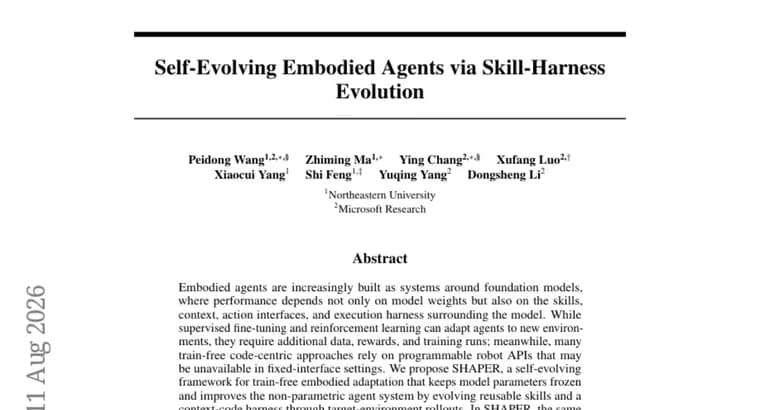
Embodied agents built as systems around foundation models depend not only on the model's weights but on the skills, context, action interfaces and execution harness surrounding it, the authors write. Adapting such an agent to a new environment has so far meant one of two costs. Supervised fine-tuning and reinforcement learning can adapt an agent, but both require additional data, rewards and training runs. Train-free code-centric approaches avoid that training cost, but many of them rely on programmable robot APIs, access that may be unavailable in fixed-interface settings.
The authors propose SHAPER, a train-free framework for embodied adaptation that keeps the model's parameters frozen throughout. Instead of updating weights, SHAPER evolves the non-parametric parts of the agent system: a library of reusable skills and a context-code harness, refined through rollouts the agent performs in the target environment itself. The same frozen model fills both roles in this loop: it serves as the planner that carries out tasks and as the optimizer that refines its own external skills and harness, without any parameter updates.
SHAPER is evaluated on two benchmarks, VLABench and ESI-Bench, chosen because together they cover embodied agents with different low-level action interfaces. The comparison spans pure execution of the base agent, supervised fine-tuning, and test-time-scaling baselines such as verifier-free selection and voting.
The authors' conclusion is that optimizing an agent's skills and harness, rather than its weights, is a practical route to self-evolving embodied agents when training the underlying model is expensive, unavailable or undesirable. The abstract does not give the numeric results of the comparison on VLABench or ESI-Bench, does not explain what either benchmark measures, and does not spell out what the name SHAPER stands for. It also names no individual authors or affiliated institution, and describes only benchmark evaluation, with no mention of testing on physical robots.
Key facts
- SHAPER is a train-free, self-evolving framework that keeps a foundation model's parameters completely frozen and instead evolves the agent's reusable skills and a context-code harness through rollouts in the target environment.
- It targets the costs of two existing routes: supervised fine-tuning and reinforcement learning need extra data, rewards and training runs, while many train-free code-centric methods depend on programmable robot APIs that may be unavailable in fixed-interface settings.
- The same frozen model serves as both planner and optimizer, refining its own external skills and context-code harness without any parameter updates.
- SHAPER is evaluated on two benchmarks, VLABench and ESI-Bench, covering embodied agents with different low-level action interfaces, against pure execution, supervised fine-tuning, and test-time-scaling baselines such as verifier-free selection and voting.
- The authors say the results suggest skill-and-harness optimization is a practical route to self-evolving embodied agents when training the underlying model is expensive, unavailable or undesirable, but the abstract gives no numeric scores for the comparison.
Why it matters
The authors frame embodied-agent performance as resting on more than a model's weights: the skills, context, action interfaces and execution harness built around it matter just as much. That framing sets up the problem SHAPER addresses. Supervised fine-tuning and reinforcement learning can adapt an agent to a new environment, but both need extra data, rewards and training runs; train-free code-centric alternatives skip that training cost, but many of them rely on a programmable robot API, access that fixed-interface settings may not provide. SHAPER is offered as a way around both costs: a frozen model that evolves its own skills and harness through rollouts, rather than being retrained or requiring a programmable interface.
Who it affects
The direct audience is researchers building or evaluating embodied agents on top of frozen foundation models, especially where a fixed, non-programmable robot interface rules out code-centric train-free methods, or where the cost of fine-tuning or reinforcement learning is a barrier. The abstract gives no company, product or deployment context. It also names no individual authors and no affiliated institution, so it is not possible to say from the text who built SHAPER or where the work originates.
How to use it
SHAPER is described as a method rather than as a released tool. Applying it means running rollouts in the target environment, during which the frozen model refines its own skill library and context-code harness, with no extra training data, reward signal or fine-tuning run required. That sets it apart from train-free code-centric baselines, many of which rely on a programmable robot API; SHAPER instead targets exactly the fixed-interface settings where such an API is unavailable. The abstract gives no publication venue, submission date, or timeline.
How solid is it
The evidence is a benchmark comparison rather than a set of published numbers. The authors test SHAPER on VLABench and ESI-Bench, benchmarks chosen to cover embodied agents with different low-level action interfaces, against pure execution, supervised fine-tuning, and test-time-scaling baselines such as verifier-free selection and voting. The abstract states only that the results suggest skill-and-harness optimization is a practical route to self-evolving embodied agents; it gives no accuracy, success-rate or score figures for SHAPER on either benchmark, and does not explain what VLABench or ESI-Bench actually measure. Without those numbers, the size of any advantage over the baselines cannot be judged from the text alone.
Risks and caveats
The abstract names no individual authors or affiliated institution, so the work cannot be weighed against a lab's track record. It gives no publication venue or date, so its review status is unknown. Every comparison described, against pure execution, fine-tuning and test-time-scaling baselines, is reported only as a qualitative conclusion, with no numbers behind the claimed advantage. The evaluation is also confined to VLABench and ESI-Bench: the text makes no mention of testing on physical robots, so whether the skill-and-harness approach holds up outside these two benchmarks is not addressed.
“In SHAPER, the same frozen model can serve as both planner and optimizer, refining its external skills and context-code harness without parameter updates.”
— the paper's authors