Spark-to-Paper generates full research papers as composable skills
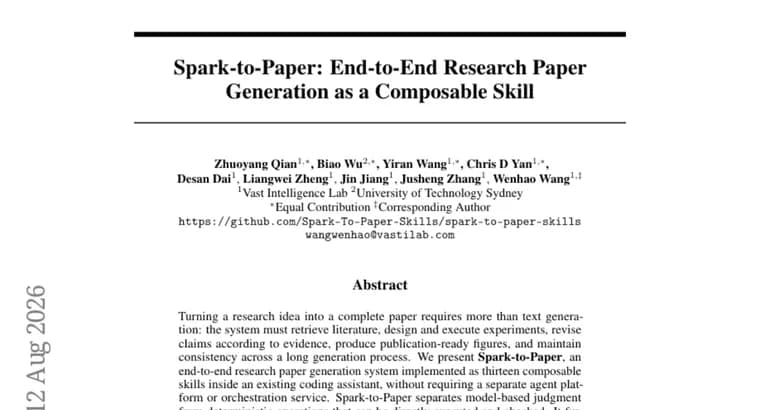
Spark-to-Paper is an end-to-end research paper generation system: given a research idea, it is meant to retrieve the relevant literature, design and run experiments, revise its claims against the evidence those experiments produce, generate publication-ready figures, and keep everything consistent across what the authors describe as a long generation process. It runs as thirteen composable skills inside an existing coding assistant, which the text does not name, rather than as a separate agent platform or orchestration service.
The system's core design choice is to separate model-based judgment from deterministic operations that can be executed and checked directly, and to separate experiment planning from reporting: the evidence a claim will need is specified before the underlying experiment runs, and the manuscript's claims are then revised to match what the experiment actually measured. To stay reliable across a long research trajectory, Spark-to-Paper combines deterministic integrity checks with self-critique, and it bounds what the authors call a Self-Refutation Loop, a failure mode in which repeated experiments keep rejecting the original research objective. The text states the loop is bounded but gives no numeric threshold for how.
For figures, the system produces editable vector graphics: charts of experimental results come from programmatic plotting, and diagrams of the proposed method are rebuilt from code rather than generated as flat images.
Tested across eight controlled research topics, Spark-to-Paper reached 99.5% citation validity and 96.4% figure editability. A controlled ablation measured how much the reliability machinery contributes on its own: fabrication detection rose from 14% for a single-pass draft to 92% once the full integrity-and-review stack was applied, while adversarial review achieved 74% precision. This comparison is internal to the paper; no other paper-generation system or external baseline is tested against it.
Running the full system costs $8.1 per manuscript and takes 3.2 hours on average; the text also states it uses 11.9M tokens overall, without saying whether that figure is a per-manuscript number or a total across the evaluation. The authors conclude that end-to-end research paper generation can be implemented as a lightweight, composable workflow inside existing coding assistants, while keeping experimental evidence central to how claims are accepted, revised, or abandoned. The text names no individual authors or institution and gives no publication venue or date for the work.
Key facts
- Spark-to-Paper runs as thirteen composable skills inside an existing coding assistant, with no separate agent platform or orchestration service.
- Across eight controlled research topics, the system reached 99.5% citation validity and 96.4% figure editability.
- A controlled ablation raised fabrication detection from 14% for a single-pass draft to 92% with the full integrity-and-review stack, while adversarial review achieved 74% precision.
- Running the full system costs $8.1 per manuscript and takes 3.2 hours on average, using 11.9M tokens overall.
- The system bounds a Self-Refutation Loop, repeated experiments that keep rejecting the original research objective, though no numeric threshold for that bound is given.
Why it matters
AI systems that draft full research papers face a specific trust problem: a fluent manuscript can still contain fabricated results or invented citations. Spark-to-Paper's contribution is architectural rather than just a matter of model capability: it separates subjective model judgment from deterministic, checkable operations, and it plans the evidence a claim will need before running the underlying experiment, then revises the manuscript to match what was actually measured. It also runs as skills inside an existing coding assistant rather than a dedicated agent platform, keeping the setup lightweight. The clearest evidence that the design choices matter is the ablation: adding the full integrity-and-review stack lifts fabrication detection from 14% for a single-pass draft to 92%.
Who it affects
The direct audience is teams building agentic or coding-assistant-based tooling for scientific work: Spark-to-Paper offers a concrete blueprint, thirteen composable skills plus a specific integrity-and-review stack, with published numbers to measure other systems against. It also speaks to anyone assessing whether AI-authored manuscripts can be trusted, since the paper's central concern, fabricated results and citations that read as plausible but are not backed by the stated evidence, is exactly what worries that audience.
How to use it
Spark-to-Paper is not a separate platform: it runs as thirteen composable skills inside an existing coding assistant, which the text does not name, and needs no separate agent platform or orchestration service. Running the full system costs $8.1 per manuscript and takes 3.2 hours on average; the text also gives 11.9M tokens as the total for the full system, without saying whether that figure is per manuscript or a total across the evaluation.
How solid is it
The headline numbers come from eight controlled research topics: 99.5% citation validity and 96.4% figure editability for the full system. The strongest evidence for the reliability machinery is a controlled ablation, which isolates the effect of the integrity-and-review stack: fabrication detection rises from 14% for a single-pass draft to 92% with the full stack in place, while adversarial review achieves 74% precision. That comparison is internal to the paper: no other research-paper-generation system or external baseline is tested against it.
Risks and caveats
Even with the full stack, fabrication detection tops out at 92%, not 100%, and adversarial review's 74% precision leaves room for error in either direction. The Self-Refutation Loop, repeated experiments that keep rejecting the original research objective, is described only as bounded, with no numeric threshold or limit given for what that bound actually is. The text gives no breakdown of the 3.2 hours by phase, so it is not clear how much goes to experiment execution versus writing versus review. And the text names no individual authors or institution, gives no publication venue or date, and does not say which coding assistant hosts the thirteen skills.
“a failure mode we call the Self-Refutation Loop, in which repeated experiments continue to reject the original research objective”
— the paper's authors